Exiles Then and Now…

It’s not easy to live as a stranger and foreigner in a world which feels like home. We might know we are heaven-bound. But something about living on this world makes you anchor yourself here just a little. It’s like we are called to keep pulling the anchor up, but it’s a heavy weight and sinks again. And so we struggle with worldliness while journeying to another world.

Although Christians and non-Christians inhabit the same world, there is a deep and fundamental spiritual antithesis between the two. There is certainly no lack of biblical argument for this statement. However, Vandrunen starts in a place we might not typically think of first. That is with the covenant with Noah.

The first covenant is with Noah to all people (see Gen 9), and that’s important to notice. God will preserve the cultural works of all people in this age as the sun and moon continue in their path and as the seasons come and go when people sow and reap. All the people of this age are to pursue these activities with justice. All people of this age are to be fruitful and multiply. But importantly, the covenant to Noah is temporary. It will last as long as the earth remains. Now that is going to be a long time, true. But there will be a time when this age comes to an end (something we all too easily forget. Even as Christians, we struggled to keep the second coming of Christ at the front of our minds). At the end of the age, all these cultural activities will end. All people will cease to do them. These cultural works will be no more.

What is important to realise about the covenant God makes with all people in Genesis 9 is that God is the ruler of all people. We are all living in His world under his promises to all people to maintain the sun and moon the seasons as we work and toil under a universal inclination of justice in Genesis 9. All humanity shares that in common. Meaning we all live in the common kingdom of God. But don’t get that mixed up with the second kingdom—the heavenly kingdom of God. The covenant with Noah does not promise salvation to anyone. It is merely the preservation of this age.

At the same time, a second covenant is made with a particular group of people. It is the covenant of Abraham to bless him and the nation that comes from him. The promise made to Abraham, and its blessings is a special relationship with God, a saving relationship. This comes to fruition in the Lord Jesus.

There are two things to note about this promise. The children of Abraham still inhabit the common kingdom. Day by day, Abraham, Israel, and Christians, share the world with those who do not receive the promises of Abraham for salvation, and so we live in two kingdoms; the common kingdom and the redemptive kingdom. We are citizens of this world, and we are citizens of heaven at the same time. We operate in both. That is the first thing to note.

The second thing worth noting is that our commitment to the common kingdom is tempered. We are in the world but we are not of the world. We are redeemed from the world and we will inherit the world to come. This is particular to those in God’s redemptive kingdom. Those in the common kingdom will not inherit the world to come. As we mentioned earlier, there is a spiritual antithesis between the two groups of people. So although we work side-by-side at the office in the common kingdom, only some of us will inherit the life to come through faith in Christ. To put that another way, although God promised Noah to preserve all people for a time, even to preserve the ways of this age for a time, that does not mean all people will be preserved into the age to come. That comes from another set of promises made to Abraham to bless people through faith in Jesus Christ.

So what does it look like to live in two different kingdoms simultaneously?

Abraham was a sojourner and a stranger among pagans. At times he entered into covenants with the civil rulers of the lands in which he lived. He buys land from them to bury his wife. The same is true for his descendants. Consider Joseph. Through Joseph, a devoutly godly man, the whole land of Egypt is blessed. Of course, Joseph is a prisoner in this situation. Egypt is not his land, yet he works for its benefit and of course for the benefit of his family – those that are recipients of God’s promises.

Eventually, when Israel become a nation outside of Egypt, they lived according to the Mosaic covenant. So now, their “common kingdom” is basically indistinguishable from their “redemptive kingdom” as a religious nation. It’s an interesting time to consider when the Israelite people lived in the promised land under God’s rule. I don’t want to dwell on that too much right now.

But what about when Israel get kicked out of the land?

Unlike Abraham, who was a sojourner and stranger in a foreign land, Israel as a nation became exiles in Babylon. But the Lord gives them a particular command through the prophet Jeremiah (see Jeremiah 28:1-4). The Israelite nation was to seek the welfare of the city in which they were exiled. They were to pray for that city on their behalf seeking its welfare because its welfare would be their welfare. This is a particularly striking command because the Israelite nation was so distinct from the nations around them, especially Babylon. But when they go into exile amongst the Babylonians, they must seek the common good while maintaining spiritual purity.

Again this is only temporary. The exile is going to end and they are going to return to the promised land. Important to note, is that Israel’s goal wasn’t prosperity in a foreign land. They were always going to return to the promised land. They were going to build homes and plant gardens which they wouldn’t keep in the end. To add to that tension, they were both seeking Babylons prosperity (to a degree), while also longing for its destruction and justice to prevail against this tyrannical power that opposed God ( not that Israel was any better themselves at this point…), but you get the picture, the tension.

For a more personalised version of Jeremiah 28, read the book of Daniel. It’s much like the story of Joseph in a sense. A devout believer living in a land not his own, yet it prospers and benefits from his work in it. All the while, Daniel is spiritually opposed to it.

These Old Testament examples are helpful pictures of what it means to live as sojourners and strangers in a foreign land. We have a lot to learn from how they were intimately involved in the common kingdoms they inhabited. At times they lived as foreigners in exile, seeking the prosperity of a foreign land while maintaining a distinct spiritual fervour. Their temporal residence didn’t undermine their commitment to do good, even though the goods they would build up themselves would ultimately not be theirs in the end when they left.

It’s a constructive picture of how we are to live as sojourners and strangers in the Babylon of this world.


VanDrunen, D. (2010). Living in God’s two kingdoms: A biblical vision for Christianity and culture. Crossway. 75-97
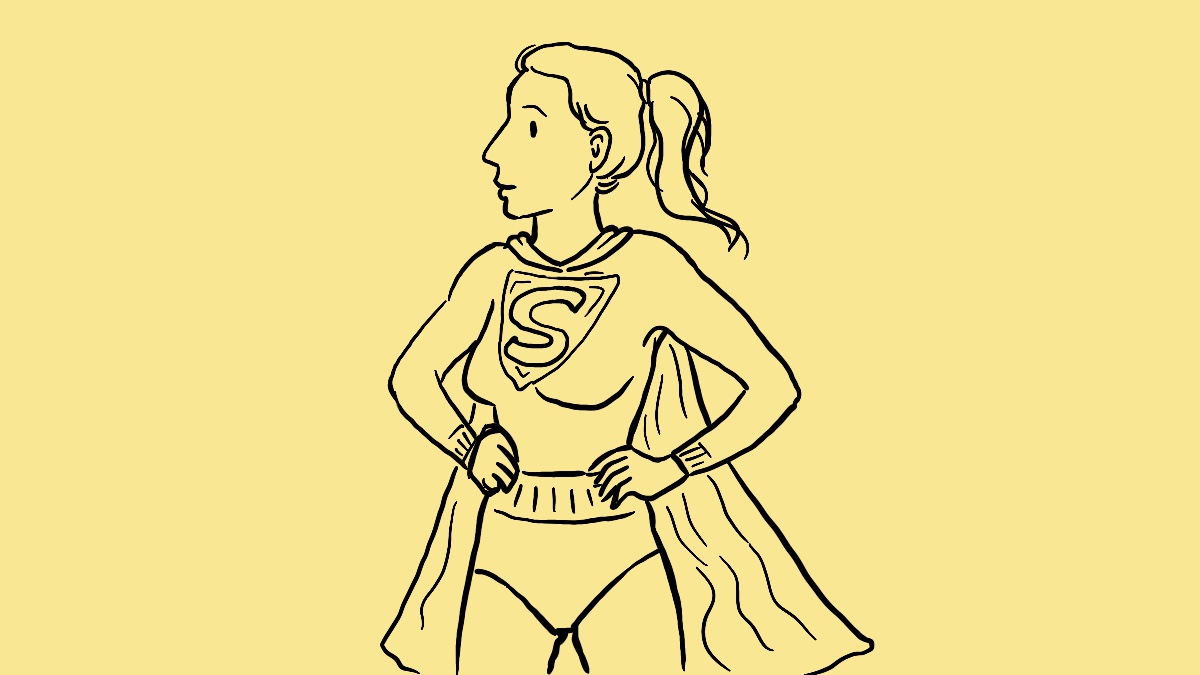
Superwoman

I used to be a superwoman!

I think fondly back to my early-to-mid twenties when I thought I could do everything. When I could say ‘Yes’ to pretty much any deadline and all I had to do was a few almost-all-nighters. Sometimes that was a week of almost-all-nighters. At times it was rough. But I took pride in my energy, and I could perform. 

I know other superwomen too. Women who are very capable and can do a decent job of pretty much anything they put their minds to. I admire them, and I feel an affinity with them.

But now staying up late wrecks me. And I’m not the only one. Sooner or later my superwoman friends also discover their limitations.

But I often think of myself as that twenty-something woman who could do everything. I often forget that my capacity and time availability is significantly diminished from what I used to have.

And so I am very thankful that the incident involving Jesus, Martha and Mary in Luke 10:38-42 was recorded for us. 

It’s a classic passage for a woman’s talk. We like to get distracted with busy-ness don’t we? So many things that are important to do – that we think have to be done.

But I am encouraged by Jesus’ words in vs 42 – “few things are needed”. 

As I consider this, I reflect on my current life situation and what the Lord has been teaching me. Over the last few years, with love, marriage, further study and then babies, I have found my capacity of time and energy increasingly diminished. Now, with a seven-month-old infant in tow, my time and energy is so restricted that I really do have to ruthlessly determine what really is needed to be done and what is ‘important but unnecessary right now’.

I was recently reminded that we are our habits. And so what sort of woman would I like to be? When my child takes her steadily diminishing nap, should I fill it with chores? 

Rather, like Mary listens to Jesus, so too I want to be a woman who is shaped by the words and life of Jesus, and spend some of those precious few minutes drawing near to him and dwelling on his word.

It is costly. My to-do lists increase, and some important things have been neglected for a long time. I used to be a superwoman and I feel the frustration of my increasing limitations. I want to get things done. I long to make art too. There are things I want to bake and there are so many books that I want to read. But I know the sort of woman that I need to be. I know that listening to Jesus is the most important thing and the thing that will shape me for the better in the long term.

And so that is what I will prayerfully keep striving to be. 

I may no longer be a super-woman, but I can be a woman who listens to Jesus. 

My dear superwoman, will you do so too?

The First Adam Failed. The Last Adam Finished. So what do we do?

When God made humanity, they had a God-given task. Made in the image of God, they were to rule creation. As VanDrunen put it, referring to Adam, “he was made in the divine image as the royal son of God, commissioned to exercise wise, righteous, and holy dominion over this world.” (p.40).

Tasked with ruling creation in the likeness of God, VanDrunen argues that just as God completed his work and then rested, so too for humanity. So the cultural mandate to have dominion over creation, ruling it and crafting it to God’s glory, was a task expected to be finished, and then humanity would enter rest (patterned after God).

The fall derails all of this.

Fallen humanity cannot have dominion over creation. Fallen humanity cannot attain the new creation, entering into glory.

But the Bible story develops. Wonderfully we meet Jesus Christ, who was the last Adam. He performs the work of redemption and consummation; that is, he rules all things and has dominion over all things for God’s glory. He performs the task first given to Adam and Eve, to have dominion over all creation and to rule it in wisdom, righteousness and holiness.

No person could accomplish the task of the first Adam after the fall. Until the Lord Jesus, none truly had dominion as the image of God, a dominion characterised by wisdom, righteousness, and holiness. It cannot and will never be the case that humanity will fulfil the cultural mandate now. But now, the Lord Jesus has fulfilled the task given to humanity. He has not made the task possible for humanity. He has completely and utterly completed it, once and for all. Importantly then, “Christians will attain the original destiny of life in the world to come, but we do so not by picking up the task where [the first] Adam left off but by resting entirely in the work of Jesus Christ, the last Adam who accomplished the task perfectly.” (p.50) VanDrunen exclaims, “This is absolutely essential for issues of Christianity and culture! If Christ is the last Adam, then we are not new Adams. To understand our cultural work as picking up and finishing Adam’s original task is, however unwittingly, to compromise the sufficiency of Christ’s work… God indeed calls Christians to suffer and to pursue cultural tasks obediently throughout our lives. But to think that our sufferings contribute to atoning for sin or that our cultural obedience contributes to building the new creation is to compromise the all-sufficient work of Christ. (p.50 – 51)

What then for the pursuit of cultural activities? We pursue cultural activities, not to contribute to the new creation in some way. But the opposite. We respond to the fact that the new creation has already been achieved in Christ, and we live that out now (and only for the here and now). We are still very much in the world and entrusted with a variety of responsibilities within it. We are called to engage in cultural labours. But the purpose of these labours is not to build the world to come.

Instead, we are to live as the Israelites did in Babylon. We certainly pray for its flourishing that we might, in turn, flourish. That the place we live in is a place of peace that we would be able to proclaim the Prince of peace more readily and live lives of peace more easily. Nevertheless, we are a people in a land that is not ours. We are Christians in Babylon, not Jerusalem. We know that Babylon will be destroyed along with all the cultural activities and products of that land, some of which we contributed to. (more on this next post)

If that makes you feel sad, perhaps you haven’t seen how good the land to come is, the world come. Redirect your focus. Consider the greatness and the grandeur of all that the Lord has in store for us. If you think that the world we live in now is better than that which is to come, then I would strongly encourage you to consider your perspective on this world in comparison to the glory of God.

But more than that, don’t miss the work of Christ. He has conquered the world and reigns over it. His work is sufficient, and we live in that sufficiency, and we live out of that sufficiency. We no longer strive to complete cultural dominion like our lives depended on it. Because they no longer do, which is good news. Fallen humanity cannot acheive the task anymore. But the gospel is a heavy buden relieved from our shoulders. The Lord has done the work, and we live in his completed work on our behalf.


VanDrunen, D. (2010). Living in God’s two kingdoms: A biblical vision for Christianity and culture. Crossway.

Cultural Dominion under Christ’s Dominion

A Christian lives in two worlds. We are saved from the world we are born in and become citizens of heaven, another world, the world to come. Yet all the while, as citizens of heaven, we are still citizens of this world. If we are astute, we feel the tension every day, making us consider how we ought to live as citizens of this world and of heaven. In particular, we wonder what the value is of our day-to-day lives as we contribute to the pursuits of this world, given that this world will pass away. A Christian mother sees the eternal value in raising their child in the truths of God but then struggles to understand the place of secular work as a beauty therapist or dentist. The Bible study leader sees the eternal value in teaching the truths of God to others in the group but might struggle to see the value of their building project or truck driving job. The Christian working in politics to shape climate action might wonder what the point is if there will come a day when there is no sun or moon, but God will be our light.

The doctrine of God’s two kingdoms can help us get clarity on these matters.

Temporal and earthly pursuits are not valueless simply because they are temporary. At the same time, they ought not to be considered eternal things (our cultural pursuits here on earth will not enter God’s new kingdom). There is a distinction between here and there, a discontinuity. If you’re reading the Bible and don’t see a distinction (even a sharp distinction) between the kingdoms of earth and the kingdom of God, you might have your Bible upside down.

“The two kingdoms doctrine strongly affirms that God has made all things, that sin corrupts all aspects of life, that Christians should be active in human culture, that all lawful cultural vocations are honourable, that all people are accountable to God in every activity, and that Christians should seek to live out the implications of their faith in their daily vocations. A Christian, however, does not have to adopt a redemptive vision of culture in order to affirm these important truths. A biblical two kingdoms doctrine provides another compelling way to do so. According to this doctrine, God is not redeeming the cultural activities and institutions of this world, but is preserving them through the covenant he made with all living creatures through Noah in Genesis 8:20-9:17.” (p.14)

The argument posed by contemporary neo-Calvinists is that the new earth will be the return (in sorts) to the garden of Eden’s perfection plus “the fullness of the centuries,” according to Alvin Plantinga. The idea is that the cultural products of the centuries are part of the age to come or will be (they will be redeemed we might say, or contribute to the new heavens and earth). But because of the fall of humanity, God responds by saving humanity. For the neo-Calvinist, the salvation and redemption of Christ is essentially a restoration or re-creation. So, God does not start over new but accomplishes his original plan (p.18). The idea is that the redemption brought for us in Christ frees us from sin and restores us to the ongoing task of the cultural mandate seen in Genesis 1:26-28, to rule creation is to unlock its potential. Hence, the argument goes as Christians we can say all cultural work is kingdom work. That is certainly one way to alleviate the tension within ourselves regarding the value of our cultural labours, to say that they are preserved into the age to come.

VanDrunen proposes a two-kingdoms alternative in his book “Living in God’s Two Kingdoms”. He wants to honour the cultural activities of our age while distinguishing them from the coming kingdom, the new creation. Others might argue that you can’t honour the cultural activities of our age if ultimately they contribute nothing to the age to come, the new creation. But VanDrunen wants to argue that just because something is temporary does not make it worthless (he uses the word ‘preserve’ in respect to the current age). That’s to propose a false dichotomy. Nevertheless, he wants to maintain clear distinctions. Hence politics, commerce, sports, or music are not necessarily going to be activities that build the kingdom of God (p.26).

His big idea is that “redemption does not consist in restoring people to fulfilling Adam’s original task but consists in the Lord Jesus Christ himself fulfilling Adam’s original task once and for all, on our behalf. Thus redemption is not “creation regained” but “recreation gained”, in Him. (p.26)

It is important to understand that Jesus has accomplished redemption in its entirety for us. he does not merely accomplish our freedom to then complete the task of cultural dominion as genesis puts it. He has achieved all; dominion and power through his life, death, resurrection and ascension on our behalf.

By analogy, consider sanctification. In much the way that we are totally and completely sanctified by the Lord’s work at the cross, we are also undergoing a renewal here and now. Even though at the return of the Lord we will be totally transformed. There is a similarity between that process and the way we understand our cultural tasks. The Lord has achieved the dominion we were tasked with in Genesis 1:28, 9:1. Indeed he achieved it on our behalf because we cannot achieve it. Yet, at the same time, we are now living out or living in what Christ has achieved for us. knowing Jesus rules all things, we seek to honour his rule continually even as we long for the return of the Lord when his rule will be absolute in a new way.

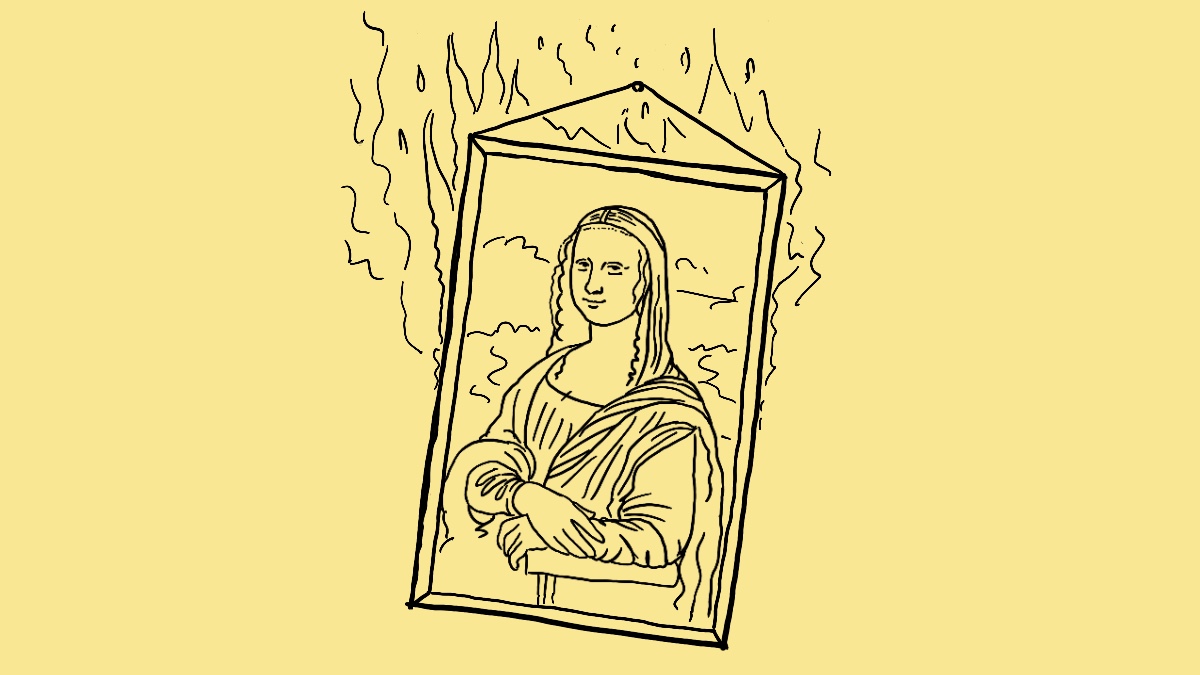
Something doesn’t have to last forever to have value. If we think, for example, their artistic pursuits were the of entering into the kingdom of heaven, we have made one of two mistakes. We have either valued our work too much, thinking it’s worth more than it is – even if we made the Mona Lisa or the original matrix trilogy (yes, all three, the fourth one is… interesting). Because compared to the heavenly glory awaiting us, these things indeed are dust. This leads to the other potential mistake; we have undervalued the glory awaiting us. In comparison to literally everything this world has to offer, God is greater. We lose sight of this great truth when we get too focused on our work here on this earth, building sand castles on the beach. Some sandcastles will be more beautiful than others, and there is value in that. Something being temporary doesn’t mean it’s valueless. As a prime example, consider marriage. Biblically speaking, marriage is temporary. If you argue that marriage has no value because it’s temporary, you are making a contrary argument to the Bible.

Now we might say that marriage is a little bit different to cultural works. Without getting into the details of comparing the institution of marriage to cultural pursuits such as music, politics, or healthcare, let’s consider something else temporal in the Bible. What about the temple itself? Or the tabernacle? Or the Ark of the covenant? These were arguably masterpieces in their day. And yet they were temporary. For a time, they pointed beyond themselves to the temple of God’s people, the tabernacle of Jesus’ incarnation, and the presence of God by his spirit. But the physical masterpieces are no longer. Their value wasn’t in their culturally appropriate craftsmanship. Nor are they valueless because they are no longer.

It may be a stretch, but a similar argument can be made for all cultural works (albeit to a lesser degree because capitalism, climate change policy, truck driving, k-pop and the matrix aren’t mentioned in the Bible, and of course, has relative value by a variety of measurements).

In all these matters, the two kingdoms’ doctrine will give us clarity on the value of cultural pursuits and clarity between the earthly kingdom we reside in and the heavenly kingdom for which we are citizens. To muddle these two together will diminish the value of our citizenship in heaven and all that it entails and unduly inflate the value of our earthly works. Clarity in this matter will help us to work better because we will have a clearer purpose for our work (which I haven’t presented in this short post). In conjunction with this, having a clearer view of God’s kingdom will shape everything we do in the common kingdom, the secular kingdom, the world we live in.

For now, we need to understand that Jesus has accomplished all the work of the Kingdom to come. He has won it all. Rules all. We live our lives under his rule and to his honour. To requote Vandrunen, “Christians should be active in human culture, that all lawful cultural vocations are honourable, that all people are accountable to God in every activity, and that Christians should seek to live out the implications of their faith in their daily vocations. A Christian, however, does not have to adopt a redemptive vision of culture in order to affirm these important truths.” (p.14)


VanDrunen, D. (2010). Living in God’s two kingdoms: A biblical vision for Christianity and culture. Crossway.

Growing in faith out of the Pentecostal Church. Part 3.

[Part 1 is here, and Part 2 is here.]

What do four years at Moore College do to a man who came straight from a Pentecostal church?

It cooks his brain for one. It puts him through months of despondence. But when he gets over that, it shapes his mind and heart to appreciate God’s goodness in his word, Spirit, and people.

At first, when I arrived, I got culture shock. That means that I was riding a high for a number of weeks, maybe even months. The novelty of it all was fantastic. I was learning new things, although some of it was very challenging (i.e. Greek). I loved the community, which was a significant reason for me extending my course by three years. But as the months passed by and all that wore off, I found myself struggling with terribly low moods at times. I was agitated about why everything was so different to my old church context. It felt restrictive and dry at times. If you knew me before I went to college, even during my time at college, I was toward the end of the spectrum known as ‘quirky’ – to be sure, I was not a straightlaced Sydney Anglican (like I am now…). I felt like I fit into Marrickville and Newtown. Everyone there had crazy moustaches, ponchos, mullets, and is generally of an artistic persuasion which is possibly good and possibly bad. Admittedly there was a lot of change going on for me. I moved city, moved church, got married, quit my job and started a degree in an entirely different field. Perhaps my Pentecostal leaders were right. Before going to college, one of my former pastors and my Bible study leader both gave me disapproving looks and even disapproving words about going to Moore College.

But that was all just culture shock. It comes and goes. As difficult as it is in the moment, what is needed is perseverance.

I was very grateful to have found others in a similar situation as myself at the time. I was in a prayer group with another brother who was formally from a Pentecostal church and I met two other people in my year group from Pentecostal backgrounds. I found some support amongst them and a place to voice my thoughts about all the differences. A listening ear goes a long way.

Despite the first year being difficult, what I found to be most helpful and even crucial to ‘winning me over’ as it were, was the way everything was explained. So we had chapel services two to three times a week (and one of them was plus-ultra-prayerbook-old-skool). Those chapel services were, of course, for our edification. They were also examples of how to run church services in that manner. They were taken as moments to teach us why certain things were being done. I eventually found these chapel gatherings helpful and even edifying by the time the shock has come and gone.

Some modern commentators (such as Jon Anderson) have lamented the fact that when we go into tertiary institutions nowadays, our views are not so much challenged but affirmed, otherwise, the tertiary institution is in trouble. This is a terrible state of affairs. But I’m happy to say that going to Moore College shaped my mind and challenged me. Some things I’ve changed my mind about, and other things I have learned from scratch without prior knowledge so that I’ve grown in my understanding. I am very proud of the college I went to for this reason.

In my estimate, most people attend theological college (at least the one I went to) to be equipped and enter into ministry vocationally. But a number of us went into theological college to be equipped to return to secular work only more prepared as regular church members. While this is how my story started, with the desire to return to secular work more prepared as a Christian, over the course of the degree and then the following two years (partly secular work and partly volunteer ministry), the degree set a fire in my heart for vocational ministry and slowly that’s eventually what happened. An unorthodox pathway, no doubt.

All through my Anglican College’s bachelor of Divinity, I had my eyes on my history. At the end of the fourth year I chose to do my church history assignment researching the first Pentecostal minister (a lady by the name of Jane Lancaster – if I remember correctly, because I lost all of my work when my computer crashed… Still not over that), and I also did my fourth year theology paper with a focus on prayer and faith (as it seemed particularly pertinent given my history in the Pentecostal church). Through college I came to appreciate both my Pentecostal heritage and my Anglican tutelage. I think that I specifically came to appreciate each more because of the other.

At this stage, it’s almost cliché to say, ‘we need both perspectives to strengthen each other and build each other up’. But as I reflect, I think I appreciate my college more than I ever thought I would and as the years go by I continue to appreciate it more and more.

So what do four years at Moore College do to a man who came straight from a Pentecostal church?  It cooks his brain for one. It puts him through months of despondence. But when he gets over that, it shapes his mind and heart to appreciate God’s goodness in his word, Spirit, and people.

Rereading

What is the value of rereading in a context that prioritises speed, efficiency, novelty and practicality?

Of course, in the asking of the question are many hidden premises.

There are some video games I love replaying. I suppose that’s due to a variety of factors. The most replayed of my games are those with substantial variety and multiple plotlines/endings. But it’s not quite the same with a book, at least in my experience. I guess that comes down to the way that I view books. Generally speaking, I view them as a one-and-done experience. A book is static and linear, at least superficially (i.e., there is only one ending). But for the astute reader, that statement is woefully inadequate and displays a kind of ignorance by the one who would say such a thing. The intricacies of a plotline, the deeper meanings that become clear only as the whole is comprehended, a poignant line at first glanced over. These are like side quests we didn’t realise existed which provide great rewards. If only we treated our books like treasured video games (am I speaking only to myself here?)

There is excellent value in rereading.

In the prior posts, we considered the importance of internalising knowledge. We also considered how contemplation plays a vital role in that process. In this post, I want to consider the value of rereading and how it likewise is a discipline worth training in. Especially as a Christian reader (with specific emphasis on rereading the scriptures).

Some people have proposed that rereading is a discipline made unattractive by the digital screen and how digital screens provoke certain habits: to scroll past, never to return. I think that this is worth keeping in mind as we consider the discipline of rereading. Rereading on paper will probably be more effective than on a digital medium for that reason, not to mention the tactile nature of paper books. Certainly, rereading on a Kindle (or some other electronic device) is possible, but it’s worth remembering there are some hidden subconscious challenges that the digital medium entails.

As we considered in the prior posts, one of the traits of a good reader is their ability to internalise knowledge, which allows them to draw more analogies and connections when confronted with more information. It provides more of the necessary basis for critical thinking. Building this internal reservoir obviously requires a certain degree of memorisation and familiarity. Rereading is key for this to take place.

If only there were a shortcut.

Well, for most of us, there isn’t. But sometimes, we mistakenly take external knowledge sources to be shortcuts. We certainly will treat them as such. But in terms of internalised knowledge which promotes critical thinking, analogous connections, and deductions, it is not. So we cant treat it like it is. We must delineate between external and internal. Knowing where to go for information is not the same as knowing the information.

If you are worried by arguments (whether professional, popular or personally made) that don’t carry with them a level of convincing critical thinking and seem to parrot some external source (which they probably haven’t read), then you have felt the effects of someone who hasn’t read and certainly then has not reread.

But in a rushed world, it’s easy to run past this discipline (much like contemplation earlier written on).

But to put this discipline into practice, one must already make the time to decide which books, articles, essays, et cetera, to read amongst the plethora of options. However, on top of that is the added burden of deciding which of these is worth rereading. That’s okay. We are only human, and in recognising as much, we are only trying to be faithful stewards of our time, attention, energy, and enthusiasm.

But one clear place in which we are already putting this into practice (I assume) is with our personal devotions in the scriptures.

Reading and rereading the Bible is something Christians have done for centuries. That is because we never move beyond it (unlike other books more generally). This practice means that our knowledge of the word of God becomes increasingly internalised. But the Bible is big. Its ideas and concepts are vast and deep. One cannot truly plumb its depths.

In reading and rereading the Bible, we are giving ourselves much opportunity to develop deeper thinking so that we might draw more connections. In this way, we are treating the Canon as a Canon, as we measure one part with another part giving clarity to both, drawing clear connections and finding deeper truths.

Keep reading and rereading the Scriptures. But also carry this practice over into our habits of reading other material. Let us shift our focus away from the finish line of the book to the internalising of the book. To that end, rereading will be of great help.

The Reader’s discipline of Contemplation

What does a good reader do?

In a productivity-driven world, a good reader is someone who reads the most books. In a time-poor society, a good reader is someone who reads books the fastest. In the therapeutic age, a good reader is someone who finds the books that makes them feel good.

These perspectives on the skill of reading should hopefully highlight that the way we approach reading a book in part determines what we get out of that process.

In her book, “Reader, Come Home”, Wolf proposes there are three key standards that make a good reader. These standards mirror Aristotle’s standards for a good society. “The life of knowledge and productivity; the life of entertainment and the Greeks’ special relationship to leisure; and finally, the life of contemplation.” (p.13) Drawing from this, a good reader is one who acquires knowledge, one who has learnt to enjoy the process of reading, but important to my thoughts in this post, one who practices contemplation.

The final chapter on contemplation by Wolf has to be my favourite in her book, “Reader, Come Home”. It is the one I’ve thought most about, the one I re-read, and of course, the one I contemplated on.

She writes, “The third life of the good reader is the culmination of reading and the terminus of the other two lives: the reflective life, in which—whatever genre we are reading—we enter a totally invisible, personal realm, our private “holding ground” where we can contemplate all manner of human existence and ponder a universe whose real mysteries dwarf any of our imagination.” (p. 190).

Cultural critiques note that in the first two respects we excel. We want more knowledge and we want more entertainment. But in the critical aspect of contemplation, each day we drift further and further from its practice, which ultimately happens because we drift further and further from valuing it. Generally speaking, people consider that the digital culture undervalues and even threatens the meditative dimensions of human life. I wholeheartedly agree. I agree because I see that happen in my own life and try and fight it off, I see it happening in other people’s lives around me, and I’ve heard it commented on in many places by many different voices.

Just stop and think about the last time you stopped and thought…

That memory may have been easy enough to conjure up. But let’s ask the same question with a bit more of an edge. Stop and think about the last time you stopped reading so that you could think deeply about what you just read…

Those moments are very novel to our experience.

We face many difficulties when it comes to the art of contemplation. We crave novel stimuli which makes the slow burn of quiet contemplation a restless activity. Quiet contemplation itself might be hard to achieve literally because there are many noises around us. I think of the notifications we receive, the phone ringing, the music we are playing non-stop, the people talking around us (in certain situations such as on the train), and of course our own noisy thoughts. Alternatively in our landscape, we fall prey to thinking that it is more important to react than to think deeply. We don’t want to take the time to contemplate, because we want to be distracted. Our distractions then are masquerading themselves as “been in the know”. (p.188) Furthermore, contemplation takes time. This investment of time to sit quietly and think is a big ask when we are time-poor people who are constantly striving for “efficiency.”

For the most part, the last point is the most demanding obstacle to overcome. Contemplation takes time. We have to ask ourselves if we are going to be people who allocate our time to the process of deep reading and deep engagement with a book. Now at this stage, we think we have spent enough time performing the reading process. But we have not (which is precisely the challenge). We need to then perform the follow-up activity of simply doing nothing but sitting quietly and thinking about what we have read. This is the act of inwardly digesting and mulling on the thoughts presented to us.

The consequence of failing to contemplate will mean that we lose the opportunity to grow in wisdom. Knowledge alone is not wisdom. We can have all the facts and figures, as it were, without the skill to implement and apply.

The answer is deceptively simple but will require great self-discipline. We need to allocate time for contemplation.

Exemplified by the interactive dynamic that governs our deep-reading processes, only the allocation of time to our inferential and critical analytical functions can transform the information we read into knowledge that can be consolidated in our memory. Only this internalized knowledge, in turn, will allow us to draw analogies with and inferences from new information. The discernment of the truth and value of new information depend on this allocation of time. But the rewards are many, including, paradoxically, time itself—for uses that could otherwise go by the wayside of our lives without notice, my segue to turn to the invisible harvests that spool from the third, contemplative life.” (p.192)

As our culture, broadly speaking, transitions into the predominance of digital media, the skill to slow down and reflect is important. The barrage of so-called information increasingly necessitates the immersion of oneself into an involved book to have socially useful skills. And this skill is the character attribute of wisdom. Our world already highly values knowledge. But we might say that it overvalues it to the detriment of its own use. Knowledge requires the time and space to contemplate it in order to then apply it to our lives and this world.

The task of contemplation will take time. But it will be time well spent.

Reference

Wolf, Maryanne. Reader, Come Home. HarperCollins. Kindle Edition.

The Reader and External Knowledge

What is more important, to have; a limited but growing amount of internal knowledge, or to have access to a vast and exponentially growing external source of information?

There certainly isn’t anything wrong with having access to vast and exponentially growing sources of external knowledge. I know that you’ve even used these frequently perhaps even recently. Someone raises a topic or asks a question and you don’t know the answer. So you open your phone in your pocket and Google it, or check Wikipedia. Equally, we increasingly inform ourselves about the ongoings of the world through social media. For a lot of topics that randomly appear in our conversation throughout life, we will be informed by snapshots, pithy remarks, two-minute video excerpts, and memes. There can be something good about this. We get a quick overview of many things. We don’t have the time to look at it all. But we get a glimpse of a lot. There is a place for that.

But as to answering the question of importance, we should favour a limited but growing amount of internal knowledge. Compared to the information available and captured around the world, one person’s knowledge is surely close to mathematically being zero. So perhaps it’s strange to say that we should favour the limited amount of internal knowledge we have. But it’s worth highlighting that external data is not knowledge. Information alone is not knowledge. And that’s the key to the importance of internalised knowledge and why we should seek to grow it with a slow and steady approach.

Maryanne Wolfe puts it this way in her book, “Reader, Come Home”, “The relationship between what we read and what we know will be fundamentally altered by too early and too great a reliance on external knowledge. We must be able to use our own knowledge base to grasp new information and interpret it with inference and critical analysis.” (p.55)This last sentence I think is the key sentence. Having an internal knowledge base is how we interpret external knowledge sources. This interpretation is more discerning, more able to come to the truth of the matter, able to connect more data together (inferences), and able to critically analyse better if we have greater stores of internal knowledge.

Consider the opposite. Having little background knowledge, a smaller supply of internal knowledge, means we do not have the tools that are necessary for making inferences, deductions, and analogical thought (transferring meanings through analogies). If all that sounds a bit too abstract, consider your own lived experience of this matter. You’ve seen this play out already when people hold to a view that is obviously one-sided such as the fake news issues of our day, or something more complicated like politically polarised views. Maybe you’ve asked someone after they present a very charged opinion, “but have you actually read what that person said?” You get a very angry remark back which is hiding the sheepish and defensive, “No.” This person has fallen prey to an “unadjudicated position”. (p.56)

So how do we address this issue?

The solution isn’t so much to read more. After all, we could simply spend more hours on social media reading the news headlines that the algorithm gives us, or we could read the taglines and memes. All of this is a mere superficial engagement. More of this kind of reading engagement is not going to help address the issue.

Rather, we should engage in what is called the “deep-reading process”. And it’s exactly as it sounds. Reading a book, reading a long-form essay. And then rereading, and then reading someone who proposes a different view on the subject at hand. If the problem is that we don’t give ourselves enough time to slowly digest and assimilate new ideas into our internal knowledge base, then the solution will be the very uncomfortable and time-consuming practice of reading. Reading slowly. Reading deeply. Consciously reading. Reading with pauses. And doing all of this with others who are doing the same.

As Christians, we have the valuable resource of the church community. We have a community that we meet with regularly who can push us and challenge us. Likewise, you can push and challenge them. Sadly the church can all too easily fall prey to the problem we raised earlier, we can heavily rely on external sources of knowledge without deep engagement. Then we who are to be people of the truth can fall all too easily into misinformation, sketchy foundations, and poor thinking. This undermines our call to be disciples of truth. And so I should hope that we in particular are motivated to promote within ourselves and in our community good reading habits. Especially so because the world around us does not seem to value this kind of reading all that much.

Reference

Wolf, Maryanne. Reader, Come Home. HarperCollins. Kindle Edition.

Coffee is life. So why do I like burnt coffee?

I enjoy the unique taste of coffee which makes me a wholly un-unique person. It has a pleasant and interesting taste which differs from cup to cup.

I first got into coffee as a nurse. It was a mix of pragmatism, to stave off sleep, and because there was an expectation that nurses drank coffee. But now I enjoy it simply because I enjoy the taste, appreciate its various aromas, and delight in the making of the coffee (from roasting pan, grinding, through to percolating it). I also appreciate the way that it is associated with my morning routine and the way that it is associated with my social life, meeting with friends and acquaintances.

At first, my favourite coffees were the sachets with lots of sugar that were caramel flavoured. But times have changed. I now love a classic short black – just hot water through grounds, please. Ironically, we might say that my tastes have been refined for I no longer prefer the refined.

Nowadays I roast my own coffee. It was a long journey through life to get to this point, but I think the thread of coffee is somewhat representative of my life – representative of the journey itself.

It represents the unrefined in a refined world, the imperfect in a specialised world, the authentic in a mass-produced world, the analogue in a digital world, and the unrushed in a rushed world.

There is a world of difference between the caramel sachets from the supermarket to the home-roasted, home-ground, home-brewed coffee that I now make. We could say that the refined product is the product of a professionalised, perfected, and convenient process. Indeed, none of these is necessarily problematic. But in our current context, each element is so heavily present in society that it is worth highlighting the exchanges that take place so that we might have “unburnt coffee”.

My burnt coffee represents the imperfect in a specialised world. My coffee is good enough. Maybe only just. Maybe only 51% of the time. But preference dulls the edge on imperfection. I drink specialised coffee in our specialised world. At times I prefer it over my own and at other times I don’t. But whether I prefer it or not doesn’t diminish the fact that professionals made it with professional gear. While on the other hand, I have made very imperfect coffee. It is an unrefined process producing a product of imperfection. But is there a place to say a palate for the unrefined is more mature? We do it in some other ways. Children mature to appreciate foods beyond the simple and the refined. Similarly, we might argue thus for the appreciation of the imperfect as well. Some examples might be the op shop couch over an IKEA couch, or “imperfect picks” over the pear-shaped pears and the apples of our eyes.

Moving on, my burnt coffee represents authenticity regardless of its imperfection. The handmade has its maker’s touch (and some of his hairs floating around too). So every bean which is burnt, and every bean left slightly under-roasted (with the potential to break my grinder), is an authentic work of an artisan who himself is perhaps overcooked in some ways and undercooked in others.

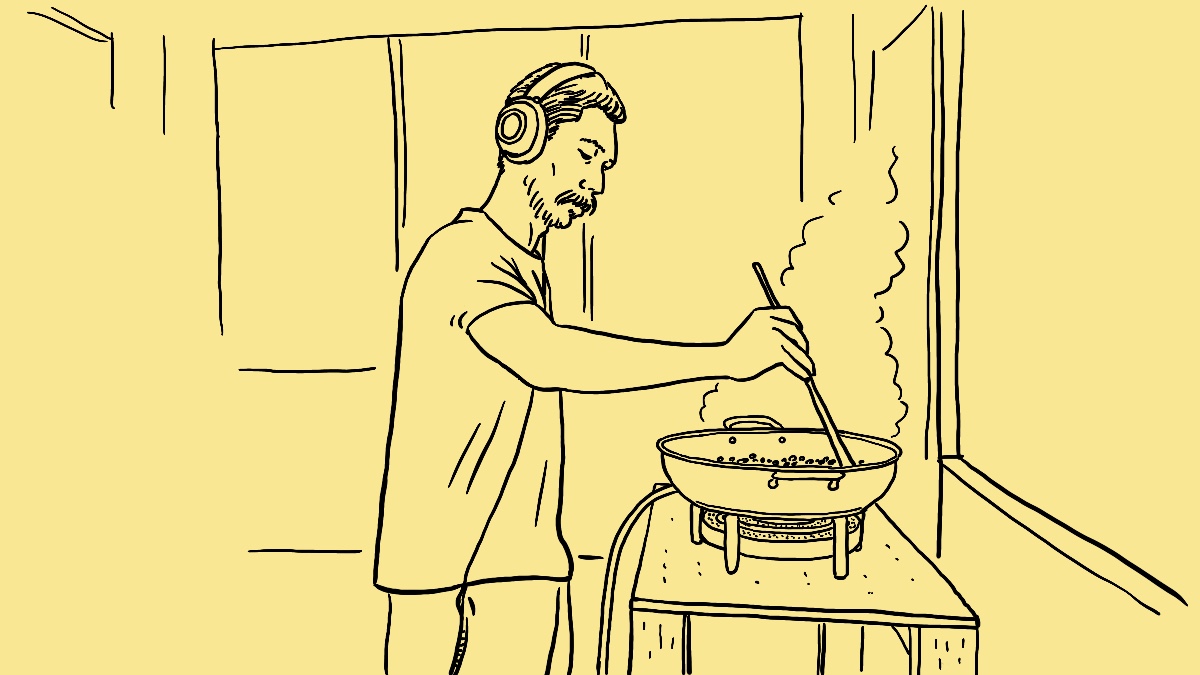
My burnt coffee also represents the analogue in a digital world. You see I get imperfect, although authentic, burnt beans because I use a gas cooker and a thick pan with a wooden spatula. There is always going to be a margin of difference between the bean profiles and that’s because I’m using analogue methods. These methods are old school. There is no algorithm involved. There is much human error involved. But it is simple. Anyone can do it. It is cheap and affordable. The maintenance is minimal. The expectations are low. It has very clear limitations. There is little stress involved. It is analogue in a digital world.

And finally, it represents the unrushed in a rushed world. Making imperfect yet authentic burnt coffee with analogue methods takes time. It takes the time to roast and the time to wait for it to degas, and then the time to do it all over again to produce another small batch. Yet after all that time, I get freshly roasted beans. So although it takes me more time I’m closer to what I want and made. While in one sense, the rushed product leaves me further from what I want. Then consider that coffee is somewhat representative of hustle and rush, productivity and product. But it takes time to burn coffee.

No doubt striving for excellence is worthy. But equally, we should consider what determines excellence. A product is more than its measurable end qualities. It is also the cumulation of its process and even its maker’s motivations. It is part of an interconnected network of relationships – “my mum’s soup”, “my neighbour’s veggies”, “my friend’s signature dish”, and “my mate’s home-roasted burnt coffee”.

But at the end of the day is it really all a metaphor for my life? Or am I just justifying the fact that I make, drink, and serve burnt coffee?

Time and the individual.

One way we see time is as a resource given to an individual. Each person is given an allotment of time to do with what they see fit. But we oft complain of its shortness, the speed with which it passes, and our inability to use it effectively to our own ends and desires. Our lives are short, our time is finite. We feel this way (in part) because we have a view so constrained upon the self that we measure things in reference to the self. I don’t think that this is necessarily wrong because there is certainly a lot of truth to it. Our life is our own, our time is our own and nobody else’s. We are responsible for our use of it.

But it’s not all about what I accomplish with my life. Whether I realise it or not my life is always going to be part of something bigger than my ‘self’. We might feel the need to measure our life according to some narrow conception of achievement with a direct link to our own efforts. Thus, that which I have started and consequently completed, or saw develop is to be numbered in my achievements. To measure my use of time is then a narrow measurement of actions or consequences linked as closely as possible to my ‘self’.

By example, with my time I received a Bachelor of Nursing and I received a Bachelor of Divinity. After a number of years you can view my chess accomplishments according to my chess rating (ELO) which is a pitiful representation of my time. All these examples have a direct link to me and what I have done with my time. They include a perspective that is attributed directly to my efforts and nobody else’s. The bachelor has my name on it. My chess rating has my name on it.

Christian or church history doesn’t have my name on it. Australian history doesn’t have my name on it. My wife or my friends’ holiness does not have my name on. Yet with a view to the bigger picture and the story connected through other people’s stories, I will be a contributor. That’s a keyword – contributor. We are not the sole accomplisher but a mere contributor to a grander story. What I accomplish with my short dishevelled, disjointed and contradictory life, will be nothing of note. What I contribute to, however, may be of great note depending on the cause – it will be bigger than my life, than ‘my’ time.

The point is not to measure my contribution. That’s to make the same error we are seeking to avoid, only in a different guise. The point is to forget yourself as you contribute to something bigger. Perhaps in this sense we consider our time as an investment in something big. My time is not for myself (at least not solely for myself – yes I will be judged according to my life, but I will contribute to more than my life.)

I’m not exactly sure what this means for my life. Perhaps it’s just a passing thought. I think it does give me a little more perspective in a world so preoccupied with the ‘self’ and achievements. In this sense, there may even be some minor anxiety I am relieved of by being a little less concerned about my inability to achieve unrealistic goals with my finite time.