Preaching Knowledge through Obedience

When a preacher preaches, they must preach the text. In preaching the text, they wish to apply the text. And to apply the text, they move through theology. But that is not always the case. It may often be the case that theology informs transformation, which is to say theory leads to practice, or a cognitive understanding leads to action grounded in that knowledge. But that is not the only way. It’s more nuanced than that, biblically speaking. Scripture also shows that faithful action, obedience, and a transforming life deepen our knowledge of God.

On the one hand, there will be people who want to get down to the nuts and bolts and do something or change something in their lives, but what they must first realise is that knowledge and affection (awe or fear etc.) are a basis for action. So the person who wants to go away changed from church may feel shortchanged if they receive teaching on the doctrine of the Trinity, or the attributes of God, or the identity and nature of the Son, or an exposition of justification. ‘What do I do with such information?’ they may ask. And the response is that a knowledge of God and an affection such as awe are strong grounds for action.

Alternatively, if someone were to preach or teach about changed lives and the actions that are required—say, for example, that someone were to preach on the Ten Commandments and, during this series, they didn’t always repeat something to the effect that the commandments come after salvation in the narrative—I can so easily see (because I have experienced it) godly and mature Christians not responding appropriately to such a message because, in their minds, the only framework for action is in fact a knowledge of salvation, which must always and only come before and be the grounds for action. To say that it can be the other way around is akin to heresy in some people’s minds—easily confused with some sort of works-based salvation theology, which many Reformed people are extremely sensitive to. This is not a bad instinct because the human compass is pointed toward moralism. But this reflex of the Reformed can mean they miss out or hesitate in the more interdependent nature of knowledge and action in the Christian life.

Moral transformation and action can lead, and do lead, to growing knowledge of God. That’s to say that the more one walks with the Lord, the more one knows and learns about the Lord. And the more one learns about the Lord, the more closely one walks with the Lord. To be sure, salvation is always grounded in Christ; but obedience is one of the means by which believers grow in the knowledge of God. Consider the relationship of knowledge, affections, and actions in 2 Peter chapter 1.

“For this very reason, make every effort to add to your faith goodness; and to goodness, knowledge; and to knowledge, self-control; and to self-control, perseverance; and to perseverance, godliness; and to godliness, mutual affection; and to mutual affection, love. For if you possess these qualities in increasing measure, they will keep you from being ineffective and unproductive in your knowledge of our Lord Jesus Christ. But whoever does not have them is nearsighted and blind, forgetting that they have been cleansed from their past sins.” (2 Peter 1:5-9)

This verse is famously difficult to parse out the exact relationship between, and dependence of, knowledge and action. Which comes first? It’s not so easy to answer, which is exactly the point. There is an interdependence. Knowledge of God leads to transformation, all the while transformation leads to deeper knowledge of God.

We see this in Colossians as well.

“We continually ask God to fill you with the knowledge of his will through all the wisdom and understanding that the Spirit gives, so that you may live a life worthy of the Lord and please him in every way: bearing fruit in every good work, growing in the knowledge of God…” (Colossians 1:9-10)

These passages should shape our preaching, especially if we are rigidly sticking to a preaching framework that insists we must start with theology to then inform practice. That is true and good, but it is not the only true and good way. The passages above can give the preacher opportunity to talk about a transformed life, which would then lead to greater knowledge and awe of God as the application. That might seem backwards, but it’s not alien to the Scriptures. Better still, it may lead to greater maturity in the body of Christ if a more robust framework is used.

Just recently, a minister was talking to me about their church’s financial situation. The church members were not contributing generously to the church financially (as had historically been the case until recently in the church). And he said that he wanted to make sure that their hearts were in the right place before they financially contributed to the church. This position of his led to him not taking up a physical offering until he was more convinced of their heart posture. But I challenged this man and said to him that perhaps the very act of giving financially, and providing that opportunity to do so even before you know their heart posture, will in fact transform their heart. That the action of giving can be a means of the Spirit in changing the heart of the giver– the two need not be at odds. I don’t think I got very far in convincing him. To me, it seemed as though he was creating his own problem, when in fact there was so much more freedom that could have helped if a certain framework of affection before action were not kept so rigidly.

The Bible, for its part, can be systematised, and should be, in order to understand it better. But its genres hint at the variety that should be reflected in our own preaching and teaching and in the styles therein. We see this in the storytelling of the Old Testament, which housed the commandments, and in the gospel narratives, which housed the parables. This one collection of many books, with a single driving narrative and author, is perhaps a good analogy for the preacher and his preaching.

The Bible is not an impersonal to-do list but the very words of the living God through the voices of his people in all their diversity. The Bible itself shows us the very personal nature of God (his word through his people). To this end, in the journey of someone coming to know the Lord, it is often a combination of knowledge and action (in community), of learning about God and ‘trying it out’. It includes sitting under the word in church or Bible study, plus walking alongside other Christians and ‘doing’ the Christian thing. This is not so far from the words of Psalm 34:8, “Taste and see that the LORD is good,” or, in the words of Jesus, “Anyone who chooses to do the will of God will find out whether my teaching comes from God or whether I speak on my own.” (John 7:17)


Reflections on Simon Gillham’s chapter, “Theological Formation Through the Preached Word: A Biblical-Theological Account,” in the book by Kuhn, C. R. (with Grimmond, P.) (2021), Theology Is for Preaching: Biblical Foundations, Method, and Practice.

In Praise of (some) Ignorance

The presence of evil in the ordinary and mundane existence of life is itself difficult to ponder. The presence around us of simple horrors and distortions of good is a fear-inducing reminder that somehow, we live among the darkness and that it stalks us, seeking to infiltrate our own lives. Need we ponder more evil than its local manifestations simply because we can? What is it that draws our eyes to the train wreck? With evil being as complex as it is, confusing and seemingly unjustifiable, global evil is either unbearable and crushing in its scale, or this grand scale is trivialised in order to cope with the knowledge of it. Simply, how can we do justice even to the contemplation of evil?

While some may see ignorance as an evil in itself, there may be merit to an ignorance of evil — to knowing of its presence in vague and shadowy silhouettes as opposed to the definite and grotesque clarity available. Ignorance of the global is merited, I think, where it enables sympathy and care for the one right in front of you. The mental toll of evil in the everyday is at risk of being eclipsed by the faraway catastrophe to which little but empathy and prayer may be attended from an equal distance (bearing in mind that, speaking personally, even thinking about and praying about something as near-constant as broken or complex families in my neighbourhood is a task I seldom achieve). Also worth noting, I speak from the relatively peaceful country of Australia (rural Australia at that!). It may be that the global crises that spot the face of the planet are circumstances you are close to or within. Nevertheless, the scale of the global makes it seem more important, but life is lived in the relationships one actually has, and that is made up in greatest part by those who walk with you day by day — the embodied.

Biblically, Avoid association with evil

A number of passages that are close to this idea speak of being innocent of evil, mostly in that you do not partake in it, but also in a more arm’s-length distancing from evil. For example, Ephesians 5:11–12, “Take no part in the unfruitful works of darkness, but instead expose them. For it is shameful even to speak of the things that they do in secret.” (ESV) Not only does the Christian not partake in evil, but they expose evil through the light of godly living and holiness (v. 7–9). However, there is also a caution that the Christian ought not speak of the shameful deeds of evil done in darkness. Why is that? Well, earlier Paul wrote that even crude joking or foolish talk is to be avoided (v. 4). It’s “out of place”. There is a parallel set up here, of not talking of foolish matters, and not speaking of evil matters, of which perhaps the same reasoning applies to both: that in both cases it’s “out of place” or unseemly. That in the talking like a fool, you’re obviously foolish. But by derivative or association, the speaking of secret and shameful matters done by others is somehow shameful for us to do. There is a tension between exposing the evil yet not speaking of it. In many cases you must speak of evil to expose it. But the primary thrust of the passage is the exposing through godly living (see also 1 Peter 2:15).

Today people are very quick to speak in order to expose. We feel a deep, deep need to share the evil of others so that someone will finally do something. But another biblical alternative is to first and foremost not commit the evil ourselves (Romans 2 has much to say on this ease at pointing out evil but hypocritically partaking). Surely it is easier said than done to say this evil should not happen, all the while we are guilty of the deeper root cause of the evil (whether lust, or pride, or anger, etc.). The biblical first step is not so much to speak out against, but to not do it ourselves, and then to live and act oppositely to the evil. To be light in darkness. While others may pucker their lips at the idea, saying you are not making any difference in the world, it may be that you are in fact making the greatest difference. Is anyone above evil at a personal level? Absolutely not. The difference between the global and the local is not such a difference as people think. After all, every person is capable of the evil we deride others for having done. The unimaginable evil of the global is often unnoticed and dormant (and under the common grace of God, often restrained) in each of us. Which is why the first step of exposing evil should be not doing it ourselves — of which that is a task harder than might be anticipated.

Not cynical and not naive.

So now, regarding the global evils or grotesque details of evil. You do not want to be naive, but you also do not want to be cynically depressed. Evil has a way of crushing you as you share emotionally in it through empathy with the victims or perpetrators of evil as you know of it. At the local level, this is obvious: grief at death, counselling through lived experience of sin (one’s own, or at the hands of another), whether of an everyday variety or a tragic variety, and depending on where you live, the two may be close together. This weight and burden takes its toll: the simple objective knowledge of evil, without even partaking in it, is a sullying of the mind, leading or tempting toward depression, cynicism, or hopelessness; or desensitisation, so that one does not treat the weight of evil in the lives or environments of oneself and others appropriately. Then what you relinquish is the ability and capacity to care for and love those under its effects. Walking side by side with people around you and in your church is troubling and dangerous because of life’s pains and sorrows, let alone our own pains and sorrows. There is wisdom in “self-care”, that awkward term which speaks of the danger a personable and helpful saint may gravitate toward, having all the love and empathy drawn out of them with no reserve left. The result is cynicism and hopelessness.

That being said, you certainly will not be naive if you engage people enough to hear their stories and encourage them in life. Life contains evil. People sin and are sinned against. You will only maintain a naivety by not getting personally involved in people’s lives. So the antidote to naivety is relationship. Blissful ignorance is possible to achieve if you do not have anything but surface-deep relationships at church (which is not hard, it seems).

The tolerance for the knowledge of evil and its contemplation is wildly varied, it seems to me. Some people balk at my time as a mental health nurse (which was absolutely no problem for me), while I balk at the idea of working on a job site surrounded by porn, Friday night hopes for casual sex, and weekend spending. Some people cannot handle the presence or discussion of certain evils while others can, and then those cannot handle much of another evil while the other handles it better. This could be due to temperament or history. So there is no wrong in admitting a sensitivity to particular evil such that it is too difficult to properly engage someone’s struggles with it in a helpful and encouraging way that bears burdens. Having no sense of the self and your capacities in this regard will mean you unwittingly become a casualty in the pursuit to help others, as Jude puts it: “save others by snatching them out of the fire; to others show mercy with fear, hating even the garment stained by the flesh.” (Jude 23 ESV)

How different is this side-by-side journeying from the ethereal and purely abstract knowledge of another country’s woes? Where sweeping statistics and numbers are thrown into space to be wrestled into concrete experiences of suffering you can do nothing but imagine. Knowing of global evil and its scale in detail is too brutal to ponder with justice, as all those who suffer are reflections of God’s image in a tragically broken world. Yet knowing this and considering it requires the greatest of mental capacities to do justice to it. In an effort to stay sane, then, we depersonalise or venture only into the vagaries as a means of self-preservation. Is this a sign of your moral inferiority? Not necessarily. Perhaps it’s wisdom and focus. It’s just as possible that many people will use the brutality of the world far away in an enraged state to simply defer their own struggles in life. After all, my anger at my children is surely not as important as the murder of a child in the next state over, right? Who cares about my minor indiscretion? Look over there at the greater evil!

The Joy of Evil

Then there is the weird and twisted desire to look at the train wreck (in Australian terms, to watch “Dash Cam Owners Australia” on YouTube). Of course, there are far worse depictions of evil. But the desecration of the mind is in part due to indulgence in the unsavoury, brutal, or depictions of evil out of the joy of it. Ignorance of evil today may look like an ignorance of global news, which is more like “infotainment” than anything else. It is the feeling of FOMO when you do not keep up with the vulgar show your friends watch. Perhaps it is a vague understanding of the details of important events while not delving into the specific depravity of this or that scandal. Boring.

So it is that ignorance today in the tech-obsessed, hyper-connected landscape may make you look like a Luddite in comparison to the majority. Honestly, my 80-year-old father is more informed than I am. Even the old cleaner at my office got talking about some terrible crime the other night of which I was totally unaware (but I can now assure you, without any desire of my own, am now very aware of… And even she said at the end, “it would be better not to know” — I, ironically, agreed). It seems as though the propagation and proliferation of evil content is heavily dependent on online platforms and infotainment news channels running constantly. Ignorance may require distancing yourself from many forms of technology or media platforms (mainstream or otherwise).

This is ultimately not hard to justify, I think, if you are busy embedding yourself in the lives of others for their encouragement and support, which can only be done in person. Even their mental anguish at [insert event overseas which they are not involved in at all] is something that does not require you to understand in order to help them. Understanding a greater meta-narrative may help (i.e. a biblical perspective of politics in general, or technology in general, or war in general). Perhaps it will be of the greatest benefit to inform your more general or biblical knowledge on a subject with some distance from its global manifestations, in order then to help those who are unhelpfully entangled in the minutiae of the details without a robust understanding of the greater narrative or principles it fits within. This is to be informed by a framework (biblical in this case) before having our framework informed primarily by the events or manifestations of evil (which will lead to a confused worldly framework or perspective). I can only imagine someone who is socially disconnected touting the superiority of global/international and even national evil as more important than its local manifestations in lived experiences and relationships. But you won’t have a good comeback to these challenges if you aren’t actually embedded in people’s lives such that that’s true.

But in conclusion, go back to the priority put forward in the Ephesians passage above. These latter paragraphs are secondary to the actual life that’s lived not merely in ignorance of evil deeds done by others, but by a life that is “ignorant”, that is, does not partake in evil itself. That is the greatest combating of evil — your mortification of sin.

‘Talk for 12’ Podcast Interview with Jemima

Jemima was recently interviewed for Orange Evangelical Church’s Talk for 12 podcast. In the episode, “Stillbirth and Infant Loss”, she shares the story of Ellie’s life and death, how God sustained her through grief, and some advice for caring for others who experience similar loss.

Listen at: www.oechurch.org.au/talkfor12/stillbirthandinfantloss-gy6da

Undistracted Worship

It’s embarrassing to watch, the fumbling, the struggling, the unspoken, “where did I put it?” as they scrounge through the multidimensional bag. We’ve been that person! Which is why it’s painful to watch. The all-too-familiar chime or ringtone which activates some subconscious instinct to act. It has sounded its presence, in the presence of others, who gather in the presence of God. Called to worship or just… getting called? Like the demon in the synagogue, we don’t often think to wonder, “what’s that doing in there?” There was an ambush, an invasion, an infiltration of the world into a sacred space of focused devotion to God.

What could be more important than this? Perhaps the emoji reaction to the message you were sending right as church started, when you could have said hello to someone new. Or was it someone calling who doesn’t usually go to church and doesn’t care much about disturbing you at church? Perhaps the noise I heard wasn’t a ringtone; it was the audio of a video you started watching, but your phone wasn’t turned down. Yes, you could have put the phone on silent but forgot. But you also could have just left it at home or in the car.

Now, in the moment, the individual is embarrassed (and distracted). The congregation is distracted by the noise designed to gain attention (and feeling slightly embarrassed on their behalf). Furthermore, we are each self-aware of our own phones. The leader or minister is now derailed mentally, or perhaps annoyed since they had put some time and thought and prayer into the service and into your presence. Or, more humorously and slightly forgivably, the Bible audio playing suddenly when someone finds the passage we are reading.

From up front, a church can subtly encourage this through the “realist” attitude that not much can be done about the presence of the all-pervasive phone, so we do some compromising management. Because if you can’t beat ‘em, join ‘em.

Namely, we tell people at the start of a service, or during the welcome slides perhaps, “phones on silent.” Or whenever we announce the Bible readings, we say, “Get out your Bible, or open your Bible app.” We assume the presence of the digital: “Scan this QR code,” or, “I’ll give you a minute to get out your phone and save the date in your calendar for event X.”

On the other side of the spectrum are churches who have dedicated apps just for their church or church brand where a variety of church life activities are managed. If that sounds too megachurch resource level, well, you are probably using Elvanto and it’s app. We can’t all be rich. Stay humble. But stay connected!

In order to audit the behaviours and effects of the phone in church, we should consider what is happening in church and why.

Church is a time to connect to God, with others. Praising God together and learning from his Word together, and praying together. We do not give up gathering together to spur one another one. Because of the distracting and trivialising effect of the phone, its presence is going to be, for most people, a hindrance to the ends of the church. Which is a hindrance to glorifying God, learning his Word, and praying for our and others’ needs.

One might ask: what enables me to give and get the most from church? Undistracted, focused time in devotion through prayer, praise, and word. Paper Bible in hand. Notebook on lap. Mind given to thoughts of the Lord in prayer or praise. This is the act of setting our minds on things above. On giving our thoughts to what is noble and praiseworthy and good – The Lord. The church gathering is the very opposite of the mundane and trivial or simply entertaining.

For all the glorious work that is taking place, it’s not long—an hour or so in church. It’s not difficult—except that our psyche is in anguish due to worldly conditioning. Furthermore, you have the greatest motivation: saved by the Lord from sin and the world and the Spirit dwelling within crying out to the Father.

With the ability to be contacted all the time, there is an expectation to be contactable all the time. That because you have all the entertainment imaginable at your fingertips, you ought to be in a constant state of jovial consumption as you see or hear new and novel matters. That because you can, you should get on board with this attitude. This leads to a boundaryless existence where all things bleed into each other. When distance or location can be breached with a text, call, or scroll, then the walls of the church, the boundary, the defining experience of gathering, can be broken through by the outside through this cellular connection.

We don’t need bigger walls (or firewalls in this instance). We need purposeful minds and hearts. It is as old as oldness. The heart is always, in every age, prone to wander. It has just got a particular device to enable that so profoundly at present. Perhaps a spiritual firewall is needed. What is this but the soul primed to gather with purpose and devotion in praise of God with his people for the encouragement of self and others.

Despite all the above, perhaps there are some uses for the phone in church which you are likely considering – the exceptions. After all, phones are not inherently worldly or wrong. There are generally exceptions to patterns. Could it be that you are one of the rare cases, not prone to distraction or worldliness with good grounds for its use?

I read my Bible on the phone.

Bring a paper Bible.

But I take notes on my phone.

Take notes in a notebook.

But I might need to organise a catch-up.

That can happen after church, obviously. Or better, switch to a paper calendar.

But somebody might need me!

Indeed. At this point, there may be a genuine need to be contactable. But the caution I would want us to have is against defaulting too easily to this response. Given current standards and expectations around matters like this, it is highly likely, in my opinion, that people set the bar too low for what constitutes a real need. We are too sensitive and have a lower threshold in matters like this. We either overestimate our own abilities and contribution, or exaggerate the seriousness of issues so that terms like “crisis” or “need” become less meaningful. So yes, someone might need you. But what does “need” mean?

But the crèche requires a mobile number.

Tricky. But what if you tell them you didn’t bring a phone? That’s what I’ve done. I’ve just told the crèche volunteer, “I’m the one with a yellow shirt,” or something similar, and made sure my kids have gone to the toilet before crèche. This is obviously case by case and may be an actual requirement for something like a safe ministry protocol in the church. But if you can get around it, say by alternating responsibilities for a Sunday service between parents, then you may be able to get the intended result: parents, mothers particularly, being enabled to give greater attention during the service.

For these and so many other potential “buts,” one could simply and easily argue that, if you didn’t have a phone, then you would have to forgo an opportunity or undertake some minor, and it will be minor, inconvenience. Which is exactly the point. These scenarios represent conveniences or efficiencies. These conveniences and efficiencies, however, may not be the best means for achieving the greatest ends of the church gathering. If greater spiritual growth and encouragement and glory is given to God through other less convenient or efficient means, then at the very least we should ask if we are able and willing to pursue those means to give and get the most from the gathering of the saints and the praise of the Lord.

Wholesale dismissal isn’t the point by the way. Some potentially genuine beneficial uses might include large point font bible apps, hearing assistance, or other accessibility related functions.

But for the most part we would agree from experience that when the presence or use of a phone is at work we often find ourselves on a slippery slope of distraction. We intend to text someone but end up getting taken off track and surfing the web or responding to other unrelated notifications. All too familiar are the words, “what was I doing again?” Without a doubt, this effect will be brought into the church environment along with the phone despite one’s best intentions. The phone outplays your intentions. It doesn’t care that you’re in church. It has its own agenda.

On top of this, it’s not just you in your own world of willpower. The gathering is made up of many, of course. How odd it would be if 80% of people didn’t bring a phone to church but you were one of the few. You’d feel very different in that situation (which is like a country church filled with oldies a bit!). But that’s often not the case (even in country churches). I’m often the odd one out not using my phone as much in church, or forgetting it (happily) and working from pen and paper.

On that note, not every example is equally weighted. The minister will inevitably set more of the tone and his example will carry more weight. So this topic is all the more relevant for consideration by those of us who are in positions of leadership in the church body. At this point you might be more convinced of the benefit of using a phone in church for the sake of convenience and efficiency as you are organising and doing much more than simply turning up. Nevertheless, that’s all the more reason to consider these matters. There is all the more need for you to lead in the means and ends of the gathering to praise the Lord and teach and pray in undistracted and focused devotion. Far from having exceptions in this matter as a minister or leader, you are to heed the words of Romans 2, to paraphrase, “you who call people to undivided devotion and attention of the Lord, are you distracted?”

Perhaps the next best step is to start how many start the journey of faith, by ‘giving it a go’. What difference might the inconveniences of virtual disconnectedness make to your spiritual connectedness? I anticipate it will be a battle between the real feelings of greater focus on God and others, while also feeling the occasional pain of inconveniences you once enjoyed coupled with a sort of ‘digital nakedness’.

Perhaps by the grace of God, you’ll be able to weather the momentary troubles for the greater joy and delight of God’s presence in the presence of others.

Evolutionary Psychology – A Narrative, and Reflection on Narrative

There was a period in my heavy podcast-listening phase when I happened to notice a lot of talk about evolutionary psychology. It certainly was not confined to podcasts alone. The authors in the secular world I was interested in had a kind of ‘biblical theology’ approach. That is to say, they always start at the beginning—with evolution—and arrive at us in the fullness of the narrative. Have you noticed that? In my areas of interest, it was people like Cal Newport where I especially noticed it a lot, and the self-professed E.P. fanboy Chris Williamson from Modern Wisdom.

Before going further, a quick note: I’m currently agnostic about precisely how God made us—the mechanics. For the most part, I think we do not know exactly, though that is not to say we do not know some things.

In books or podcasts from this self-help and personal development sphere, they are clearly trying to explain behaviour in order to then have people change behaviour. The framework they use is often the evolutionary framework, and particularly the evolutionary psychology framework. Mindset, right? I guess physical evolution is a little too slow.

Every time I hear people explain behaviour or motivation on the basis of evolutionary psychology, I mentally ask, with scepticism, “Really? How do you know that?” And asking that question is all the more relevant and important because people will build the applications of their ideas on these evolutionary psychology theories. Which is why, when you read or listen to them, they often start with a ‘how we got to this point’ narrative. It might be true, to a degree. The problem is that this kind of grounding is not something we can test. It is a vastly enormous narrative seeking to explain a kajillion-year time span. Another word for this ‘theory’ is a ‘narrative’. A story, which does not mean it is not true; it is just a category, is all I am saying. Ever since a friend of mine, a theistic evolutionist himself, pointed this out to me, I have never been able to unsee it—or unhear it, rather—when I hear people reason with it.

“We behave like this because our ancient ancestors 10,000 years ago were vying for dominance.” — Oh, I didn’t realise you were there. “We do this because our ancient ancestors 50,000 years ago had to struggle to survive by any means necessary.” — That’s a profound insight, given that we struggle to know the history of 4,000 years ago with much certainty.

Again, this is not to say evolutionary psychology has no explanatory power. It clearly has a decent degree of explanatory power when you accept the foundational premises. Rather, what we want to do is try to measure its power appropriately. Because by the same speculative logic, I am just as justified in proposing that meal times are linked to the daily sun cycle.

Think about it. Have you ever wondered why we eat three meals a day? The answer, of course, lies deep in our evolutionary past. One hundred thousand years ago, our ancestors hunted and ate at sunrise, high sun, and sunset. At sunrise, the nocturnal animals were heading to sleep and were easy to catch and eat. At high sun, the daytime animals were resting in the shade and were therefore easy to catch and eat. At sunset, the daytime predators were slowing down, vulnerable, and ready to be caught and eaten as well.

Therefore, these three hunting windows became fixed in the habits of our species. Over thousands of generations, the pattern embedded itself so deeply into the human psyche that now, as a kind of post-agrarian and industrialised people, even though our hunter-gatherer days are long gone, we still find ourselves eating at sunrise, high sun, and sunset. Not because we are hungry or have found the most opportune time for hunting, but because ancient survival rhythms still govern the mind.

I hope you see my point.

My point is not to disprove the narrative. In my experience, a lot of Christians have seemed a bit cagey about evolution, as though their ancient predator instincts are coming out at its very mention. My point is simply to understand that the category of evolutionary psychology is akin to a narrative. It may be a true story, as I have said. That is quite aside from the point that it is a story. And remembering that has helped me understand its explanatory power better.

For comparison, and as an exercise, you could take a whole range of different evolutionary psychology assumptions and replace those assumptions with biblical assumptions. This is not foul play. It is literally the same process for both. First, find the foundation. Then build off the foundation. Either begin with evolution, then build a psychological narrative, then act on that narrative; or begin with a biblical foundation, then build (or discover) a narrative of human behaviour, and then change or realign as fits the narrative. That is, crudely, what is happening in both. So let’s compare some examples.

Mate selection and attraction: evolutionary psychologists will tell you that people are attracted to beauty or symmetry or health because they are markers of strong genetics and hence better fertility, leading to increased chances of reproductive success. Or you could just go with the biblical narrative of God designing beauty and attraction, with its inbuilt by-product of marriage and family and children, for joy, blessing, and the careful stewardship of the rest of creation. At the heart of this created order is a reflection of who God is: relationship—Father, Son, and Holy Spirit.

Or consider women seeking high-status men. The evolutionary psychologist might say that a woman is naturally inclined to seek a man with resources and status in order to ensure the stability and survival of her offspring. Or we could just go with a kind of biblical narrative approach, where security and stability are a concern, consider the narrative of Ruth, but where there is also a moral element to it. From the perspective of God’s order and the wisdom inherent in his creation, we might say that those who live wise lives, in this case a potential husband, will more often than not reap the fruits of their labours. These fruits are driven by their moral outlook on life, which is rewarded in God’s order with prosperity. And that prosperity is a sign of that potential husband’s wisdom and good leadership. The attraction might be morally grounded as opposed to being physically grounded only.

Consider altruism. An evolutionary psychologist might say that altruism is something that evolved in order to build social bonds and increase the likelihood of survival for the tribe. But from a biblical perspective, we could just as well say that altruism is simply a form or expression of love, and that at the centre of all creation is a loving Creator. Altruism is not a strange quirk in a brutal world of survival, but is essential to the relational nature of creation, even at cost to oneself.

And what about things like tribalism, or guilt and shame, or male aggression, or status-seeking? We could explain all of these from a psychological and evolutionary perspective: that we care more about our tribe for survivability, that we seek status for fertility, that we experience guilt and shame because those related actions have hindered the safety of the tribe and its survivability, and so on. But from a biblical perspective, we could simply and clearly state that so many of these issues are genuinely moral issues that result from sin and corruption. It can be that simple. A simple absurdity. Simple favouritism, pride, lust, and genuine guilt. Because the world is a moral world in which humanity has rejected what is good by rejecting God.

Again, we could keep going with examples and exercises. But suffice it to say that if you feel some sort of shady logic going on in these comparisons, it is because you might think that the evolutionary psychologist is doing something with irrefutable data while the Biblicist is being irrationally dogmatic. But you have to treat the two sets of evidence equally, or at least recognise that they are operating with the same means. They are both accounting for the world with narratives. And we might even say that those narratives are assumed frameworks which are more or less given warrant by the power of what they explain or how much they explain. Both are essentially unprovable, but rather provide a greater or lesser explanation of all the phenomena they seek to explain.

In the case of evolutionary psychology, it gives a compelling narrative regarding how we came to act as we do, if you enter into it and accept its basis. What it lacks is any helpful framework for tackling issues. Perhaps it may explain why something happens, but it cannot explain what you ought to do, unless of course one takes the brutal fact of survival as the imperative: survive at all costs. How far are evolutionists willing to take that, I wonder? At absolute best, I think it is ambiguous as to the process of flourishing under its guidance.

And that is where the two stand apart. The biblical narrative is able to explain what happens and why. But it also, in its explanation and foundation, provides the resources to then guide you to action. It does not just tell you what is; it tells you what should be.

The narrative of the Bible is so large and encompassing that it has the power to explain evil and guide for good. The narrative does not end at the present day. It goes beyond. It speaks to a world beyond, and it gives hope. The narrative is also a narrative for our life here and for tomorrow.

So the danger is this: when something like the evolutionary psychology narrative is used to explain moral behaviour, it is natural to continue reasoning about moral behaviour with it. But what is the point of the narrative? Was it to explain how it happened as a history? Sure, okay, fine. A mechanical narrative is interesting. But the biblical narrative is a moral narrative. You can legitimately explain actions from it, and hence future direction and moral guidance from it. It may provide sketchy grounds for the mechanism of creation, but that is precisely because it is a moral, spiritual, and meaning-making narrative.

I think it’s interesting that the mechanistic narrative is used by its proponents to insist on moral direction. That should count as evidence for the biblical narrative, ironically. People can’t help it. It’s built into us, as though there is a meaning. Uncanny. The fossilised evidence is buried in the layers of moral sediment in the being of our psyche.

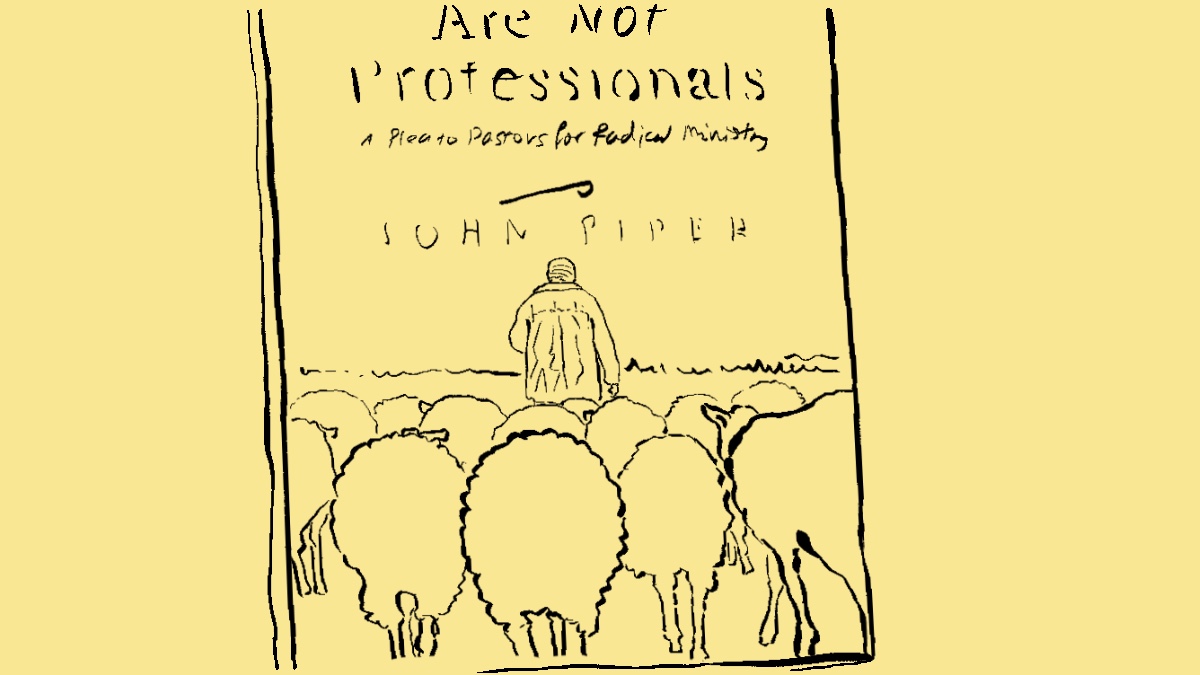
A Summary of Piper’s Key Chapters in, ‘Brothers, We Are Not Professionals’

You probably picked up Piper’s book, ‘Brothers, We Are Not Professionals’, thinking about the practicalities of ministry (the ‘profession’ of ministry, per se). However, when you read it you encounter a lot of what could be described as general doctrinal convictions. Obviously, this is not a bad thing. But if you are like me, you were perhaps expecting (or hoping for) something a little more pointed and specific. In my reading, a lot of the material was stuff I would have assumed of the reader in a book like this (i.e., God is love, preach justification by faith, even consider Christian hedonism, etc. – what we might call the general theological principles). So, to that end, this is my take on some of the key specific practical chapters, or at least the ones I found to be most helpful for me when I read a title like, ‘We Are Not Professionals’.

Note to the reader: you should go and read the following chapters for yourself obviously. I’ve taken liberties in putting his arguments into my own words and adding a good deal of my own thoughts on the subjects and then linked them to ‘professionalism’ directly (which is ironically something Piper does not do except for the first chapter!). Also noteworthy is what Piper does not address in a book like this. Subjects like rest and sabbath, or KPI’s or church governance and the minister.

Nevertheless, his first chapter starts strong and is a good defining chapter. I’ll end with a short summary of this summary at the end.


Ch1. Brothers, We Are Not Professionals

Ministry is service. A Christian (minister) is a slave of Christ. Professionalism is antithetical to that. Professionalism is about wisdom, results, honour, strengths, and recognition. It’s the sleek and trending – the curve that grows ever upward.

Service is cross-bearing, self-denial. It is to be Spirit-Filled clay pots. Crushed, weak, and looking foolish to the world. One cannot do these things ‘professionally’. A servant (minister) doesn’t become the professional clay pot. They are just a clay pot. Service is the stuff of forgettability to the world of professionalism. It is not outwardly impressive. It’s 2 Corinthians. It’s Jeremiah. It’s exile. It’s Jesus. It’s fishermen. It’s 1 Corinthians 1.

Talk of professionalism in ministry is a matter to be wary of (though I would say, not totally abhorrent) because professionalism is a sort of standard set by the world. That is why it carries with it inherent danger to the gospel of God.

Talk of the business of church is foreign to the household of God. God’s gathered people have a different mission shaped by the gospel.

Ch10. Let Us Pray

One of the first things that happens in ministry is you get a sort of ‘imposter syndrome’. It can be particularly acute because you are meant to be holy, or ‘set aside’ for ministry. But you will obviously confront two matters. First, you are quite unholy! And secondly, you are labouring at something which is ultimately in God’s hands. Hence the first and greatest practical reminder – Pray. In 2 Cor 2:16 Paul poses the rhetorical question, ‘who is sufficient for such a task [as ministry]?’. Nobody is. The burden of being an aroma of death and life is heavy. A sense of competence is ironically dangerous in this ‘profession’. Which is why Piper would remark, we are not professionals. We are servants. Success is not ours. It’s God’s will worked out as we work for him. And so, we pray, ‘your will be done’.

If you treat ministry like a professional pursuit perhaps the first thing to go, ironically, will be prayer! Not intentionally but certainly in practice this will happen. You will be tempted to think you are spending your time doing ‘nothing’ when you pray. But if you are not praying, all you do will be as nothing.

We might not be praying because we’ve fallen for some sort of pragmatism. But conversely, we might be tempted to ‘pray’ out of a pragmatic motivation. Instead pray humbly, for his will to be at work, and for the strength and wisdom to walk in it. So whereas a kind of professionalism would seek resource from within to accomplish goals for company and kudos, prayer quietly announces to God one’s weakness, dependence, and plea for strength, wisdom, resource, and His ineffable hand and will to be at work through us.

Furthermore, our role, is in part, to be example. Ministers in God’s church ought to lead in prayer, and not only up front, but behind closed doors. Teaching all that the Christian life is one of dependence.

Ch11. Beware Sacred Substitutes (or, Don’t Let Ministry Destroy Ministry)

A minister prays. Understood. But why don’t we pray? One of the reasons, we are too ‘busy’ doing ministry. The fundamental to serving God is relying on God. But to get it around the wrong way is dangerous. That is, to replace a fundamental task, like prayer, with something like ‘ministry’. Ministry relies on prayer. Service is fuelled by dependence. But practically speaking, the ‘doing’ simply overwhelms the ‘depending’. That’s what happens. So beware. Beware of ministry!

If something in ministry seems really important, a gut reaction can be to get to it pronto. And that’s exactly the kind of reaction to be wary of. It certainly doesn’t mean there isn’t a time and place for dealing with something urgent urgently. It’s just the perfect storm for losing something essential one situation at a time (because they keep coming). That’s what happens in ministry. So guard prayer in ministry for the sake of ministry.

On principle this is the very opposite of a kind of hustling professional where work is the essence of work. But in ministry (as reflective of the gospel itself in a way) work comes after grace – the grace of God received compels the worker on in the deeds God has prepared.

Ch12. Fight For Your Life (or, Read Good Books)

Ministry takes it out of you. You need to replenish. Specifically, you need to replenish the soul. How does this happen? Piper argues, through unhurried reading and reflection. Reading about the truths of God or his works in history perhaps (e.g, church history), will fill your soul.

So many of the forces in culture are trivialising, making light of things or short-lived flits of entertainment (this will relate to the next chapter as well). But the spiritual life is no trivial matter. Reading deeply of deep matters will fill the soul. And a full soul will be much healthier for a church leader.

This reading ought to be done for its own sake. It’s not sermon prep, or ministry work, or required reading for a subject – it’s not just ‘part of the job’. It’s part of a minister’s enjoyment of God. To learn of him for the sake of learning more about him because you are a Christian.

Related to this, people in church will know when their minister is reading, or when they are predominantly feeding themselves on YouTube. You are what you eat. The minister’s spiritual diet will be evident. And that is worth noting. Yes, in the first instance you ought to read for the sake of the love of God. But secondarily it will have an impact on those who you serve. They will go deeper because you are deeper.

So now you have more work! And it’s not even about the work at this point either. You have to work at praying. And you must work at reading. And the work is the work that isn’t work. All that to say, we are not ‘professional’ when we attend to these matters. We are being healthy. Enriching our souls.

Now for the flip side. Ministers should be ‘professional’ readers. We read scripture. We read theology. We read (to a degree) the cultural products of our time for the sake of our people and understanding their greater context. So it could be said, there is a sense in which this is part of what we do ‘professionally’ (if we take this not to be at odds with all that I’ve written so far). But the main point of this chapter in Piper’s book is to enrich and nourish one’s spiritual life. But this paragraph is still worth noting as the appropriate use of reading for the task at hand as well.

Ch13. Be Bible Orientated, Not Entertainment Orientated Preachers

Don’t be silly when you preach. Sounds obvious I hope. You’re not an entertainer, you’re a preacher. There are better entertainers than you and more of them. God’s people don’t need more entertainment! Lord knows. You proclaim the truths of God. Contextually, you proclaim serious truths to a people more accustomed to trivial, flippant, silly, entertainment grabs of 30 seconds or less. And as mentioned earlier, if you are steeped in that world too, then it will show. But conversely, if your authority is clearly the bible, it will show.

To that end your joy should be evident. That’s not contrary to the paragraph above. Your delight in the Lord and all that he is and does should show in your preaching. But that’s different to communicating with the purpose of entertaining. What should/will grab the hearts and attention of God’s people will be God. What do you think your task is if not to show people God in and through his word?

Here is a potential chain of reasoning which might lead you to act otherwise. You will likely start with believing your duty is first and foremost to communicate the truths about God. You gotta tell people about God. Best place is church. But the best way to get more people to church to hear about God is to be an entertaining speaker one might reason (that’s what gets the likes and subs everywhere else). But in order to protect the goal, you entertain for the sake of telling people about God. Everyone is happy! However the means is important (and the motive). Entertainment in the form of the casual, silly, laugh-seeking style will communicate something about God (or rather, not). The message will be light, not reflective of the heavy or deep truths of God. The medium or style will also diminish the depth if this is the method used. And the result will not be what you longed for. You were hoping for committed gospel-hearted, long-suffering, servant-hearted people. Instead, they are shallow and flaky. Not used to meat (or milk!). What might happen in the minds of those at church is the packaging will become more important than the content. “Was it funny? Or fun? Or interesting? Or witty”, not, “Was it true? What should I do? How do I change?”

Underneath this subject is the topic of authority. In preaching the authority is the bible. When entertainment is the packaging the biblical truths and authority of the bible can be hidden or forgotten or not appreciated. People may learn truths, but not why it’s true. Another danger is that people might learn all sorts of other unrelated truths as hooks in a long line that (hopefully) leads to bible truth. The trouble with this is (and increasingly) that others will know more about the weather, cars, sports, finance, etc than you do and an error in some hook will hook in a person’s mind for all the wrong reasons. Then the very thing you were hoping would grab and lead to the bible has now held their attention in a detrimental way. Back from the bible.

If professionalism has to do with getting results and been liked, loved, and admired, then entertainment is going to be key. But that’s not our goals, or God’s goals. We want to see hearts changed by God’s Spirit by God’s word.

Bible preachers, preach the bible. Are you enthralled by the word of God? If so, why so? Is it not because it cuts you to the heart and divides your innermost thoughts? Don’t give people less than that for themselves. The word does the work.

Ch15. Bitzer Was A Banker (or, Practise/Learn Your Greek and Hebrew)

The better you know God’s word, the greater your confidence in its proclamation and the better you will show its authority. That’s why you should keep up your Greek and Hebrew (or learn them).

Many might think this is unnecessary nerdiness which will not help people connect to the bible or God better. ‘Dry scholarship’ and getting lost in the weeds and missing the vistas some might say. Or more likely the cause of losing this skill, simply neglect. Benign and powerful.

Though not guaranteed, with the neglect of the originals by a minister, an outcome that becomes likely is the minister (and therefore church) will get the bible in a second-hand manner. In this scenario truths of the text are discovered by others who the minister then reads which he then gives to the church. There is certainly a place for this reading and second-hand nature. But much better on principle for the minister to have learnt and discovered the intricacies and weaves and connections themselves, firsthand. Like the prior topic above, the subject of authority comes up again. In the second-hand scenario, the authority is less clearly linked to the bible. The modelling of firsthand learning, time and effort, reasoning will lead others not only into the truths you find, but model truth seeking itself. As good as it is to read good books (as argued above in Ch 12), name dropping the latest best seller, or favourite author is still a step removed from the source of that author or works investigations, the bible.

Now we are surely sweating (at least I am!). Not only do I need unhurried time to pray and time to read, but original languages is surely the killer because it takes consistent amounts of time in practise. And that would be a compelling argument if the professionalisation of ministry leads us to value the pragmatics of ministry above the principles of ministry (which is a constant temptation). So keep to the principles, and fight for these skills. Languages are key to exegesis. And exegesis is key to word ministry. And you are a minister of the word.

In my mind, an argument can be made for thinking of original language skills as part of the job and that the minister should consider them part of his ‘profession’, as being set aside to devote time and energy to matters others will simply not have the time or energy to give to. This sort of professionalism is distinct (I think) from the kind that Piper is arguing against.

Ch25. Let The River Run Deep (or, Express Your Passion Appropriately)

Preaching isn’t lecturing. It’s not an info dump. It’s an art. That which moves you will move the church. The truth of God is bedrock. But we speak those truths in love (to use that phrase in a different context). Your love for God is and should be seen in the form of your speaking. You must lovingly speak of God. This is not necessarily about spontaneous outbursts (though that may be appropriate sometimes, and may not be other times), but artfully crafted and beautifully stated prose of the goodness of God. Not for entertainment or manipulation for a result. But in representation of the subject you speak of according to the tone of the text and context you are proclaiming to. Artfully explaining and communicating the intricacies of theology should be delightful for all involved. Not cold or impersonal.

That makes preaching not merely a matter of content or form which could be performed by an educated and competent professional public speaker. It must be affective to be effective – having affected your heart to then effect the hearer. This is far from the possibility of performing a task professionally but is an authentic love of God.

Ch29. Tell Them Copper Will Do (or, Don’t Love Money And Be Generous)

Finally for our purposes, ministers are paid for their work. We are paid to be who we are – Christians (which is a strange thought). Ideally you’d receive a stipend for being a servant. Not receive remuneration for dispensing of a task (though there is some scope for that too). So it’s tricky to navigate being a gospel worker without sliding into considering oneself a ‘professional’ gospel worker because we are being paid to be a Christian basically. Anyone else in the world, when paid for something, would consider themselves in an inevitability of capitalism, as someone who is a professional in that field (the arbitrary threshold probably being when you make enough to live off, which is the very idea of a ‘stipend’).

Speaking of money, the world loves money. And we all live in that world. And we receive money for our work. Although we are all drawn to it, the west is even more so due to the tides of consumerism around us (and that consumerism also creeps into churches and how people ‘consume’ a service).

On the contrary, the Christian faith is marked by abundant generosity. The generosity of God is his giving to us and our generous response in giving of ourselves. The minister is to be generous. And the flip side of that (or prerequisite) is to not love money. To not be greedy. And that may look like one forgoing luxury. If a problem in our churches is that many are giving little while owning lots, then modelling the kind of lifestyle they should live is something a minister should be mindful of. It is appropriate that it be evident a minister treasures God and not things or stuff.

It seems incompatible in the business-minded world that generosity and ‘enough’, and contentment would be valued. I guess that’s just another reason why, brothers, we are not professionals.


In summary, I think those chapters are the best chapters for fighting professionalism in ministry. You are not a professional prayer. Prayer is utterly humbling and reverential. Professionalism would put all the focus on the task, the doing, and the doing better and more efficiently all the time. Substituting service into the place of dependence is almost acceptable, it seems, but contrary to the logic and narrative of the gospel and biblical story. Professionalism is strongest here, perhaps, in the “doing.” “Wasting time” reading books for the sake of simple personal enrichment seems almost luxurious, especially if it does not seem to contribute to any direct goal or outcome, like an event, or seminar, or study, or sermon. But it is about the filling up of your soul on the things of God. It is about the personal nature of a minister, their own love of God.

Then, in the job of ministry, it is about preaching. But how does one preach? If the ends justified the means, then entertainment would be plausible. But that inadvertently undermines biblical authority, and discipleship, and maturity (which seems like a no-brainer to prioritise). Painfully study the original languages, because exegesis is key to preaching, which is key to ministry. Ironically, if you were to be “professional,” I think this is the closest you could get to arguing the need for that specialist skill. Yet how did that fall out of vogue? Simple neglect for rigorous effort.

But do not be cold. Be artful and deep in your preaching. Represent the depth of God’s word with a depth of joy, or warmth of prose, that arrests the heart and shines forth the text. And finally, professionalism is inherently a product of a worldly order; it is after worldly reimbursement. But service is very much a giving, not a receiving. That should be reflected in our contentment with enough to look after ourselves and our families.


Piper, J. (2013). Brothers, We Are Not Professionals (2nd ed.). B&H Publishing.

The Last of the Proverbs from Susella

The last of the proverbs from Susella.

The sayings of the man who walked its paths.

Compiled as he considered his departure.

 …

A parent does not choose their child’s favourite toy.

Life is simple, but there are caveats for everything.

Better burnt coffee and a noisy morning than the perfect draw at a lonely table.

Noisy cars are for young boys.
Fast cars are for grown men.

Better happiness than sorrow.
Better sorrow than sin.

Patience is a virtue and silence can be learnt.

The righteous assume their own ignorance while the ignorant assume their own righteousness.

Many doubts are set aside when you know why you know what you know.

Do not marry the one who needs to be convinced of marriage.

No one is neutral, not even one.
All will do right by their tribe.
They all seek approve and fall short of the glory of impartiality.

Great good is time with people.
But who has time for people?

Let the wise prosper in secret.
Fools flaunt their wealth.

Well placed secrets are good because not all needs to be known.
Among good friends your secrets are known.

Fear of the Lord is the beginning of wisdom.
Knowledge of self follows soon after.

Like a traveler ordering food at a bad café, are the hopes of many in life.
Soon their high hopes will be unfulfilled, or worse, turn to worms in their mouth.

The young man with his shirt off impresses himself.
But no-one else.

If an opinion is not voiced, is it an opinion?

Like leaning on splintering bamboo is the one who trusts the office printer in the day of trouble.

Do not be surprised when your technology fails you.
“Again?!”
Yes, again.

A swift response is pleasing.
But too swift and you will cause yourself trouble.

A slow response is frustrating.
But caution may save you from trouble.

“Every word of God is flawless; he is a shield to those who take refuge in him. Do not add to his words, or he will rebuke you and prove you a liar.”

Good People Think Better

To understand why you believe what you believe or know what you know is perhaps more important now, given that the marketplace of ideas has become globalised, democratised, and monetised. That’s to say that ideas from all across the world are accessible to you near instantly. The voices you hear are not necessarily those of an elite education per se, but simply the ordinary voices of people like ourselves. But people like ourselves, when given the opportunity—or when they see the opportunity—will do all sorts of things for money, namely promoting all sorts of ideas and selling them (or being paid to sell them). I hate to go there, but by way of illustration I’m basically talking about social media. But at a lesser scale I’m really just talking about the Internet. On the Internet, all sorts of wonderfully thoughtful people exist right next to thoughtless people. And on the Internet it’s simply a marketplace of ideas. How do we sift through them and determine those which are good from those which are bad? That question is simply the question of epistemology (how we know what we know—determining truth).

Looking for truth will require excellence in your intellectual life. But not only excellence in logic (which is probably what you’re thinking about right now when I say that), but excellence in character (something less often considered). You will need wisdom, caution, intellectual humility, love (of truth and people), along with other virtues. That’s to say that the intellectual life is not merely intellectual. It is also formed and informed by character and virtue.

By way of illustration, we know that physical health plays a part in intellectual ability. Some physical disabilities will mean that your senses won’t work properly and your judgements will be in error. Likewise, there is an interplay between emotions and perception and truth, and again between pain and suffering, and emotion, and judgement or perception. Consider Alzheimer’s, or anxiety, or depression, or hearing loss. In the same way, moral character can undermine good thinking. There is an interplay between good thinking and good morality—between the intellectual life and the moral life. This is absolutely nothing new in a religious sphere or to the religiously minded. But I have a feeling that it is very much something that religious and secular people alike are neglecting. So it is that those who are arrogant or dishonest or lazy will have an impeded ability to think well and pursue truth.

And he [Christ] gave the apostles, the prophets, the evangelists, the shepherds and teachers, to equip the saints for the work of ministry, for building up the body of Christ, until we all attain to the unity of the faith and of the knowledge of the Son of God, to mature manhood, to the measure of the stature of the fullness of Christ, so that we may no longer be children, tossed to and fro by the waves and carried about by every wind of doctrine, by human cunning, by craftiness in deceitful schemes.” (Ephesians 4:11–14)

Do you know immature thinkers (regardless of their age) who are tossed about? And do you know those who are using their cunning and craftiness to do so?

“For the time is coming when people will not endure sound teaching, but having itching ears they will accumulate for themselves teachers to suit their own passions, and will turn away from listening to the truth and wander off into myths.” (2 Timothy 4:3–4)

There is a moral, self-centred, and self-pleasing aspect which repudiates sound teaching because of its own passions.

These two passages clearly speak of the overlap between moral fortitude and intellectual aptitude. So clearly the Christian is called to develop both in tandem—cultivating virtue by the sanctifying power of the Spirit, and cultivating knowledge by the enlightening work of the Spirit. In this sense we might say that, similar to how having a physical deficit in sight or hearing will inhibit your ability to understand truth (something we are completely aware of), having a moral deficit will also inhibit your ability, when provided with evidence, to understand truth. So the arrogant intellectual dismisses the lived experience and ideas of the pleb, and the greedy producer dismisses the evidence of the safety advisor.

And those two little illustrations also demonstrate something more. It’s not just that the arrogant intellectual or greedy producer should be judged on the one bad decision—to dismiss the evidence of ordinary people or to produce dangerous goods in that moment. That’s because we understand that their character isn’t something that simply exists in that moment but is who they are. Many and various decisions by these two characters will be tainted by greed or arrogance over the course of time unless something changes morally. And character is judged over time. In the same way (though again this is not how we naturally think, in my opinion) we don’t simply judge one snapshot or narrow idea held by a person or propagated by a person. Sound reasoning or sound beliefs are best determined or judged over time, which would reflect the virtue of patience in one sense.

So it is that epistemology—or the judging of someone’s epistemology—is the concern of a lifetime. Attention is not merely to the end product but also to the formation of the belief framework, and even its maintenance and revision. It’s not just what you believe but how you came to believe that, though obviously it is very important what you believe.

Clearly we wouldn’t judge someone’s faith simply by their Sunday attendance and everything pertaining to it. No, there are six other days which will be accruing evidence of their faith and its quality. Likewise, with one’s beliefs. They are not merely a matter of that moment but are a product of many factors leading up to that moment, including the character that individual exercised in discerning their beliefs.

So should everyone find it necessary to explain why they believe what they believe? I don’t think so (though I think it would be helpful for everyone). But that’s a different question from whether every person ought to pursue truth in good character—for which the answer is absolutely yes. And this is why character is important in the intellectual life. Intellectualism isn’t required of all people, but moral character is.

Consider Paul’s argument in 1 Corinthians 8:1–3:

Now concerning food offered to idols: we know that ‘all of us possess knowledge.’ This ‘knowledge’ puffs up, but love builds up. If anyone imagines that he knows something, he does not yet know as he ought to know. But if anyone loves God, he is known by God.” (1 Corinthians 8:1–3)

It’s not that knowledge is wrong or inherently problematic. In the very next verse Paul speaks of some fundamental truths which we would love everyone to know: “Therefore, as to the eating of food offered to idols, we know that ‘an idol has no real existence,’ and that ‘there is no God but one.’” (1 Corinthians 8:4)

The problem is that loveless knowledge is of no benefit. So a knowledge of what is true must be coupled with love. Love is by nature personal. So it is that knowledge is not going to be merely abstract but will—even if circuitously—affect one’s life (ethics). A clear link and bond between character and knowledge is given in 1 Corinthians 8.

So although not all people are required to have great knowledge or to be capable of sophisticated understandings, all people are required to love truth and apply truth to their life. All people are to seek truth because all truth will impact their actions. And the way that they are to seek truth is through good virtues—discretion and patience, love and discernment, integrity and teachability, circumspection and humility enough to admit error.

And if we’re thinking about moral transformation, then certainly we must be dependent on the Lord. Without the work of his Spirit of regeneration and sanctification through faith in Christ, we would be left to the devices of our own sin (and its outworking being deception or self-deception, or wilful ignorance). These vices are only kept in check by the common grace of God.

And so the Christian is equipped with the sanctifying Spirit to pursue maturity in the faith by pursuing a growing knowledge and love of God and others.

As the apostle Peter puts it:

His divine power has granted to us all things that pertain to life and godliness, through the knowledge of him who called us to his own glory and excellence, by which he has granted to us his precious and very great promises, so that through them you may become partakers of the divine nature, having escaped from the corruption that is in the world because of sinful desire. For this very reason, make every effort to supplement your faith with virtue, and virtue with knowledge, and knowledge with self-control, and self-control with steadfastness, and steadfastness with godliness, and godliness with brotherly affection, and brotherly affection with love. For if these qualities are yours and are increasing, they keep you from being ineffective or unfruitful in the knowledge of our Lord Jesus Christ. For whoever lacks these qualities is so nearsighted that he is blind, having forgotten that he was cleansed from his former sins.” (2 Peter 1:3–9)


Wood, W. J. (1998). Epistemology: Becoming intellectually virtuous. InterVarsity Press. Pages 1-32

Genesis 23 – A Grave in a Cave

I’m not saying it’s my favourite passage in Genesis, because I think a passage so seemingly bland isn’t allowed to be one’s favourite. That being said… Genesis 23, aye. Simply: Sarah, the wife of Abraham, dies, and Abraham buys land to bury her. It’s mostly about a business deal. Where are the explosions, the samurai swords, and the international espionage (i.e. Gen 14—I imagine Abraham has fourteen-inch biceps and an eight-pack at age eighty)? Chapter 23 may read like a real estate transaction, but it’s Abraham’s first and only glimpse of owning even a corner of the land God promised. I find that remarkable given the promises made to Abraham and their centrality, but it shows the unfolding nature of God’s promises—again, especially noteworthy when viewed from this far away and after so much fulfilment. So maybe the reason why I love this passage so much, oddly, is because it makes me really appreciate biblical theology.

It starts with a death: the death of Sarah, the wife of Abraham. We might call her the mother of the faith in some respects.

“Sarah lived to be a hundred and twenty-seven years old. She died at Kiriath Arba (that is, Hebron) in the land of Canaan, and Abraham went to mourn for Sarah and to weep over her.” (Genesis 23:1–2)

At the end of this chapter, after Abraham has bought some land, he buries his wife Sarah—the first recorded burial. It’s weird to say, but Sarah’s death is just a preamble—a setup—for Abraham buying property. But how interesting that death is used as the grounds for purchasing part of the promised land. Preamble over. This chapter is really about real estate.

If you were to say what three things the Bible is concerned with, you could very legitimately argue, as Sydney theologian Graeme Goldsworthy has convincingly argued: the Bible is about God’s people, under God’s rule, in God’s land. And that is exactly what we’re seeing here in Genesis—we’re seeing the genesis of these three ideas which will unfold over the whole biblical narrative.

God’s people are the descendants of Abraham. God’s rule is seen when Abraham, Sarah, and their descendants live by faith in God—when they trust and obey Him. And God’s land is the land of Canaan. But at this stage, Abraham doesn’t actually own anything in Canaan (though he was promised it all)—until Genesis 23.

“Then Abraham rose from beside his dead wife and spoke to the Hittites. He said, ‘I am a foreigner and stranger among you. Sell me some property for a burial site here so I can bury my dead.’” (Genesis 23:3–4)

The Hittites offer Abraham a free tomb, but he’s not having it (for nothing). After some classic Middle Eastern haggling with Ephron, Abraham buys the cave of Machpelah for four hundred shekels. The passage records more than just Ancient Near Eastern haggling rituals—it’s a public purchase, with many witnesses. It’s an indisputable transaction, paid according to the weight of the merchants at the time. The land is legally deeded to Abraham.

Abraham legally owning this land is very different from accepting a free gift of land (similar logic to Abraham’s refusal of the king of Sodom’s gifts in Gen 14). When my brother and I were kids, our neighbours took a fence panel out and let us into their backyard to kick a ball. But that gift only lasted as long as they lived there. When they moved, the gift disappeared. That’s the same danger Abraham faced if he accepted the burial ground as a gift. What if one day the gift was taken back? But now it can’t be—he owns it.

It may seem trivial (which is part of the reason I like this chapter so much), but this is actually very important to the book of Genesis—especially to the unfolding of God’s promises (and biblical theology—again, why I like it). It’s not just Sarah who ends up buried in this tomb. Abraham, Isaac, Jacob, Rebekah, and Leah are all buried there in the end.

At the end of Genesis, Jacob says,
“I am about to be gathered to my people. Bury me with my fathers in the cave in the field of Ephron the Hittite… There Abraham and his wife Sarah were buried, there Isaac and his wife Rebekah were buried, and there I buried Leah.” (Genesis 49:29–32)

The whole family is buried in this one place! But remember—this is not their homeland. It’s important that Abraham doesn’t go back to his homeland to be buried. He didn’t go back to Ur of the Chaldees for his burial plot. Have you ever thought about where you will be buried? Because it might not be the town or even the country where you die. Where you are buried says a lot about you. Which is why I know you’ve thought about it, even if you don’t want to be buried as such.

That Abraham’s whole family is buried in this one little plot of land says something. This burial ground is the only piece of land Abraham ever owns. God promised him the whole land—and all Abraham ever gets is a little grave in a cave.

All of this should make Hebrews 11 come to life:
“All these people were still living by faith when they died. They did not receive the things promised; they only saw them and welcomed them from a distance, admitting that they were foreigners and strangers on earth… Instead, they were longing for a better country—a heavenly one. Therefore God is not ashamed to be called their God, for he has prepared a city for them.” (Hebrews 11:13–16)

Genesis 23 has helped me immensely in seeing the significance of the words of Hebrews 11 (which is often a favourite for people). That’s because Gen 23 is a picture of faith. This is what faith looks like.

As Christians (spiritual descendants of Abraham—stars in the sky, you might say), we look back to the work of Jesus in faith. We trust in His death on our behalf. We believe He is risen from the dead and ruling from heaven. And we believe He will come again. These are the deeds and the promises of God. We have received the Holy Spirit as a down payment of the inheritance to come. Much like Abraham and Sarah were foreigners and strangers on earth, so too is every Christian. This place isn’t our home—we are looking to a new home, a city prepared by God.

Brilliantly, Genesis 23 is emblematic of God’s people. They receive the promises of God for land (among other things), but they receive it only in part while they faithfully wait or hope or long for the fulfilment. Likewise for us. We receive the promises of God, fulfilled in Jesus, and yet we also look forward with faith to the return and culmination of those promises, inheriting the land to come—heaven.

I hope I’ve convinced you to bump Genesis 23 into your top ten Old Testament passages.

Brief Thoughts on Creation (without getting too apologetic)

Do you find it peculiar that in modern scientific university departments there are Christians? I hope not. But I reckon that a number of people around you would be surprised by that fact. It’s probably about a 50/50 Christian-to-atheist ratio according to Gerald Bray.

Why isn’t this a surprising matter?

Because, “In the beginning God created the heavens and the earth.” (Gen. 1:1)

It’s really important to use the word creation. Behind that word is clearly a creator. And this is one of the fundamental aspects of reality—the Creator and creation distinction. One is not the other, nor is there only one and no other. Some might argue that the universe is simply a “brute fact” (Bertrand Russell), and that matter and energy simply are. People might say that matter and energy are eternal—without beginning or end. That’s scientifically tricky because the current scientific consensus points towards a beginning (the Big Bang). And it’s philosophically tricky because every moment depends on the moment before it. And if there is no first moment, well, there’s no next moment—there is no present. Even if the universe were eternal, that wouldn’t explain its existence at all—it’s not self-explanatory. Why is there something rather than nothing? Anyway, getting too deep (I know not everyone finds this helpful, but perhaps it might be a helpful primer for others).

What about the fact that there is order in the universe at all? This is something that is often taken for granted in these debates. But not so for the Christian, because, “God said, ‘Let the land produce living creatures according to their kinds…’ And it was so.” (Genesis 1:24) “The land produced vegetation: plants bearing seed according to their kinds and trees bearing fruit with seed in it according to their kinds.” (Genesis 1:12) “Then God said, ‘Let the water teem with living creatures, and let birds fly above the earth… each according to their kinds.’” (Genesis 1:20–21)

The ordered universe reflects the deliberate structure and design of God’s creative work, for “God saw all that he had made, and it was very good.” (Genesis 1:31) The ordered nature of the universe means that we can trust our senses as we delve into the depths of its beauty. We can rely on the fact that what we have experienced will be there again to be experienced by others and by ourselves. The formless and empty darkness of verse 2 is intentionally filled.

So what is the nature of the universe (creation)? Is it at heart one of chaos or one of order? That is easy to answer if you’re a Christian, but not so easy to justify if you’re not. Though not about creation per se, Paul still says, “God is not a God of disorder but of peace.” (1 Cor. 14:33)

But the most wonderful thing about creation is that it is sustained by God in love. Creation—this universe—is not just “a fact.” It is endowed with the love of God, something greater and deeper and more meaningful than mere matter and energy. There is beauty, truth, and goodness in life (metaphysics). How can this be? Simple. Because God—He is Truth, Beauty, and Goodness. His creation reflects Him. People aren’t merely made “to be”; they are made by a loving God to love God and love one another. On top of that, they are to love creation out of love for God.

The fall of humanity is so disastrous because of the break in this love. Nevertheless, the love of God pervades all creation, as Jesus reminded his disciples when he told them, “Is not life more than food, and the body more than clothes? Look at the birds of the air; they do not sow or reap or store away in barns, and yet your heavenly Father feeds them.” (Matt. 6:25–26)

So in a nutshell. The universe is something rather than there been nothing, or it been eternally. It’s ordered and so measurable. And its not merely matter and energy – truth, beauty and goodness are part of it. All founded on God – Who he is, and what he’s done.