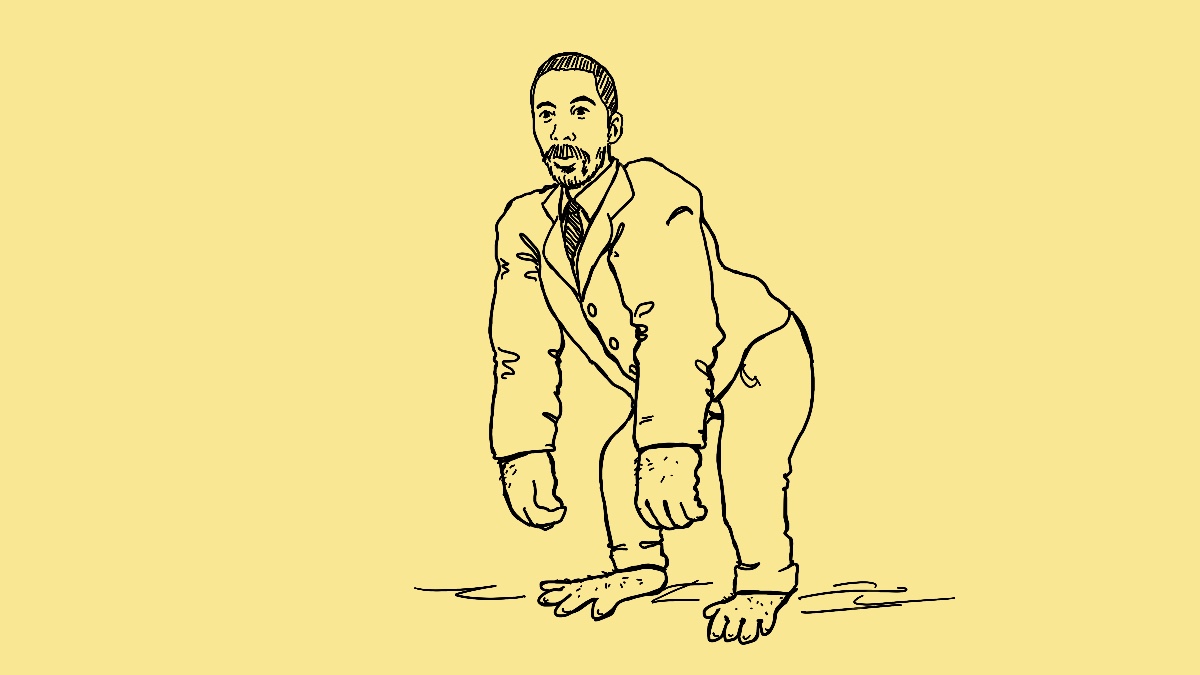
There was a period in my heavy podcast-listening phase when I happened to notice a lot of talk about evolutionary psychology. It certainly was not confined to podcasts alone. The authors in the secular world I was interested in had a kind of ‘biblical theology’ approach. That is to say, they always start at the beginning—with evolution—and arrive at us in the fullness of the narrative. Have you noticed that? In my areas of interest, it was people like Cal Newport where I especially noticed it a lot, and the self-professed E.P. fanboy Chris Williamson from Modern Wisdom.
Before going further, a quick note: I’m currently agnostic about precisely how God made us—the mechanics. For the most part, I think we do not know exactly, though that is not to say we do not know some things.
In books or podcasts from this self-help and personal development sphere, they are clearly trying to explain behaviour in order to then have people change behaviour. The framework they use is often the evolutionary framework, and particularly the evolutionary psychology framework. Mindset, right? I guess physical evolution is a little too slow.
Every time I hear people explain behaviour or motivation on the basis of evolutionary psychology, I mentally ask, with scepticism, “Really? How do you know that?” And asking that question is all the more relevant and important because people will build the applications of their ideas on these evolutionary psychology theories. Which is why, when you read or listen to them, they often start with a ‘how we got to this point’ narrative. It might be true, to a degree. The problem is that this kind of grounding is not something we can test. It is a vastly enormous narrative seeking to explain a kajillion-year time span. Another word for this ‘theory’ is a ‘narrative’. A story, which does not mean it is not true; it is just a category, is all I am saying. Ever since a friend of mine, a theistic evolutionist himself, pointed this out to me, I have never been able to unsee it—or unhear it, rather—when I hear people reason with it.
“We behave like this because our ancient ancestors 10,000 years ago were vying for dominance.” — Oh, I didn’t realise you were there. “We do this because our ancient ancestors 50,000 years ago had to struggle to survive by any means necessary.” — That’s a profound insight, given that we struggle to know the history of 4,000 years ago with much certainty.
Again, this is not to say evolutionary psychology has no explanatory power. It clearly has a decent degree of explanatory power when you accept the foundational premises. Rather, what we want to do is try to measure its power appropriately. Because by the same speculative logic, I am just as justified in proposing that meal times are linked to the daily sun cycle.
Think about it. Have you ever wondered why we eat three meals a day? The answer, of course, lies deep in our evolutionary past. One hundred thousand years ago, our ancestors hunted and ate at sunrise, high sun, and sunset. At sunrise, the nocturnal animals were heading to sleep and were easy to catch and eat. At high sun, the daytime animals were resting in the shade and were therefore easy to catch and eat. At sunset, the daytime predators were slowing down, vulnerable, and ready to be caught and eaten as well.
Therefore, these three hunting windows became fixed in the habits of our species. Over thousands of generations, the pattern embedded itself so deeply into the human psyche that now, as a kind of post-agrarian and industrialised people, even though our hunter-gatherer days are long gone, we still find ourselves eating at sunrise, high sun, and sunset. Not because we are hungry or have found the most opportune time for hunting, but because ancient survival rhythms still govern the mind.
I hope you see my point.
My point is not to disprove the narrative. In my experience, a lot of Christians have seemed a bit cagey about evolution, as though their ancient predator instincts are coming out at its very mention. My point is simply to understand that the category of evolutionary psychology is akin to a narrative. It may be a true story, as I have said. That is quite aside from the point that it is a story. And remembering that has helped me understand its explanatory power better.
For comparison, and as an exercise, you could take a whole range of different evolutionary psychology assumptions and replace those assumptions with biblical assumptions. This is not foul play. It is literally the same process for both. First, find the foundation. Then build off the foundation. Either begin with evolution, then build a psychological narrative, then act on that narrative; or begin with a biblical foundation, then build (or discover) a narrative of human behaviour, and then change or realign as fits the narrative. That is, crudely, what is happening in both. So let’s compare some examples.
Mate selection and attraction: evolutionary psychologists will tell you that people are attracted to beauty or symmetry or health because they are markers of strong genetics and hence better fertility, leading to increased chances of reproductive success. Or you could just go with the biblical narrative of God designing beauty and attraction, with its inbuilt by-product of marriage and family and children, for joy, blessing, and the careful stewardship of the rest of creation. At the heart of this created order is a reflection of who God is: relationship—Father, Son, and Holy Spirit.
Or consider women seeking high-status men. The evolutionary psychologist might say that a woman is naturally inclined to seek a man with resources and status in order to ensure the stability and survival of her offspring. Or we could just go with a kind of biblical narrative approach, where security and stability are a concern, consider the narrative of Ruth, but where there is also a moral element to it. From the perspective of God’s order and the wisdom inherent in his creation, we might say that those who live wise lives, in this case a potential husband, will more often than not reap the fruits of their labours. These fruits are driven by their moral outlook on life, which is rewarded in God’s order with prosperity. And that prosperity is a sign of that potential husband’s wisdom and good leadership. The attraction might be morally grounded as opposed to being physically grounded only.
Consider altruism. An evolutionary psychologist might say that altruism is something that evolved in order to build social bonds and increase the likelihood of survival for the tribe. But from a biblical perspective, we could just as well say that altruism is simply a form or expression of love, and that at the centre of all creation is a loving Creator. Altruism is not a strange quirk in a brutal world of survival, but is essential to the relational nature of creation, even at cost to oneself.
And what about things like tribalism, or guilt and shame, or male aggression, or status-seeking? We could explain all of these from a psychological and evolutionary perspective: that we care more about our tribe for survivability, that we seek status for fertility, that we experience guilt and shame because those related actions have hindered the safety of the tribe and its survivability, and so on. But from a biblical perspective, we could simply and clearly state that so many of these issues are genuinely moral issues that result from sin and corruption. It can be that simple. A simple absurdity. Simple favouritism, pride, lust, and genuine guilt. Because the world is a moral world in which humanity has rejected what is good by rejecting God.
Again, we could keep going with examples and exercises. But suffice it to say that if you feel some sort of shady logic going on in these comparisons, it is because you might think that the evolutionary psychologist is doing something with irrefutable data while the Biblicist is being irrationally dogmatic. But you have to treat the two sets of evidence equally, or at least recognise that they are operating with the same means. They are both accounting for the world with narratives. And we might even say that those narratives are assumed frameworks which are more or less given warrant by the power of what they explain or how much they explain. Both are essentially unprovable, but rather provide a greater or lesser explanation of all the phenomena they seek to explain.
In the case of evolutionary psychology, it gives a compelling narrative regarding how we came to act as we do, if you enter into it and accept its basis. What it lacks is any helpful framework for tackling issues. Perhaps it may explain why something happens, but it cannot explain what you ought to do, unless of course one takes the brutal fact of survival as the imperative: survive at all costs. How far are evolutionists willing to take that, I wonder? At absolute best, I think it is ambiguous as to the process of flourishing under its guidance.
And that is where the two stand apart. The biblical narrative is able to explain what happens and why. But it also, in its explanation and foundation, provides the resources to then guide you to action. It does not just tell you what is; it tells you what should be.
The narrative of the Bible is so large and encompassing that it has the power to explain evil and guide for good. The narrative does not end at the present day. It goes beyond. It speaks to a world beyond, and it gives hope. The narrative is also a narrative for our life here and for tomorrow.
So the danger is this: when something like the evolutionary psychology narrative is used to explain moral behaviour, it is natural to continue reasoning about moral behaviour with it. But what is the point of the narrative? Was it to explain how it happened as a history? Sure, okay, fine. A mechanical narrative is interesting. But the biblical narrative is a moral narrative. You can legitimately explain actions from it, and hence future direction and moral guidance from it. It may provide sketchy grounds for the mechanism of creation, but that is precisely because it is a moral, spiritual, and meaning-making narrative.
I think it’s interesting that the mechanistic narrative is used by its proponents to insist on moral direction. That should count as evidence for the biblical narrative, ironically. People can’t help it. It’s built into us, as though there is a meaning. Uncanny. The fossilised evidence is buried in the layers of moral sediment in the being of our psyche.
 Bigvai and Shiphrah
Ha, the whole way through this article, I was thinking “Hume’s Guillotine really applies to this“, and then you got there in the end. It’s the “Is/Ought paradox”. EP can tell us how we got to where we are, but it carries no real authority to tell us why we ought to do something. In fact “Evolution” is predicated on individuals not maintaining the status quo, so if anything, there is a moral imperative, if we are to grow as a species, to step outside of our psychological conditioning!
Thanks for a fun read.
LikeLike
who knew! sometimes i land on something by the end. but just because i ought to, doesnt me i do… do.
good point on status quo deviation re; evolution.
LikeLike