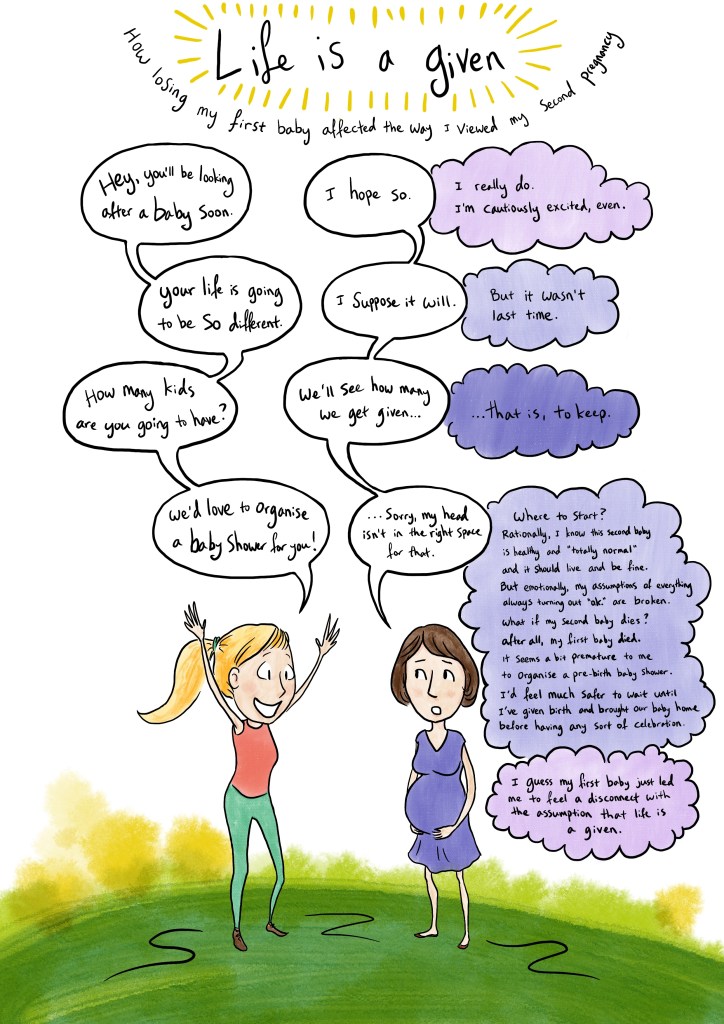
Life is a given: how losing my first baby affected the way I viewed my second pregnancy.

Life is so precious, and the arrival of a new baby is naturally a joyfully anticipated event. 

In the weeks before the birth of our second child I had many strangers ask me, ‘when are you due?’ And one old lady who I hadn’t met before but who lived on my waddling route even came out one day and said that she’d been watching me and wondering when I would pop. 

Everyone was waiting for this baby. And my husband and I were also eagerly anticipating our second little one’s birth. But for us, behind our excitement was the reality that our first child had died. In July 2020 I gave birth to our daughter, Ellie. She lived eight days in the Westmead Children’s Hospital NICU, before dying from an inoperable heart condition. We returned home without a baby. 

Despite stats and the anecdotes of others, one’s first experiences of something leave a mark on one’s expectations.  

For me, this resulted in a frequent emotional disconnect with the assumptions behind the confident joy of my beloved family and friends. As though everyone else were able to blissfully expect that I would very soon have a healthy, live baby, as though there were no possibility that anything could ever go wrong… But for me, it had before.

And so I drew this short comic. 

The intention of this post is not to have a go at anyone, but rather to share my experiences as a bereaved mother. So that, 1) readers who have not experienced this grief may empathise and have greater awareness of what other people may be going through in a first pregnancy post child loss. And that, 2) those who have experienced grief relating to infants may find some resonance here. 

Written and drawn January 2022, by J. Nichols.

The Almighty(‘s) Government

In a dark world there are many clouds. Concerns about China loom on the horizon. The storm clouds of climate change are always present in the newsfeed.  There have been stifling government restrictions brought about by covid-19. There is a general cultural failing at upholding women with dignity, but particularly so in our Parliament.

So what hope has the world offered you in light of all these problems?

In many, perhaps most of the cases, our world puts its hope in the government and it keeps telling you to do the same thing.

In this secular age, the government is the highest authority. Hope in light of China is governmental diplomacy (think political boycotting). Hope in light of climate change is governmental initiatives. Hope in light of government restrictions is of course, government freedoms. Hope in light of the mistreatment of women in the government, is ironically, government bodies introducing stricter governance on said government.

So much of our world’s hope is in government change or government action. In the minds of many that’s the highest authority to appeal to. If there is any hope for a brighter future it will come from the Almighty… government.

There certainly isn’t anything wrong with wanting change from the government. But if that’s all we’ve got then it’s a pretty dim light in a pretty dark place.

But the bible speaks of another king of another kingdom. King Jesus. Isaiah speaks of this king saying the “government will rest on his shoulders” and his reign will bring freedom to the oppressed, hope to the hopeless and peace without end. This is a ‘government’ (a kingdom) like no other (see Is 9:6-7. The classic Christmas text). No other human King can do what Jesus does. Every human ruler on whom the government rests at best brings temporary relief to some present crisis. At worst they create the crisis. And every leader goes the way of mankind. They die and their dynasty and efforts are left to another who will also go the way of mankind.

Not so with King Jesus. Jesus is born a child, he is fully man and yet he is fully God (Is. 9:6). And on his shoulders “the government will rest.” As people we feel the weight of the world on our shoulders. In our current climate we are always pointing the finger at our leaders (sometimes rightly, but other times – maybe mostly – we do it because we are way way way heaps heaps heaps smarter than them and if only I was in charge the world would be better and also why can’t I keep my own life in order again???). Yes, we feel the weight of the world on our shoulders. But with King Jesus he shoulders the load himself. He takes our burdens. But he doesn’t do it just as a man. He is the mighty God, he’s the prince of peace. That makes the world of difference. Jesus rules with perfect justice and perfect righteousness. Not just temporarily, because he has conquered death and is raised and seated at the right hand of God where he rules forever.

All of this means His is not an earthly rule but a heavenly rule. In one sense we are really hoping for an earthly rule, like a theocracy – “Jesus for president!” But that’s probably because we are tempted to put our hopes in this world and we are tempted by the solutions that this world offers us day in and day out. But our hopes go beyond this world to a heavenly King who rules all creation in justice and in righteousness. Under his Lordship and in his kingdom (his government) there is peace for his people. You might say, “peace amidst war”, there is light amidst the darkness, there is hope in a hopeless world. That’s what this king provides. That’s what Jesus provides.

“Simple Church” by Rainer and Geiger – A Brief Summary

Simple Church is a church process designed around focusing on discipleship, particularly the process of discipleship. The book is based off research done by Thom Rainer and Eric Geiger comparing ‘thriving and vibrant churches’ to churches that are not, while seeking to find what makes the difference between the two. Their answer is “simplicity”.

Complex churches have a variety of programs running all through the week. Congregation members are encouraged to attend a huge number of these many different programs. For the congregation members it means they are just going from program to program depending on what might be on that week (or whatever tickles their fancy) with no clear through-line tying everything together in a ‘discipleship process’. Congregation members have little time for anything else, while at the same time they are contributing to ‘spiritual congestion’ within the church. Nobody is moving forward, maturing. The staff in this situation all have their assigned program, and this assignment gives them tunnel vision. There is no sense of ‘the whole’, just what is assigned to one or another. The lead pastor in this situation is a program manager, just keeping the whole thing afloat.

The main problem with this ‘model’ is that there is no clear process to discipleship in a complex church. The programs don’t connect to each other with an overarching purpose of growing people in maturity. Rather it is just assumed that people would grow in maturity as they attend all these different programs. The staff are not aligned because there is no real process to be aligned to. The church motto (or mottos) is just nominal. Every idea for a ministry or outreach or event etc., is a good idea, just so long as the calendar has enough space (which it doesn’t).

A simple church on the other hand, is simple. It has clarity, a clear process and movement, the staff are aligned with the ministry philosophy, and there is great focus on the process. This means that every ‘program’ has its place within the discipleship process. It can be clearly understood why this program contributes to the overall process of making disciples and growing disciples in maturity who will eventually become disciple makers themselves. The whole process is kept in mind for any particular program’s part in that process.

Clarity in the process starts with a clear definition of what the process is. We might consider this the ‘motto’ of the church, for example, ‘we exist to love God and love neighbour’. The language is simple, it is short and concise, it requires no great explanation, it is itself a process (one must first Love God to then love their neighbour). This kind of simple process has great clarity and can be taught to the whole church and agreed to by the staff.

Movement through the process is clearly defined and expected. Disciple making in this process looks like people growing in their love for God and then growing in their love for their neighbours. All the different ‘programs’ clearly contribute to this movement in disciple making. If they do not, then they’re not run. But the programs are not just standalone events. Each is to be connected to the whole. So between the programs, between the movement in disciple making, there is a clearly defined progression to make. A congregation member in their early stages grows in their love of God. It is then expected of them to grow in their love of neighbour, and then they serve their neighbour. Each step is linked to the last and results in the movement of disciple making, the process of disciple making.

The staff in this picture are all aligned to this process. If they are not, then it may be inappropriate that they are staff. It is more important that they are aligned philosophically with the process of the church than having particularly great skills in running a certain program. No one is an island in this process, and everyone is working together, having clearly defined roles that contribute to the process of disciple making. The pastor in this situation is more like a designer, writing up the blueprint and seeing it come to fruition in the context of a team.

Focus on the process is essential. It means that if a ministry is not explicitly contributing to the process of disciple making according to the church’s defined ‘motto’ then it won’t make the cut. And this means that most ideas and desires won’t make the cut. One of the difficulties in this aspect is that churches tend to become more complex, or they ‘drift’ towards complexity naturally. So a regular refocusing is essential as well.

This, in a nutshell, is the ‘simple church process’.


Rainer, T. S., & Geiger, E. (2011). Simple church: Returning to God’s process for making disciples. B & H Pub. Group.

Psalm 13 – A Model for Suffering and Lament

How do you deal with your pain?

We could ignore it and pretend it’s not there. We could medicate ourselves so that we feel less pain or suffering. If the pain is caused by someone who wants to hurt us then we want to hurt them back. We could blame others for our pain, sometimes that makes us feel better. Or we could compare our suffering to someone else. We might say, “at least my pain is not as bad as their pain” or we say, “I am suffering much more than other people are, I deserved pity”… and that makes us feel better.

Some of these have their place. There is a place to simply ignore suffering. There is a place to medicate against suffering. There is a place to fight back against an adversary. And a bit of perspective can help us with our own suffering.

But that’s not how God has taught us to deal with pain and suffering. The way the Christian deals with hurt is given to us in Psalm 13 (amongst others).

God tells us to turn to him, complain to him, ask him for help, and affirm our faith in him.

First, we must turn to God.

If we don’t turn to God then the alternative is that we rely on ourselves to find the answer to our pain and suffering. The problem with that is that our own resources will eventually deplete.  Hence, we must first turn to God using his resources.

That means we open God’s word. Perhaps you thought turning to God means turning to God in prayer. Which is true, we turn to God in prayer. But we must first turn to God in his word. We must first hear from God. Because God will teach us how to pray.

Secondly, we complain to God.

I don’t think any of us have a problem complaining to God. We have got a lot of stuff to complain about. Complaining to God is going to be the easiest thing for us to do. Although it’s always an emotional and turbulent stage.

“How long, LORD? Will you forget me forever? How long will you hide your face from me? How long must I wrestle with my thoughts and day after day have sorrow in my heart? How long will my enemy triumph over me?” (Psa. 13:1–2)

Thirdly, ask God for help.

You can’t just stop at the complaining stage. If you’re anything like me, that’s what you do. In life I get stuck at the complaining stage. Jemima, my wife, will happily complain to you about how bad I am when I get stuck in the complaining stage. It’s too easy to get stuck complaining to God all the time. You’ve got to move beyond that. You’ve got to ask God for help.

“Look on me and answer, LORD my God. Give light to my eyes, or I will sleep in death, and my enemy will say, “I have overcome him,” and my foes will rejoice when I fall.” (Psa. 13:3–4)

The Christian has many trials, and many enemies.

For us living in Australia, it can be as simple as certain people who want to pass awful laws. Some of the laws in Victoria, basically exist to undermine Christian ethics and values. They are self-proclaimed enemies of God.

We live in a broken world where everything seems against us at no personal fault. You face some sort of trial, whether at work, or home. Whether financial or health related – physical or mental health deteriorates.

Then there’s our own sin. When you have a heart on fire for the Lord, there is nothing you hate more than the enemy that dwells within. The sin that wants to wreck your life. You want nothing more than to get rid of it, to defeat it for good. But you just can’t seem to win the battle against temptation, whatever form it takes.

And of course, there is the archenemy, Satan, the Devil. A personal spiritual entity whose only purpose it seems is to accuse us and tempt us. It’s hard to describe spiritual warfare but it’s naïve to ignore spiritual warfare, to ignore this dangerous enemy.

Whenever you face these trials, these enemies, turn to God, complain to God and ask God for help. 

Finally, we must reaffirm our faith in God. 

This is possibly the easiest part of the process… to miss! But it is equally one of the most important parts of the process. As Christians it is essential that we remember and proclaim who God is, especially when in pain or trouble.

“But I trust in your unfailing love; my heart rejoices in your salvation. I will sing the LORD’S praise, for he has been good to me.” (Psa. 13:5–6)

The writer reaffirms their trust in God’s character. The writer praises God because God has been good to them. But get this, their circumstances have not changed. They are not praising God because between verse 4 and verse 5 God immediately acted in some way. They are praising God because of who he is and because he does save (the exodus from Egypt is surely in the mind of the writer and the cross of Jesus Christ should be in our minds). God saves his people. God loves his people. I will therefore praise God no matter what circumstance I find myself in.

When we turn to God, when we complain to God, and when we ask God for help, we are doing it because we are feeling it. We say the first half of the psalm because we are feeling the pain. We say the second half of the psalm even when we don’t feel it! The writer is choosing to reaffirm their faith in God. They are choosing to praise the Lord. Don’t just praise God when you feel like praising God. Don’t let your feelings or your circumstances dictate when you praise God.

No matter your feelings and no matter your circumstances, turn to God, complain to God, ask God for help and in the end, praise God.

Struggles with Faith

When someone says they struggle with the faith, what comes next could be a myriad of different issues. People may struggle with an intellectual aspect to the faith – perhaps it’s the reliability of the gospel, or philosophical questions regarding suffering and God’s sovereignty. Others may struggle to simply ‘feel it’ (coming from a Pentecostal background, I can easily recall people who no longer walk in God’s ways because they never ‘felt it’). Others struggle with the faith because the allures of the world are much too strong for them to handle, and they succumb.

In what way do you struggle with the faith?

I think we all have our struggles, and we each feel them in different ways. One that I haven’t mentioned yet is that we can struggle in the faith because we are not seeing God’s promises fulfilled (and I might add, fulfilled as we might expect them to be fulfilled).

Personally, this is one aspect that I find challenging in my own walk, and perhaps it’s the same for you.

God has promised many things. Some promises that come to mind are promises such as,

And I tell you that you are Peter, and on this rock I will build my church, and the gates of Hades will not overcome it.” (Matt. 16:18)

And,

For when you were slaves of sin, you were free in regard to righteousness. But what fruit were you getting at that time from the things of which you are now ashamed? For the end of those things is death. But now that you have been set free from sin and have become slaves of God, the fruit you get leads to sanctification and its end, eternal life.” (Rom. 6:20–22)

I don’t want to go too deeply into these two topics, but to summarise them, God will grow his church and God will sanctify his people.

These are just two things that I struggle with at times. Obviously if the church is in a season of growth, or I’m meeting with someone whose life is completely changed for the better, I’m not struggling very much to believe these promises. God is fulfilling them in front of my very eyes.

But more often than not (in my own experience), I fail to see these things (as I might expect to see them).

Now there is a lot to unpack here and I would readily expect to be misunderstood on these points so please read me right. I believe God is always fulfilling his promises. I believe that despite not seeing it at times or for a season. This is because my faith doesn’t rest on my experience of these matters. God has already accomplished them.

If I was to do some self-diagnosis, I would simply tell myself that I’m short-sighted and my memory doesn’t serve me very well. Not that this makes me feel any better when I just want to see people saved and changed before my eyes! But it does help.

So if you’re anything like me, be encouraged.

Our perspective on God’s work is often very limited, and even now many decades of life is a short span of time in the history of God’s growing kingdom. God may not do what we had hoped in the way that we had hoped. But it will far more often be the case that God has done so much more than we had hoped. Who of us has such a vast imagination that God’s wonderful grace does not surprise us? Our most fantastic dreams about God’s work and God’s kingdom are but mere watery reflections of his ability and his work. Were we to really see what and how the Lord is at work, I dare say we would feel ashamed for even having read such a post as this – let alone having written it!

Let us keep trusting in God’s promises despite our limited perspective and our troubled hearts. For there is always more than meets the eye when it comes to God. We would do well to remember that.

“The Experiment of Faith”

When John Stott became a Christian, he spoke of his initial experience as taking, “the experiment of faith” – or to paraphrase, “I just gave it a go”. It got me thinking about how I became a Christian. I remember the time when I had exhausted many of the initial questions I had and at the end of that list decided to take “the experiment of faith”, from which I have not stopped. I have not looked back. Neither did Stott, nor many millions of other Christians for whom that is their story.

My guess is that many of us are like that. Perhaps we tell the story a bit differently though. I know I have, not intentionally, but because I did not reflect enough upon my experience. There were many aspects to my journey of becoming a Christian. But this aspect I had forgotten for some time, or at least I had not realised the significance of it.

So when I thought about how I became a Christian, for a while there was an emphasis on a ‘lightbulb’ moment as it were, or an emphasis on going to church, none of which is not significant. But there was also a distinct, “I’ll just give it a crack and see what happens”.

Consider what this may mean in our conversations with those who are yet to see the glory of Jesus. There are many parts to our evangelism. You want to be in a good relationship with them (generally), and you want to faithfully speak the gospel. But we can also call people to simply ‘test it for themselves’.

This is a very light-on approach and could be just the sort of prod one might need. God is good, and when we approach God we can see that for ourselves. Many will rely on what they have heard third hand about God and about Jesus from others who are not Christians. There is a place to simply invite someone to, “Taste and see that the LORD is good; blessed is the one who takes refuge in him.” (Psa. 34:8)


“The experiment of faith” – Foreword in Cross of Christ, p.8, Alistair McGrath Quoting Dudley-Smith, John Stott.

Modern law(lessness)

The modern human of western values is in the process of trying to re-write moral laws. What was once right is now wrong, what was once bad is acceptable, what was once a grey area is a display of the self – an expression of authenticity.

Where do these modern moral laws come from?

Much has been written on this. But basically, they come from an unmoored genesis of morality, with the only alternative being the individual as the morality maker, doing their own little dance and making it rain good stuff.

How stark a contrast this thinking is with Rom. 7:7

What then shall we say? That the law is sin? By no means! Yet if it had not been for the law, I would not have known sin. For I would not have known what it is to covet if the law had not said, “You shall not covet.” (Rom. 7:7)

Our age is comprised of a mostly therapeutic worldview, where pain is wrong and feeling good is a moral obligation. The basis of this worldview is a shifting subjectivity rather than seeing the world as a moral world where there is inherent good and inherent evil within an action or attitude.

What’s this mean? It means our age does not really know what is right and wrong for they do not have someone outside of themselves telling them what is right and wrong. The moderner is a law unto themselves. But get enough of them together and they set the law for everyone else too. Like kids playing in a playground, setting the rules to their games – all the while unawares they are fenced in and supervised by another who has set the rules already.

This has and will cause a sort of lawlessness. But God speaks to us from outside of our world. He speaks as the creator and lawgiver with authority and holiness. Now we know by what moral standard our world is measured against.

But being left with a knowledge of our darkness is a burden unbearable, and it only becomes all the more unbearable the more we look into the law of God. Even living according to our own laws is unbearable.

To this God speaks through Christ. He offers us a righteousness outside of ourselves. Just as the law comes from outside showing the darkness inside, so too does righteousness come from outside of us. It comes from Christ and is received by faith.

Set free from the master of sin, we are not our own but belong body and soul, in life and death to God and to our saviour Jesus Christ, to live for him in holiness according to his ways by the power of His Spirit.

Moralism – Faith alone in Christ alone by Grace Alone…. Again

At the heart of Moralism is our innate tendency to secure for ourselves some sort of favour based on our performance. There is an intrinsic mixture of fear (due to failure, doing wrong) and pride (an arrogance in our ability to do good, which is itself ironically not good, and wrong).

The human compass always points north to Moralism. It cannot be avoided, but it must be watched and guarded against actively as we walk by faith in Christ alone.

This north is built into all people. It means that we must be aware of it as we engage with others and as we consider ourselves before God. Whether people live to please their parents and honour them to win their approval and respect, or whether they live for themselves seeking to be “true to themselves” – the ever-changing enigma which itself has an impossible bar called “authenticity”.

Both lead to fear and pride, often a mixture of both which produces this strange burden of dissonance (not to mention the burden of fear and pride itself)! Fear of community acceptance or rejection, pride of being the top dog, fear of not living life to the fullest according to my feelings of the day, or pride of being true to myself unlike all those other plebs stuck in the system.

As Christians within the protestant reformed tradition grounded on faith alone in Christ alone by grace alone, we have a rich heritage to combat this moralism. But it is constant. We must remember, even if it seems like overkill to us, to proclaim faith alone in Christ alone by grace alone every time we mention living according to God’s laws, or holiness, or righteousness, or following the example of Christ, the wisdom of proverbs, heeding the warnings of Israel’s history, the warnings in Paul’s epistles or the teachings upon Jesus’ lips. To be lax on this issue will inevitably leave room for moralism to squeeze in. It’s a small price to pay sounding like a broken record repeating faith alone in Christ alone by grace alone over and over. But it will pay well.

Nobody will listen to a message that sounds just like the world they inhabit 24/7, a moralistic world. Moralistic Christianity is not Christianity, it’s moralism with Christianity tagged on the end for marketing.

Instead proclaim the unimaginable message of Christianity – a radically different message of faith and grace, a message only God could provide to a world burdened by fear and pride.

Efficacy of God’s Word

The efficacy of God’s word (the Bible) is predicated on its origin. The speaker is God and his speech is his work. As God speaks he has in mind his own purposes for his speech. He may make a promise to us in his word, desiring us to trust him. He may warn us in his word, desiring us to be cautious of something. He instructs us according to holiness, desiring us to obey.

God’s word comes to us in its written form. But also we are heralds of God’s word, teachers of God’s word, proclaimers of God’s word. In this sense, we are instruments.

When we are the instruments of God’s word (its proclaimer, teacher, defender, etc.) we have the experience of being associated with the effectiveness of God’s word. As we instruct according to God’s word, do people obey? If so I feel great, if not I feel a failure. Likewise, if I proclaim God’s promises desiring people to trust in them, or warn people desiring that they be cautious.

The obvious problem with this is that we associate the efficacy of God’s word with ourselves. If the outcome is not what we expected or hoped for then we may all too readily bear the burden of this seeming failure.

Let us remember then that we are heralds of the gospel, ambassadors for Christ. The origin of the gospel does not come from us, but God.

To this end, I really appreciate Spurgeon’s metaphor of the word of God being as a lion. Spurgeon says that as people attack the lion you do not need to defend it for the lion will defend itself. Spurgeon was talking about the authority of God’s word but I think this truth extrapolates to the efficacy of God’s word.

Much like a lion, the word of God is full of life. It is not dormant and static but powerful.

In times of discouragement, we may wonder at God’s mysterious work (or ‘tangible’ lack thereof). However, ironically, we may find the greatest remedy to discouragement in the word of God which will lift us up again. In our doubts or despondency let us not give up on the word of God, rather run to it, and in that way, run to Christ, the word of God, God himself.

One Greater than Solomon

To think, Solomon was one of the greatest leaders in the Bible. Certainly in his time he experienced a prosperity unmatched in the biblical record. Not only was he blessed but under his wisdom and leadership all of Israel were blessed.

He had fleets of trade ships bringing in all sorts of gold and silver and exotic animals. The value of silver plummeted, but only because gold was so prevalent and common. He had cities to keep his chariots. Cities for his chariots… And a reputation of great renown.

I read all of this as I flip through the book of Chronicles. But I have to consider the context of the book. Chronicles is written after the exile and the return of the people of Israel to their land. The discipline of the Lord regarding their unfaithfulness is in the immediate foreground.

So now as I ponder the rule and majesty of Solomon, I can’t help but read it in the context of the exile which chronologically is yet to come, and which in the experience of the chronicler (the author) has occurred. This is a unique perspective and offers a special moment of reflection. These kinds of narratives and stories don’t explicitly spell out the purposes. Rather it is implicit within the story itself. It makes me consider our own time particularly. Much like Solomon’s, broadly speaking, we have a time of great prosperity in the West. Again, broadly speaking, we have a time of general peace. We are not currently engaged in a war (unless you think we are in the midst of Cold War 2 with China). But these times come and then leave with varying degrees of drama.

In the biblical material we are told why Israel suffered military conquest and exile. It is because of their unfaithfulness (1 Chronicles 9:1). But we can’t say the same for our lives. The Bible is special revelation given to especially explain what happened to Israel (among other events). We can’t claim to have the same kind of special revelation for our own time. Is the West experiencing great prosperity because we are somehow more faithful to God’s laws or morally better people? You’d be mad to think so. Our sins are great and many! But does that mean that war and famine are coming our way very soon? Not necessarily (Although natural disasters seem to abound around us the past few years). Are they God’s judgement? We cannot say, at least not in regards to the specifics, but we can comment more generally – we live in a cursed world. We are not provided with any special revelation except with that of the Bible (which speaks about its own historical time).

However, what I do see as I read Chronicles is the way a nation can go from prosperity to (eventually) destitution through the road of division (which is superficially the cause but ultimately it was due to unfaithfulness to God). The King who succeeded Solomon divided the nation completely. The wisdom of Solomon was not at all present in his son Rehoboam. Wisdom such as, “a gentle answer turns away wrath, but a harsh word stirs up anger.”(Prov. 15:1). For this lack of wisdom a prosperous nation experiences a division so deep it never heals. Could there be a lesson from this for our day and age? Surely.

But this is really important to understand, it’s not a political lesson. It’s a spiritual lesson. It’s a lesson for the church primarily, for God’s people. That is because the people of God are no longer a ‘nation’ but rather people from every nation gathered and united in Christ our king. The lesson then?

Instead of thinking of earthly rulers, leaders or kings, let’s think of the heavenly king, King Jesus. One of the greatest Old Testament kings, King Solomon, is merely a shadow of Jesus who is the very wisdom of God. In time, even Solomon failed. However Jesus is always faithful. The unity of the people of God is secured in our union with Jesus, one who never lets us down.

Unlike the unfaithfulness of the king leading the people astray in Israel, it’s the people of God living unfaithfully to their King Jesus that causes such strife among them. But when we put outselves under his wise leadership again we experience greater spiritual blessings, peace and growth.

That being said, there is an example in the matter. We still have leaders over us, pastors, elders, etc. Much like Solomon and his son after him, all it can take is a foolish word, or decision, or unfaithfulness to God and suddenly the people under their care are scattered like sheep without a shepherd, hurt, divided, led astray or fallen away. There is also warning in the story.

However, remember that when earthly rulers fail, our heavenly ruler will not.