On Noble Bereans

How do we know what’s true about God and about Jesus?

Google? Smart people? Parents? University Lecturers?

Robbie and I recently finished preparing a kids spot for our church on Acts 17:10-15, where the gospel goes to the city of Berea. It can be viewed online via the Marrickville Road Church’s livestream for 24 October, or here on YouTube. 

In this passage, Paul visits the Jewish synagogue and tells the people there about Jesus. The Berean Jews eagerly examine the Old Testament scriptures to see if Paul’s message is true, and as a result, many of them believe his message about Jesus. 

Our application was, how do we know what’s true about God and about Jesus? We read the Bible – that’s how we know what’s true. And we looked at this from various angles, as the video will show.

In this post I wanted to reflect on this application.

As we were creating a kids spot, it was necessary to create a simple and clear message. And I think our application was good and right – the Bible is indeed our highest authority when it comes to knowing what’s true about God and about Jesus, and our children need to know this and to value its authority. 

However, as we prepared the kids spot, it also occurred to me that our culture can misinterpret this message by taking it to the extreme. That is, we can often think that all we need as Christians is just me and the Bible and the Holy Spirit guiding me. Our Australian culture is highly individualistic, and it is all too easy for us to devalue reading the Bible in community. For more on this topic, see Robbie’s video review of Tim Ward’s book, ‘Words of Life’. 

But in fact, for a thriving christian faith, we cannot afford to treat Christian community like a consumable thing that we can take or leave. As Christians we read the Bible in community – in the community of other local believers in the present, and in the community of Christians in the past – particularly those of the early church. To refuse to do this is to either stagnate in our faith, or to risk going astray. Examples of the former abound with people who have stopped going to church (is it any wonder that the writer to the Hebrews exhorts his readers to not give up meeting together? Hebrews 10:25), and examples of the latter include the modern day Jehovah’s Witness movement, who stray from the testimony of the early church and deny the divinity of Jesus, even mistranslating parts of the Bible to fit with their theology.

So let us teach our children to indeed value the Bible as the highest authority and to cultivate an investigative spirit like the noble Bereans. But let us also encourage them to value reading the Bible in community with other Christians – both locally present and past. 

A Framework for Testing Beliefs

In her book on the brain and consciousness, Sharon Dirckx presents an alternative to the materialistic view regarding the mind. In order to do this she starts by asking three simple questions about testing beliefs that we (or others) hold.

  • Is it internally coherent?

Does the matrix of the belief make sense according to its own frames of reference? Oppositely, are there internal inconsistencies? Inconsistencies from within undermine the belief in a self-defeating way.

  • Does it have explanatory power?

Is it able to explain the world around us in a way that makes sense? If something is true, then it illumines our understanding of reality as opposed to obscuring our understanding of reality.

  • Can it be lived?

Can it be authentically lived out with conviction? Or does life experience bring into question the belief’s truthfulness and validity? (I might add to this, can it be lived well by a society, by many people?)

First let’s apply this framework to the materialistic view of the mind/brain conundrum.

Is a materialistic view of the brain (that is, there is no immaterial mind) internally coherent? Science, the study of the material world, is by definition restricted to the material world. However, to make the leap that there is only a material world because science can only study the material world is a fallacy. It’s working on a presupposition which itself is not backed up by science (since science can neither prove nor disprove this).

Does it have explanatory power? Well, to reduce your conscious experience down to the firing of synapses and neurons and thus leave the experience of consciousness to be an illusion (as Dennet might argue) would in the end raise more questions than answers. So basically all of human experience is an illusion? What makes you sure that’s the valid viewpoint if you are yourself under the illusion?

And finally, can it be lived? The widespread presence of religions in the modern world such as Islam, Buddhism, Christianity, even new-age spiritualism, spiritualism in general, et cetera et cetera, shows you that very few people live as if they are merely the firing of their neural synapses. (See P.26 – 27, 52 – 53) Those who do claim its principles still speak as if there is someone doing the speaking, or thinking, like their thoughts actually matter and are not random firings of synapses.

This is the framework in action looking at a materialist view of the brain and consciousness. But this little framework applies so well to so much. We can use this framework to ask questions of big worldview beliefs or ask questions of particularities. Is Buddhism internally coherent? Does it explain the world? Can it be lived well by me and by many others? Or we could zoom in on some smaller aspects of a belief. Let’s take Karma for instance. Is the principle of karma internally coherent? Does karma best explain the world we live in? And can living according to the principles of karma be done well by me and by many others?

These questions are good to apply to the beliefs that people present us with and they are also good to apply to our own beliefs in a reflective way. For some of us we are more inclined to use these questions as a means of examining the rationality of beliefs held by other people. That’s fine as long as it’s done in good faith and with grace and respect. For others of us this framework will prove most beneficial as we run our own beliefs through it. More often, I would imagine that this framework actually raises more questions as it leads you to consider more and more particular aspects of beliefs.

On some occasions we don’t have to dig far to find issues because they lie close to the surface. Other times it takes a lot of digging and getting involved in the nuances and minutiae of a belief before we find any serious errors, or not even errors, just aspects we don’t understand or are ill-equipped to engage with. Generally speaking I think the harder you have to dig the better the belief is. Although that’s not always the case. Sometimes you have to dig a little but eventually you come across an issue that actually undermines the belief in a catastrophic way.

It may be a helpful practice for you to run your own beliefs through this framework. Or if you’re encountering another set of beliefs, run them through this framework. Doing so may illuminate important areas to deal with or show their relative importance. Otherwise it’s also a great framework to memorise as we encounter all sorts of people with different beliefs, or as they challenge our own beliefs. These three questions are another tool that may help you in being prepared for such an occasion.


Sharon Dirckx. (2019). Am I just my brain? The Good Book Company.

The Science of Personhood

Today, for good reason, science stands on a tall podium. The views of scientists are often the most sought after and influential ideas in Western society. Having labels such as “scientifically proven/tested”, are sure to gain keen ears.

Again, let me state, this guy is all for science (I have a bachelor in nursing science and practiced as a registered nurse for a time). But science is also bigger than itself. The practice of science and the scientific method in the modern age have come a long way. There is history to science, there is sociology to science, and there is philosophy to science. All of which must be taken into consideration.

Our history, sociology and philosophy affect our scientific pursuits because it is from these that we ask questions of science.

One such question that we ask science is, “what is a person?” Questions of human identity and personhood are exceedingly important to us, so it is only a matter of time before we look to science to answer this.

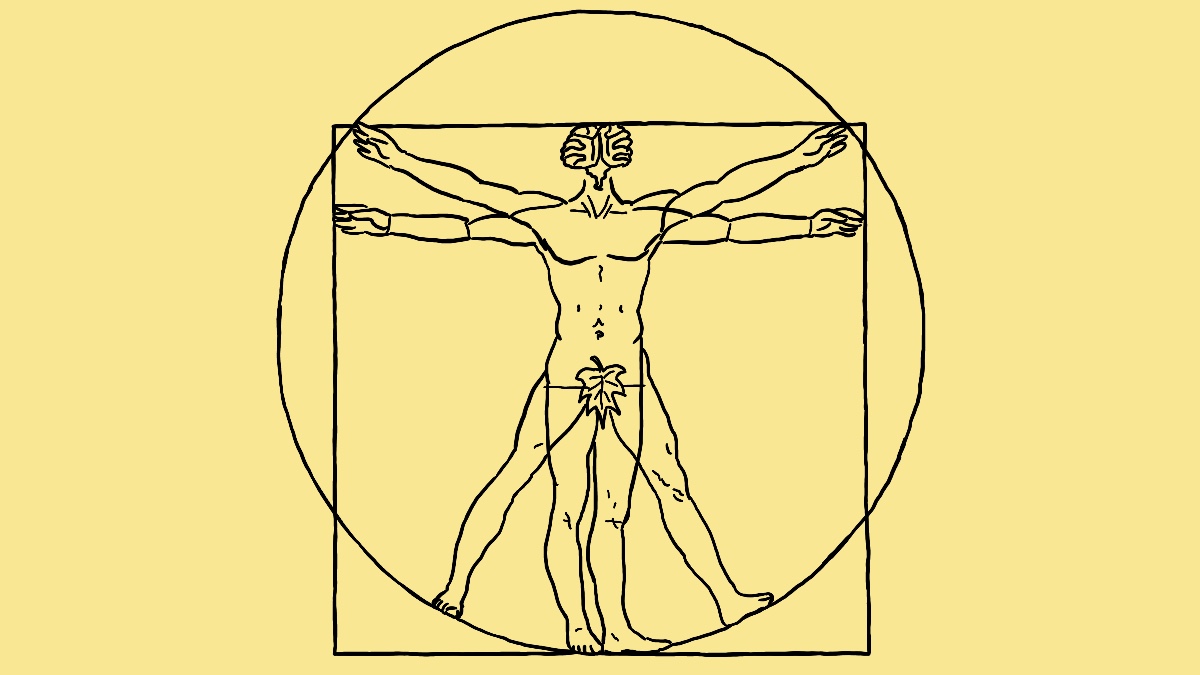
Scientific responses to this question tend to be physiological in nature (unsurprisingly) – we are the molecules that make up our body. Specifically however, scientists/philosophers might respond (I am thinking of people like Harris, Dennet, Pinker and the like), ‘we are our brains’. As neurons fire, memories are recalled or made, emotions are felt, actions are taken. Some look at this and say the brain is synonymous with the mind (even the person). Proponents of this view are working from a philosophical standpoint of scientism, generally speaking – which is a reductionist framework. One might say that if we can describe and explain everything to do with the ‘what’ of the brain, then we have come to the end of the grey matter regarding what a person is – it’s just that black and white.

However, when it comes to questions of personhood, we must deal with a greater scope of information and data than what science alone can interpret, while certainly taking on board all that science can illuminate. The question of personhood needs a variety of disciplines collaborating together to give a robust explanation. Sociology, philosophy, science, and theology are all involved.

For example: our jobs play a role in who we are as people, our relationships to other people play a role, as does our influence and status in society, our physical bodies dictate part of who we are, our view of who God is and therefore who we are to God (or not) plays a role (I’d argue, it is the key to unlocking the rest), our lived experience and history as a person says something about who we are.

So it is that in our search for who we are, we might be misled if our brain finds its ultimate refuge in itself. But it’s worth being aware of this stance because it’s not necessarily an uncommon one.

I think that part of the reason behind the uptake of such a view is our reliance on modern medicine. We are asking science such weighty and burdensome questions about personhood because as a society one of our prized values is our health. As science comes to solve problems that have plagued the human condition, it slowly but steadily gets a reputation for itself – ‘is there nothing that science can’t solve?’

Linked to this sentiment, we then habitually ask science to define the person (something very important to us). But it may not be such a healthy place to look for answers (if it is the only place we look for answers).

So what are you as a person? Are you just your brain? I think you know that you are more than that (or if you don’t ‘know’, you feel that you are more than that). Even as you ponder what you are, what is doing the pondering? The mind, the conscience… Is that you? Of course it is. It seems that the most complex component of all life – the physical entity of the brain – is unable to capture and sum up all the complexity of what a person is. To reduce ourselves down to the materials and mechanisms of the brain is an ironic way of dealing with the most complex organic organism known to mankind.

For me, the ever persistent presence of the mind, the first person experience, the intangible essence of a person, is one of the undeniable realities of a life that is not reducible to the material. When the arguments of scientism and materialism want to reduce you down to molecules, the conundrum of the mind fights back. Ultimately (although it is premature to discuss it now) it allows for an explanation beyond the physical. We venture into the spiritual, the transcendent, might we even say the mind after which all minds are made, God.


Sharon Dirckx. (2019). Am I just my brain? The Good Book Company.

Wisdom in God’s Ways

Good living looks good. When you see successful living, you want to know how they do it don’t you?

There is a passage in the Bible recording Moses’ words to his people just before they enter into the Promised Land, very near the inception of their nationhood. It reads,

“See, I have taught you decrees and laws as the LORD my God commanded me, so that you may follow them in the land you are entering to take possession of it. Observe them carefully, for this will show your wisdom and understanding to the nations, who will hear about all these decrees and say, “Surely this great nation is a wise and understanding people.” What other nation is so great as to have their gods near them the way the LORD our God is near us whenever we pray to him? And what other nation is so great as to have such righteous decrees and laws as this body of laws I am setting before you today?” (Deut. 4:5–8)

In many ways this passage is alien to our ears. First of all, we are not Israel. Specifically, as God’s people, we are not a nation. Christians are brought together from many nations and united through Christ, not land. We inherit the promises of God in Jesus, which are spiritual blessings and not necessarily physical blessings. Also, the “nearness” of God is again more spiritual (through his Holy Spirit indwelling us) as opposed to the tangible pillar of cloud and fire.

Those differences aside, the underlying principle of this passage is still very true in our day and age. The word of God, particularly the ways of God for his people as expounded in his word, brings wisdom – is wisdom. There is a success to life when living in accord to the way we were made to live.

However, this acknowledgement of God’s ways as wise is not always the case. In our secular age where multiculturalism is one of the principles for our democracy, the ways of God (according to the Bible) is just one way among many equally viable alternatives. To measure these alternatives and determine their relative merit for a society undercuts the principle of multiculturalism (for surely the wisest way of living ought to be the way the laws of the land guide us – and one can’t be better than the other in our system, just… different).

On a related note (and pardon me for contradicting myself, but our society is itself a contradiction on this matter), our secular age is in fact built on the foundations of the Christian ethic. So it just so happens that our society is living (to a degree) according to the wisdom of God but they do not even realise it. Such arguments are made by the likes of Tom Holland in ‘Dominion’. But remember we are not a ‘Christian nation’ necessarily because God’s people are not a nation. So it’s not as if ‘Christian West’ outshines Buddhist, Communist, Atheist, Socialist East. Although the Christian ethic that underpins western society does outshine its counterparts in other countries. I think there are many who can see this and maybe many more who see and don’t speak of it (because that’s not in accord with our modern propriety).

So in a sense, this Bible passage has been fulfilled in front of our very eyes. Society has so imbibed the Christian ethic that they think it is foundational to reality (which in God’s wisdom is true). But at the same time it is slowly drifting away. In light of this drift, there is an opportunity for Christians to live according to their Christian convictions and in so doing they will look very different to the society around them. To some this will be the aroma of death in a sense. But to others, it will be a testimony to the wisdom of God’s ways.

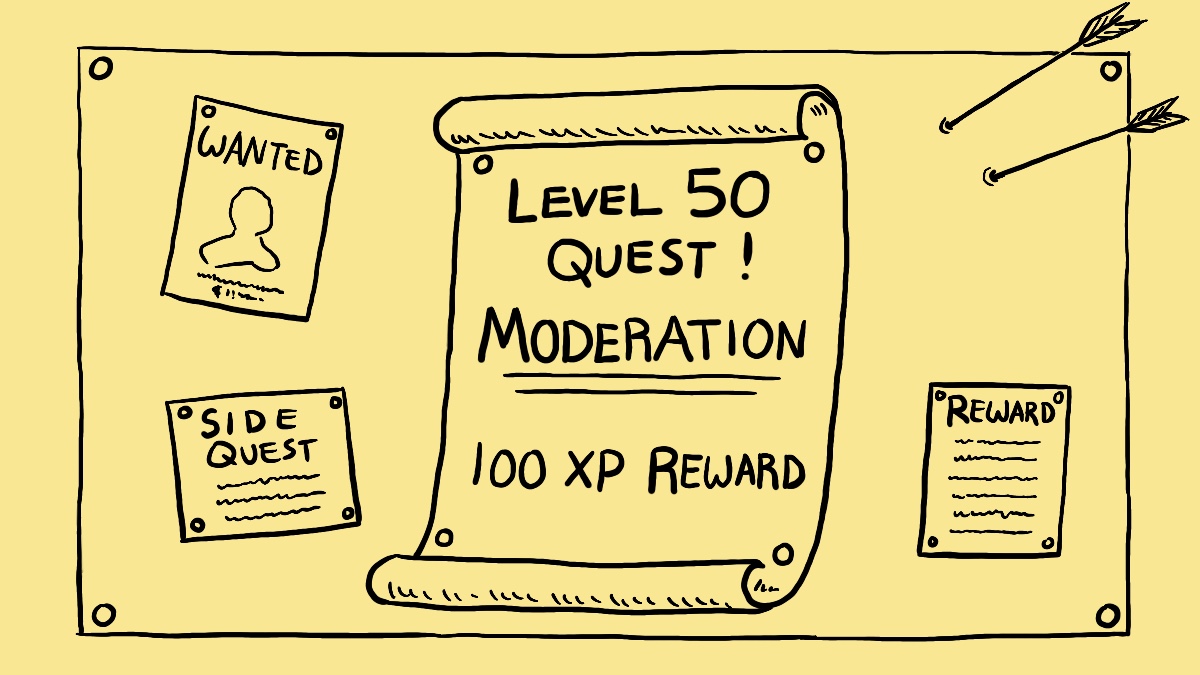
Video Games – The Level 50 Quest for Moderation.

In the last two posts, we have thought about video games and how they are not (strictly speaking) inherently wrong as a medium – they can be a joy and a pleasure as we explore the mind’s creations come to virtual life.

But hopefully we all know video games are also a bane on the human condition because they magnify the human condition – they can bring out some pretty ugly things stored within us. Our chasing after pleasure finds a never-ending pit in the video game world. Games are designed with addictive elements at the very foundations. Screen time and hours played are the metrics of success in the market of gaming.

So although I’ve argued that there is no inherent issue with the medium (much like books, movies, TV, and social media) the medium is still the vector for a vast array of unhelpful content. There is a certain kind of formula used by video game designers; small incremental rewards to keep you engaged as you progress step by step, little deposits of potentially special loot to give a sense of luck and the thrill of gambling mixed in, grinding missions that are pointless but essential to attain the required weapon to proceed (or make it easier to). These are some pretty standard engagement methods.

Moderation is the friend of the gamer. But as we can see, moderation is the enemy of the creator. That’s not to say there are no real gems on the video game market. Games driven by a sense of story and adventure, with profound messages and creative designs or problems that can exhilarate at times do exist. But it is much more akin to a ‘needle in a haystack’ situation than otherwise. So even when we as a gamer want to engage responsibly with the medium, the odds are stacked against us. We would be naïve to think otherwise. In the modern climate of media consumption there is a sense of honour at the hours we sink into consuming media, which I would say is particularly the case in video gaming (this shows up in reviews and is one of the first metrics you will see on your console or gaming client).

In the end, although I have stated in the two prior posts that there is not necessarily anything wrong with the medium of video games (again, strictly speaking), I’m also not going to endorse them because of the amount of power that video games can hold over the mind and body. Even though there is nothing inherent in the medium that makes it wrong, the current culture of video gaming is worth warning against. I think it’s too easy to say that moderation is the answer. Although moderation is the answer, that answer is rather quixotic. Like saying peace is the answer to war.

In my opinion, it takes great wisdom, willpower and discipline to engage in video games. I also think that there are few of us who play video games who have the necessary wisdom, willpower and discipline to do so well.

This leads me to one other thought: if the medium of video games is not inherently wrong yet it’s worth warning against the consumption of video games, how do we talk/advise/counsel each other about video games? We love giving black-and-white answers to each other, or black-and-white opinions, but in the case of video games I think it’s hard to state a black-and-white stance. To give one side without the other is to misrepresent either side. Often video gamers are on the defensive without taking seriously the issues presented by video gaming. On the other side, those who condemn video games do so from a place that leaves them open to hypocrisy or legalism.

I’m not sure what the middle ground is. I’d say moderation, but as I’ve said already, moderation in the current media environment is elusive and even burdensome to chase. I might suggest that one disengage from video games as a general rule, but that might verge upon legalistic.

Really, much prayer is needed. Accountability is needed, self-reflection and honesty. But what is also needed is for the videogame market to reform. But you can’t change the world. Worldliness will always exist on this side of heaven (the good and the bad of it). But hopefully this post helps us think about how we engage with each other and with this particular kind of worldliness, with wisdom.

Video games and Escapism.

Is ‘escapism’ a fictional charge against video games?

It certainly is a charge raised against video games. That they are an escape into unreality, an active attempt to run away from the real and lived experience of the world. Perhaps you’ve heard it said or said yourself, “nothing but fantasy worlds”. So is the exploration of a fantasy world, engagement in the fictional and unreal programming of video games, an unhelpful escape from the world?

I think this depends on the motivation behind escapism. Thus it would come down to the particular case. Are we seeking an escape from reality because we don’t want to face it, because we think there is something better than reality, or because we are unknowingly deceived about reality? Those are problematic motivations for escapism.

However, escapism into another world can be more about enjoying a thought experiment, an experience of immersion and exploration, even a break for the mind from serious matters in the world – like a rest.

This kind of escapism is also not a denial of reality and can ironically be a great experience of reality in a sense. For the experience of escapism, or exploring fictional ideas in games, is a real experience anyone can have. But this comes with other issues. To trip on LSD is an actual experience but what you experience in the hallucinations are not themselves real no matter how real the experience of drug-induced hallucinations feel. We might say the physiological event of a hallucination is real, however, the content of the hallucination is not real. We might say it is the real experience of encountering the unreal.

So it is that engaging in the fantasy world of games is a real experience of the unreal. In this regard, I don’t think escapism holds up as an argument against video games necessarily. There is a joy in being spellbound as you are taken on a cerebral journey without ever journeying from the spot you are in, similar to a book of fiction, a movie, or a story told by another. In the exploration of imagination, there can be a wonder and awe of the God-given mind and its intangible creations.

Like most good things, the problem is in excessive escapism. Most people who take issue with video games apply a blanket criticism to the outcomes of excessive and ungodly actions. I am sympathetic to this because you need a broad canvas to capture the many many millions who are enthralled with the products of this medium. For this reason, it’s hard to see the medium as separate from the outcome. I might even have double standards. I don’t like social media for all the negative consequences, but those consequences are not essential to the medium. We are certainly responsible for our actions in this field as much as in video games.

But much like the last post, the indulgence in excessive escapism afforded through video games is like an explosive display of the human condition as opposed to the cause of the human condition.

Why is it millions seek to drown out the reality of the world in endless fantasy exploration that purposefully leads nowhere? Could it be that we are seeking to escape this world because we know there is truly something terrible about this world?

We endlessly fight make-believe battles on screen because there are real battles to be fought in the world which we feel powerless over, but desperately want justice. The stories are often also good vs bad, light vs dark. More than that though, we seek endless progression and enjoyment because there is true beauty we are seeking in the world.

Our desire to escape might very well point to a problem deeper within ourselves and a beauty beyond our grasp.

The world is broken, we want to escape. We are broken, we want to escape. There is beauty we wish to see and enjoyment we long for that the world provides in drips and drabs, we wish to attain the sublime beyond the tangible.

What we are really longing for is God’s redemption – an escape from the brokenness of the world – and an experience of his beauty, the enjoyment of the sublime. In a sense, video games and the escapism they provide is just another taste of the true experience we seek. At its best, it is a medium of art which is just another expression of our chase for God. 

Video games – Asking the Right Questions.

If I could, would I simply stop playing games altogether? This direct line of interrogation stirs up my innards. It feels like it gets right to the heart of the matter because it evinces a visceral response. But actually it doesn’t illuminate much. It’s too simplistic a question. You see,the question you ask determines (in part) the kind of answer you will get. So perhaps I’m asking myself the wrong questions. Like asking, are video games good or bad?

We often want to put things in 1 of 2 boxes, good or bad. Fat, bad. Sugar, bad. Vitamin C, good. But for those of us who have spent just a little time looking at these components in consumables, we know it’s not so simple. There are bad Fats and there are good fats (or better fats), there are good sugars, sugars from fruit for example. And Vitamin C, well, too much and you get diarrhoea. So unless you think that’s a good idea then perhaps our boxes are not doing a great job of containing the distinctions.

But I love boxing things.

Video games. Good or bad? Wrong question I think. So what is the right question(s) to ask of video games? Let’s consider some and see what kind of question(s) we arrive at.

To start, ‘Is the medium of video gaming inherently bad?”

This question is looking broadly at the medium and asking if there are intrinsic qualities to the medium that are worthy of disapprobation. Without a doubt, people have said ‘yes’ to this. Lots of people take issue with the medium of video games, applying wholesale disapproval. This occurs generally for one of two reasons. Firstly, it’s viewed as a waste of time. Secondly, it is seen as a promotion of reprehensible content (especially violence).

The latter argument has some validity to it. However it is addressing the content and not the medium itself. This fuddle between medium and message is a classic muddle. If the message is a promotion of unethical glorified criminality delivered through the medium of interactive programed pixels, then take offense at the right aspect of the problem – the message. The medium is not responsible for producing the message. The same promotion of unethical glorified criminality may be delivered through a TV show, or through a book. Nothing inherently wrong with books or TV shows. Likewise, I think there is not an inherent issue with the medium of games.

How about the former issue, time wasting? Again, in my experience, people have used the ‘time waste’ argument but then straight away have promoted ‘alternatives’ or even unknowingly admitted to watching excessive TV.  The ‘waste of time’ argument can backfire in this way because anyone can waste time doing just about anything. To some folding origami could be seen as a waste of time, play sport can be seen as a waste of time, reading, TV, cooking. You get the picture. We all have leisure activities that to someone else who does not share the same interest will appear as a waste of time.

But… in both argument above, there is also truth. Through the medium of video games there has been a lot of content that is questionable, we might call it ‘bad art.’ Again, through the medium of video games, many have truly wasted time. Here technology and the market have come together in such a way that they are able to create the perfect storm that sucks you in to a gore filled, sex filled, addictive time drain. This does not have to be the case but it nevertheless is more often true than not (in my opinion). So is there something to the medium of video games that’s inherently bad after all?

Still, No. I think video games are just really good at bringing out the worst in us. People have to create and program those games filled with terrible art that’s purposely addictive (time-wasting). Yet these content creators and designers are also doing so because the market demands it (us). That’s how it works. I’d be very surprised if in heaven we are playing GTA 5. We made that here on earth and we pay good money to play it. So video games can easily bring out the evil stored up in us.

Then what questions should we ask of video games? Is the problem with the medium? No the problem is not inherent to the medium. Then we asked is the message (the content of the medium) the problem? Yes, the content is what determines a good game from a bad game. But we went one step further and looked at the one engaging with the game. How are we the problem?

I think we ought to assess the value of a game on an individual basis, much the same way we approach movies and books. There are good movies and good books, and terrible movies and terrible books. Same with video games.

But we should also go a little further in asking the right question of ourselves. Does this video game bring out the worst in me, or the bad side of me?

These are much better questions to ask of the medium, the content and ourselves.

Growing in Faith in the Pentecostal Church. Part 2.

In part one of my journey in the pentecostal church I told the story of my conversion in the pentecostal denomination. There was a battle between Catholics and Pentecostals over the affections of my heart, there were strobe lights and deadly perilous youth games, there were the typically un-typical Pentecostal spiritual experiences, and there was Bible and prayer. Anyways that was part one. (Check it out here)

What I wanted to write about in this blog post was how I grew in the faith in the following years.

As I mentioned earlier, I had become a Christian through the pentecostal church at my home town. But my conversion to the faith also occurred during my first year at university, and the university itself was in a different town. So in a sense my life was split to some degree by my degree. I had my pentecostal church at home which I would attend on the weekend and I had my evangelical group in my university home which I would attend through the week.

So what was it like to attend both at effectively the same time?

First of all, I didn’t know anything different. This was how it all started and so it was that I didn’t immediately grasp the difference between the two. What I mean by this is that aside from the very obvious differences in style and presentation, I wasn’t particularly aware of the differences in theology or their degrees of significance.

In fact, during the car trips (in my 1980’s hand-me-down V6 Holden Commodore) between the two towns I would listen (with the help of a radio transmitter contraption) to both the Bethel Church Sermon of the week, and John Piper’s sermon of the week, to Brian Houston then Mark Driscoll, to Steve Furtick then Tim Keller. Now if you don’t know the difference between each of these people, then you need to know there is a difference between each of these people. Which again, is not something I immediately grasped.

Over time however, I found myself drawn to the substance of the reformed crew. There was a certain kind of compelling logic that gripped my mind. But when I say, “over time”, I mean over at least a couple of years. So over a couple of years, I would make a two-hour car trip just about every weekend (not to mention all the different trips in between, such as going to work in another town), and in these car trips I would be listening to this diametric selection of preachers. There was a great deal of content being consumed which meant I was learning a good deal during that time (which is typically the case for a new Christian). I mention this in order to give a sense of how much content I was consuming, because eventually when I found myself drawn more to the reformed crew, it certainly wasn’t for lack of engagement and consideration of the pentecostal crew’s content. It was the ideas themselves that won me over and I genuinely became persuaded of the reformed evangelical framework. These preachers and teachers had a depth to their preaching, it was exegetical, the whole counsel of scripture was on the table, it was deeply coherent philosophically, and there was a variety of pastoral concerns – the word of God was shown to apply to every part of my life in many different ways. But at this point let me provide a caveat, there’s no reason the Pentecostal crew couldn’t achieve all these aforementioned qualities. I’m just saying it wasn’t my experience. I think my experience says something about the Pentecostal framework, or ‘vibe’. Even though it’s a generalisation, I think it is fair to say they will not produce teachings of the same calibre. That’s because they’re using a different framework that produces a different kind of teaching. In my opinion, I was listening to some of the most popular and important preachers from the pentecostal church.

In the end, I favoured listening to the reformed evangelical preachers for all those reasons listed above. As you might have assumed, this profoundly shaped my theology.

Did I stop going to my pentecostal church at home? Absolutely not! I was still a young christian at this stage. So although my thinking was very much reformed I nevertheless held to some of the more typical points of Pentecostal theology (notions about the Holy Spirit, tongues, prophecy, etc.). Yet at the same time, I had the inkling that Pentecostals and reformed Christians didn’t necessarily get along too well. Not that I ever really saw this in action. I just had some Pentecostal friends who wouldn’t attend the reformed evangelical AFES Uni group which I attended. And I believe it was because of differences regarding prophecy and maybe some other things like that. I’m very sympathetic to these differences. Having been in both traditions, to the members of either tradition, the practices of your church are important (I might even now say, worth disagreeing over). I, however, didn’t feel the pinch quite as hard as others. I had good friends in the reformed uni group and in the Pentecostal circles – still do!

There was also a lot of intentional discipleship from the AFES uni crew: a mid-week meeting, one-to-one meetings with friends who discipled me, one-to-one meeting with the head of the AFES group as well – I asked a lot of questions and I had a lot of questions asked of me, many challenges were put to me, I was thrown into walk-up evangelism, more to watch than to do at this stage. All generally good. Probably the only difficult time I had that I particularly remember was when one bro tried to read Deuteronomy with me. I thought it was so boring. I just couldn’t quite track with it all. I’m glad I no longer think that way.

When I finished university or was coming to the end of university I had to decide what kind of church to go to. What kind of church do you think I went to?

Well, I attended my local pentecostal church. Steve and Sherryl were my pastors. My very dear friend Nathaniel ran the youth group and I would occasionally help out. There were nights of prayer and praise and wonderful fellowship together.

Eventually I had to move town for work. What kind of church do you think I decided to go to then?

I attended my local pentecostal church. Greg and Tina were my Pastors. It was hip and happening. The walls were dark. The lights turned down. The music was pumping and the people were of a variety of ages and ethnicities (which was rather special in a rural city I thought). Not typically all young, although there was certainly that demographic. But I attended both the young adults Bible study and also a Bible study in which I was the youngest member by a couple of decades! I attended this church for about a year and I gotta say it was a pretty mixed bag on reflection. It was the classic kind of Pentecostal vibe I became a Christian in. Lots of music. Topical sermons (one was even on hell! Which is notable if you know what I mean). Big flashy building. Lots of prayer meetings. As part of this church I managed to be involved in some outreach as a ‘Red Frog’ at the university campus. Which also got me connected to the university ministry there (run by an AFES worker. But I couldn’t attend that very often unfortunately). I also met up one-to-one with a number of people which was good.

But memorably and sadly, I gotta say there were a couple of times when the teaching was not right in the least. And somehow they both managed to be on the book of Jonah! I don’t think that the minister necessarily screened what was being taught before it was being taught. Occasionally the minister would invite people to come and preach, whether from within or without the church (as a guest). But there were some moments that were definitely below par. Sometimes the preachers would start with, ‘I prepared something to teach on today… But the Holy Spirit spoke to me and told me to preach on something else just this morning.’ Another time it was from someone who seemed to be respected by the senior minister. So it was a bit of a contradiction. The senior minister was himself a decent preacher and I thought he was solid (generally speaking). But then at other times under his authority he would let other people say things that were in error. I’ve seen this sort of pattern in other churches as well, big notable churches. For example there have been times that Hillsong have endorsed preachers that they ought not to have endorsed. Although Hillsong themselves, at least certain key individuals, haven’t necessarily made the same errors (at least not regularly in my understanding).

By this stage I was dating my now wife. And while I travelled up to Sydney I would visit an evangelical church (Urban Grace). I thought the teaching at Urban Grace was absolutely solid. It was the kind of nuanced and gritty teaching I’d heard so many times in the podcasts. But by this stage I wasn’t prepared to leave my old church, the pentecostal church. Rather I committed to the pentecostal church all the way through till my marriage.

Then I spent four years at Moore College…

On Pandemic Prayers

Over the last while I’ve heard prayer requests from people around me for the Covid-19 pandemic to end. 

This reminds me of other prayer requests I have heard from both adults and children for God to protect us from bad things. 

I was reflecting on this. So often we want God to take our troubles away. To end the pain. To deliver us from evil. And I want to affirm that it is good and right for us to ask him to do this – after all, there is firm biblical precedent for this – many psalms call out to the Lord to save us, to deliver us from evil people or bad things (eg, Psalm 54:1-2, 59:1, 64:1, 69:1, 70:1, 71:2, etc.). There is even a line in the very prayer that our Lord Jesus taught us to pray, ‘deliver us from evil’ (Matthew 6:13). And the Lord delights to answer our prayers and save and deliver his people from all kinds of trials. 

However, this is not the complete picture. Because the Bible also richly describes the place of suffering in the life of believers – suffering which involves the Lord allowing us at times to be impacted by evil people and bad things – like a pandemic. Just this morning I was reading Revelation 7:9-17, where in v14 it is revealed that the great multitude in white robes who stand before God are the ones who have come out of the ‘great tribulation’. Whatever the ‘great tribulation’ is, it doesn’t sound like a life unaffected by suffering – in fact, quite the reverse. In fitting with this, Hebrews 11:35-39 lists a whole lot of painful things that various people of God have suffered because of their faith, and multiple apostles write about the place of suffering in our spiritual formation – e.g, see Paul in Romans 5:3-5, James in James 1:2-4, and Peter in 1 Peter 1:6-7.

So I could just pray for God to end the Covid-19 pandemic, but it seems apparent that there is a good and right place for hardship in the Christian life. 

So, how do I communicate to people around me that it is both good and right to ask God for protection from bad things, but that if they still come it does not mean that he hasn’t heard us, or that he doesn’t exist, or that he doesn’t care about us? 

I am reminded of another passage, in Daniel 3:17-18, where Shadrach, Meshach and Abednego are before king Nebuchadnezzar, and are being threatened with being thrown into the blazing furnace if they don’t worship the king’s statue. In their defence, they both affirm that God is able to save them from the furnace and will save them from Nebuchadnezzar’s hand, but also affirm that, ‘even if he does not…’ they would not serve the king’s gods. This response both affirms God’s ability to act in this world to protect his people, and that he will ultimately save us (which, as Christians, we know he will do when Jesus returns), but also expresses that God is free to do otherwise – his power and his faithfulness are not undermined by him not always acting in line with our requests. We are called to worship him alone regardless of how he answers our prayers. And in fact, as we have seen elsewhere in Scripture, he may have very good reasons to let us suffer for a time (see the list of apostolic passages above).

So, when confronted with requests like our starting one, I do two things. On the one hand, I do indeed pray for God to end the pandemic. However, I also want to affirm that God greater and wiser than us, and that even if he doesn’t, I know he is good and faithful, and I pray he would give us strength to endure whatever hardship we are facing, and for God to grow us in our character and our trust of him through this time. 

A Therapeutic or a Moral World.

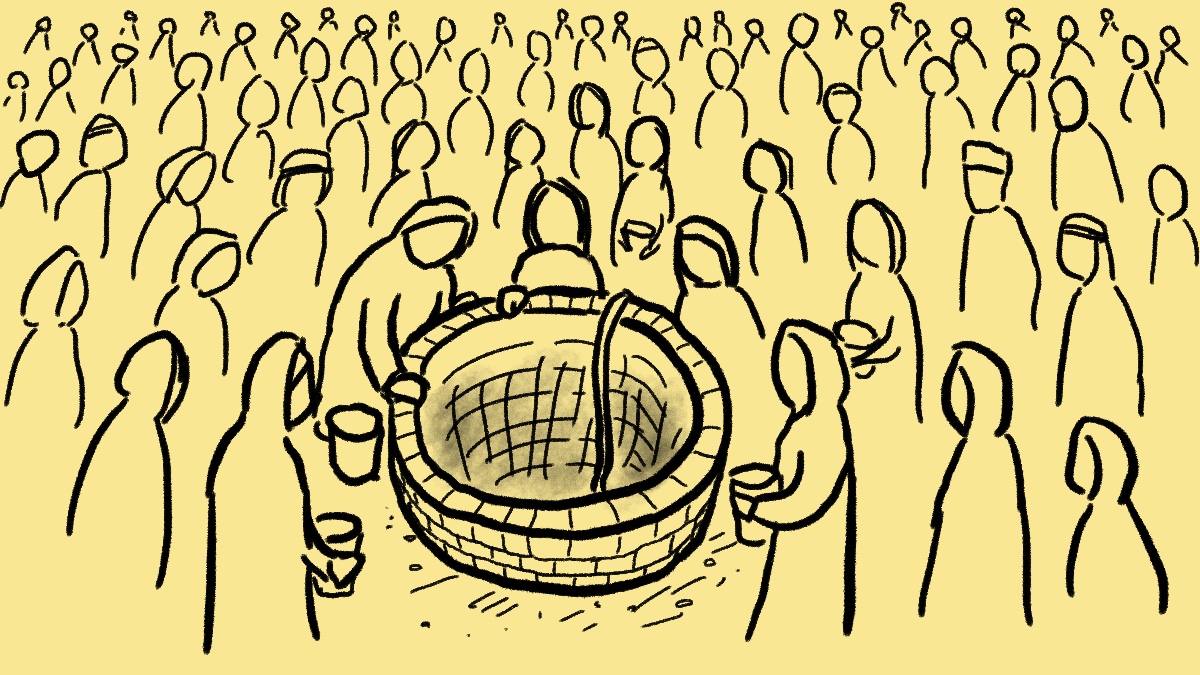
We find what we look for. In many ways, big and small, this is true. We are looking to convince someone of the truth about lollies, they give us bouts of energy and help us complete those pressing tasks. Of this, I am completely convinced. But likewise, it happens on bigger and grander scales too. A whole people can be looking for water from a well, convinced the well has water because after all, they are all there trying to get water from it. It would be rather silly if the well had no water. After all, look how many millions of people are here at the well!

So it is in our world. Our worldview is a self-propagating one. We live in a psychologised and therapeutic world. Chasing happiness is the name of the game. Unfortunately, it’s one of those new kinds of games that technically doesn’t have an ending. It’s just a good ride.

As has been well documented and talked about in many different places, we are peoples who are suffering from a cacophony of distractions, a multitude of choices, a growing collection of un-assimilated knowledge and a proportionally growing weight of the burdensome responsibility towards it all. One particularly is the burden of happiness. We hear of pleasures, we must seek them. We hear of injustices, we must right them (and feel good doing so). We hear of new opinions and positions, we must adjudicate them (which is really fun, thrilling almost). All this, done in a bid to find some happiness: to feel good for stomping on injustice, feel good for experiencing the thrill of some chase, feel good informing the ignorant of the views they should hold. There is a lot to do to feel good. Many buckets to fill. It’s a job to fill them, isn’t it? Luckily, God is on our side right? He helps us fill the buckets of happiness we need filled up. And there are lots, even for God to do. Where did all these buckets come from? No idea, I just put them out here to fill up. Just doing my job here pouring water into them. Help me out will you God!  The sun is out today and it’s evaporating as I pour all this good stuff in.

David Wells makes this point about our happy-hunting culture,

 “[Our culture] shapes the way we see things, what we see, and what importance all of it has to us. It allows us our own private reality because it inclines us to live only within ourselves and to see all of reality from behind this peephole. We see everything from the position of the self with its senses and aches and needs. This shapes everything else. In this psychological world, the God of love is a God of love precisely and only because he offers us inward balm. Empty, distracted, meandering, and dissatisfied, we come to him for help. Fill us, we ask, with a sense of completeness! Fill our emptiness! Give us a sense of direction amid the mass of competing ways and voices in the modem world! Fill the aching emptiness within! This is how many in the church today, especially in the evangelical church, are thinking. It is how they are praying. They are yearning for something more real within themselves than what they currently have…” (p.126)

This is a pretty astute comment. It cuts me somewhere inside. Perhaps the work of the Spirit within… The culture around me is very much like this. It tells me to look for happiness wherever I can find it. And I also happen to be a Christian living in this culture, so I have someone I go to when I have a problem, God. Except what I have done is I’ve taken my culturally produced felt need to God without considering necessarily if this is indeed the burden of God toward me in his word. This happens because of the subtlety of culture – it’s everywhere around us in the thought world (but paradoxically it’s also relentless at the same time, throwing its barrage at us). 

What’s the right way of viewing the world then? If the world is not there to provide for me a sense of contented happiness, what then? David wells continues,

“Those who live in this psychological world think differently from those who inhabit a moral world. In a psychological world, we want therapy; in a moral world, a world of right and wrong and good and evil, we want redemption. In a psychological world, we want to be happy. In a moral world, we want to be holy. In the one, we want to feel good, but in the other, we want to be good.” (p.126)

This is a shift of the mind that requires one to be born all over again, such is the difference in worldview. But that is the Christian experience. We are born into the moral world, the world made by the holy God of love. His character is imbibed by his creation. The presence of moral darkness and corruption introduced by his creation has tilted this world on its axis. Our man-made compasses led us astray but led us exactly where we wanted them to go. We sought after the blessings, not the one who blesses. But no longer. As Christians we know we live in a moral world ruled and governed by the holy and loving God. We confessed our moral failures and experienced his redemption. Now we too seek to image the one we are made after, the Lord Jesus. He is goodness. His presence is happiness to us.

In our broken therapeutic world, we will never stay long in the feel-good climate. The therapeutic world spins on its axis and we are taken to another season of discomfort or worse, all too soon. But in a moral world, we seek redemption through the death, resurrection and ascension of Jesus. Now in Him, we are as He has made us. We seek now, not to feel good, but to be good, no matter what darkness we find ourselves in through all the seasons.


Wells, D. F. (2014). God in the whirlwind: How the holy-love of God reorients our world.