In Howard Overman’s 2019 rendition of ‘War of the Worlds’ there is a very interesting scene that made me take note. A couple arrive at a military base looking for their son. They first of all find a woman who has lost her two kids. This woman asks the other mother, “Do you believe there is a God?” Of which her response is a very solemn and honest, “No.”
I really appreciated this scene. Generally speaking I really appreciate sci-fi because it enables us to work through different thought-experiments in such interesting ways. One of the most frequently used topics is ‘God and death.’ This scene is a classic example of that.
The mother of the dead children goes on, “Can I ask you to do something for me?” To which the couple promptly and enthusiastically reply, “Yes of course, anything.” The request, “Bury me with my children.” She is going to kill herself. “No! Don’t do this! Not like this!” Comes the couple’s pleas. “What would you do?” Asks the mother… their answer? They do not answer.
I said that I really appreciated this scene, but not because there is something new here. We’ve probably all seen this played out many times in many different shows and genres. Someone loses something of immense value. Then they lose their hope or purpose. So they ask, “Is there a God?” And as often as I have remembered the scene played out, the answer is, “No.”
I think this is a snapshot of humanity in the West (at least the intellectual currents of our time as popularised by media). If my opinion holds some truth, then that is a very damning snapshot. Those that shape the currents of our thinking can provide no answer in the face of the one thing that matters, death. That is because they reject the one answer to this insurmountable problem, God.
What is the outcome? In this scene of ‘War of the Worlds’ it is hopeless resignation for the bereaved mother, or, inconsistent stubborn persistence to live without any lasting purpose.
To reject God is a brutal self damnation.
Thanks Howard Overman for giving us a glimpse of that reality.
What does it mean for God to be a ‘rock of refuge’? If I trust God to be this, does that mean that he will prevent bad things from happening in my life?
This is a question that myself and a friend were recently discussing. Perhaps you might have wondered the same thing. The idea of God being a ‘refuge’ is a common one in the psalms. But how does it square with bad things still happening in our lives?
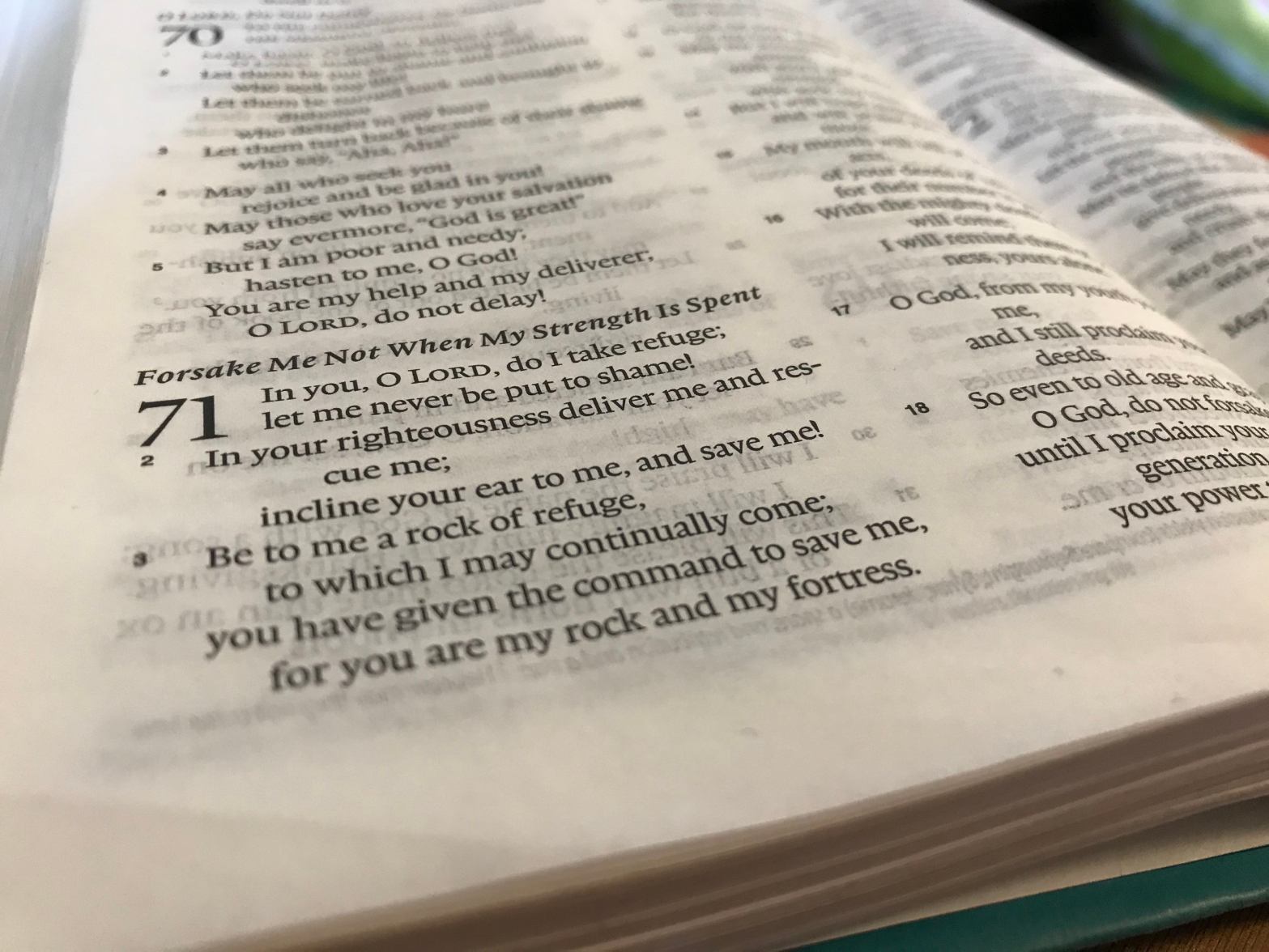
A couple of weeks earlier, I met up with another friend to read the Bible and this topic had also come up. Having been recently bereaved I was not in the headspace to decide what to read, and so she suggested that we read Psalm 71.
Something that I particularly appreciated about this psalm was how the psalmist both described God as a ‘rock of refuge’ and someone who was worthy of his trust, and yet he also acknowledged that God had brought ‘many troubles and calamities’ upon him.
From a biblical perspective then, for God to be a ‘rock of refuge’ is evidently compatible with bad things still happening in the lives of those who trust him.
To return to the conversation with the first friend I mentioned, we discussed our options.
For God to be a rock of refuge and for bad things still to happen in our lives meant that either…
1) Bad things wouldn’t happen if we trusted him (obviously not always true).
2) God was not trustworthy and would not look after us (not true in the experience of myself and my friend, and certainly not true in the testimony of the Bible).
3) We could trust that God would be faithful to his promises to work good through everything (Romans 8:28) and also that he would be with us and give us the comfort and strength to endure hardship (2 Corinthians 1:3-4; Romans 5:3-5; Hebrews 13:5-6).
As much as we may not like the idea that we won’t necessarily be always protected from bad things happening to us, something that came out in the conversation was how we can often forget that God is good and kind and merciful. And yet he has proved this again and again in our own lives. We both had gone through things that were quite difficult, and yet God had been with us and comforted us and helped us. In the case of my friend he had provided a way of escape from a bad situation. In my own case he brought me through the valley of the shadow of death and yet showered me with his love and mercy all the way – and brought much more good out of it than I could ever have imagined. As I reflect upon other hard times in my life God truly has been a rock of refuge in the sense that he has been a constant, unchanging source of help and comfort and strength. In his mercy he has also delivered me from many difficult things – and even shortened a recent trial that my husband and I had to endure.
It occurs to me that one can hypothetically picture all sorts of bad things happening in the future and ask, ‘how can God allow that?’ And yet forget that when God has actually brought such things about in our own lives he has also cared for us every step of the way through them.
As the psalmist writes,
“Your righteousness, O God, reaches the high heavens. You who have done great things, O God, who is like you? You who have made me see many troubles and calamities will revive me again; from the depths of the earth you will bring me up again. You will increase my greatness and comfort me again. I will also praise you with the harp for your faithfulness, O my God.” Psalm 71:19-22a
First of all, this is not a review. It’s more a reflection on the experience of reading the book itself. A book-reflection then? Probably not a good idea to redefine established formats just yet. Call it what you will, I read a book and now I’m thinking about it and sharing my thoughts with you. So what was that book? It was, “The Bible in Australia – a cultural history” by Meredith Lake.
I wanted to read this book for a little while now but hadn’t quite got round to buying it. The solution to this problem was my friend Tim. He simply told me to borrow the book from him, which meant I had no choice but to read it in order to get it back to him in a respectable and timely manner. This in itself is no small feat because the book was like a 350-page tome! (Perhaps that says more about my reading habits than anything else) But Tim’s actions forced my hand. I read the book. I loved the book. Let us begin our little journey on the book.
Many of you will have experienced the life-changing effects of reading the Bible. Consider that you are one person in time. Consider that the Bible has been around throughout the centuries. Think about how much the Bible has changed history, nations, communities and individuals. If that thought is enthralling, then you should read ‘the Bible in Australia’ because you will see the way that the Bible has shaped the Australian nation, its migrant communities, its indigenous communities, and certain people important to our collective history. It’s a mind-bending thought to consider that so many individuals’ lives would be shaped and changed by the Bible that each individual then shaped and changed their community which in turn shaped the nation through time. Meredith Lake’s book is like sitting on an inflatable bed with a beer as it floats down a river which is twisting and turning before your eyes and you are watching the riving shape the landscape around itself and around you (But sometimes you spill the beer because it’s a rough ride. History is like that).
There are so many stories to tell, and Meredith does a great job at it. As you read you’re really taken on a journey. I don’t know if you’ve driven through the countryside, or gone for a really long hike through the mountains, but the terrain changes so much in the Australian landscape even on one drive or hike. That’s what reading this book is like. You get a glimpse as you walk through the centuries at the different landscapes in the Australian history.
Personally, it’s not until these last few years that I’ve come to appreciate history. Yet it has taken some time still to appreciate my own history, that is, Australian history. The history of the Bible in Australia is not black and white. You’d be forgiven for thinking that it was. After all, tertiary institutions are doing a pretty poor job at providing a balanced education regarding certain topics. Which then of course leads to tertiary-educated journalists in the media writing pretty unbalanced depictions and assessments regarding those topics – of which the Bible is one such topic. This we all know because we experience it today – we can’t help that. That sort of naivety was what was shaping my understanding of Australian history. But the Bible’s history in Australia is a complex one. Coming to appreciate that is special and all the more because of my ignorance regarding its cultural power (here I am speaking as a Christian!). I’ve always known that the Bible has shaped Australian culture (because it shaped British culture immensely) but there is really something special to the intricacies woven into history.
Now I am pretty old, 28 years old in fact (well nearly… My birthday is in November) and so my perspective on life is obviously broad and sweeping, encompassing nearly three decades of experience! That’s huge! … Nah. It’s very easy for me to feel like my experience in life is a normative experience by which I measure and assess all other experiences and viewpoints through history. I’m not saying I want to do this, I’m just saying that’s what naturally happens and I must actively fight against this inclination of mine. A surprising tool to this end was reading this book. Let me just name a couple of examples that made me feel very small (helpfully) in the grand scheme of things.
It was fascinating to read about how Charles Darwin and his research was shaping the debates in the 1800s. The science verse faith debate is nothing new to our age (which sounds so obvious). But as they dealt with it then, so we continue to do so today. It’s a funny thing to realize (or even be reminded again) that many people before us have dealt with many of the same things that we deal with. Another example is liberalism. Around the same time as the science verses faith debate, German theologians were pumping out their critical theologies and histories of the Bible and unravelling many people’s faith. Again, this continues to be our experience or at least we feel the hangover of these debates. All that to say, what we struggle with today can be remedied by the fact that we have been struggling with these topics for generations. Being so individualistic and disconnected from our own history is a lonely place to be and in a strange way reading ‘the Bible in Australia’ was like a weird antidote. At least that was my personal experience.
As a Christian, I primarily see my citizenship as a heavenly one. I think this is a good and right perspective. Yet sometimes this unhelpfully overshadows the fact that I am currently an Australian and have been all my life. It’s kind of weird having not known my own history for so long. But I’m very glad to have read the book because it does give me an appreciation of my Australian heritage. More importantly, it gives me a better perspective of my Christian heritage. And should you read the book, I hope that is your experience too.
It is a funny irony to be a Christian and to dislike history because to be a Christian requires faith in the historic claims of Jesus and his disciples. This ironic situation was a reality for the first few years of my Christian faith. As I went through high school I disliked history and I don’t think I was the only one. In my opinion and experience the topic of history was seldom discussed because its relevance was lost to us (except for one guy who really liked history. But we thought that was weird). Our modern values and our language show us that my little thought and experience is perhaps quite systemic. There is a trend to live for the moment, to be in the present. We use sayings like, “well that’s history”, or, “that’s all in the past now.” I think these little snippets of the zeitgeist are telling. As Christians we can certainly breathe it in, long and deep, drawn-out breaths, until our blood is infused with historic levels of ambivalence.
What is the answer to this problem? Well just like the answer to most of life’s problems is to eat more vegetables, such is the case in this instance. We must eat more history. And who knows (!) perhaps you’ll even come to like it.
First of all, the Christian faith is historical. It is centred on the historic person of Jesus. It relies upon the eyewitness accounts of his disciples, what they saw and heard and even touched. Our faith is to be the same as their faith and the link between the two is a long line of history.
So what of this long line that connects us to the first disciples? Well that we call church history. Church history is not as important as the historic faith itself. Nevertheless, it is important. But it’s also particularly important in a time of revisionist history, in a time that is very sceptical of history, in a time that intentionally tries to cut itself off from the past to seek its independence – because we are not independent of our past. To be specific, the church is not independent of its past and we must recognise that. We ought to acknowledge the value of our history because our history is a history of faith, conviction, knowledge and discovery from which we can gain all the same from.
To that end let me share some quotes from some very early Christian writers and writings.
Clement of Alexandria (A.D. 150-215) wrote this in his letter to the Corinthians.
“Let us fix our thoughts on the blood of Christ and reflect how precious that blood is in God’s eyes, inasmuch as its outpouring for our salvation has opened the grace of repentance to all mankind.”
In reading these words we get a glimpse of the centrality of Jesus work at the cross for us and our salvation. As much as we say this is true for us now let us remember it has always been the case.
Again, Clement, encouraging the Corinthians in light of the sin of envy, says this,
“Take the noble figures of our own generation. Even the greatest and most virtuous pillars of our church were assailed by envy and jealousy, and had to keep up the struggle till death ended their days. Look at the good apostles. It was by sinful jealousy Peter was subjected to tribulation, not once or twice but many times; it was in that way that he bore his witness, ere he left for his well-earned place in glory. And Paul, because of jealousy and contention, has become the very type of endurance rewarded. He was in bonds seven times, he was exiled, he was stoned… In him we have one of the greatest of all examples of endurance.”
It is an interesting thought that Clement is talking about the apostles within recent history of their lives. I appreciate this little quote from his writings for that very reason.
Another interesting fella was Ignatius of Antioch (A.D 98-117). He was apparently the third Bishop of Antioch after St Peter according to Eusebius. Poor Ignatius (although he wouldn’t see this way) was martyred. His thoughts on martyrdom are quite intense and I think worth quoting just to get a sense of this man’s convictions. He writes to the Roman church,
“For my part, I am writing to all the churches and assuring them that I am truly in earnest about dying for God – if only you yourselves put no obstacles in the way. I must implore you to do me no such untimely kindness; pray leave me to be a meal for the beasts, for it is they who can provide my way to God. I am his wheat, ground fine by the lion’s teeth to be made purest bread for Christ. Better still, insight the creatures to become a Sepulchre for me; let them not leave the smallest scrap of my flesh so that I need not be a burden to anyone after I fall asleep… So intercede with Him for me, that by their instrumentality I may be made a sacrifice to God. However, I am not issuing orders to you as though I were a Peter or a Paul. They were apostles and I am a condemned criminal. They were free men and I am still a slave… For the present, these chains are schooling me to have done with earthly desires… No power, visible or invisible, must grudge me my coming to Jesus Christ. Fire, cross, beast fighting, hacking and quartering, splintering of bone and mangling of limb, even the pulverising of my entire body – let every horrid and diabolical torment come upon me provided only that I can win my way to Jesus Christ!”
What an intense character Ignatius must’ve been! Before we write him off for being insane, we must certainly appreciate his confidence in the Lord Jesus shown through his deep longing to be with him. Nevertheless, his example ought to be tempered in our minds. It’s not recommendable to pursue martyrdom! But his perspective is one we must learn from, “For the present, these chains are schooling me to have done with earthly desires.”
These are just little snippets from the vast array of early Christian writings available. Let me finish with a quote from the Epistle to Diognetus, a letter written around 120-200.
“To put it briefly, the relation of Christians to the world is that of a soul to the body. As the soul is diffused through every part of the body, so Christians through all the cities of the world.”
And we would do well to remember that Christians are also diffused throughout history shaping its course under the will of God to bring many into the kingdom by the power of the gospel, the gospel passed down through the ages themselves. This is the history that you are a part of.
I don’t know what most parents expect as they buy their child’s first bike. Perhaps many see it as a necessary step in growing up, a milestone in independence as they are enabled to travel further faster. Or it could simply be a toy that happens to give them genuinely important life skills. After all, you never forget how to ride a bike.
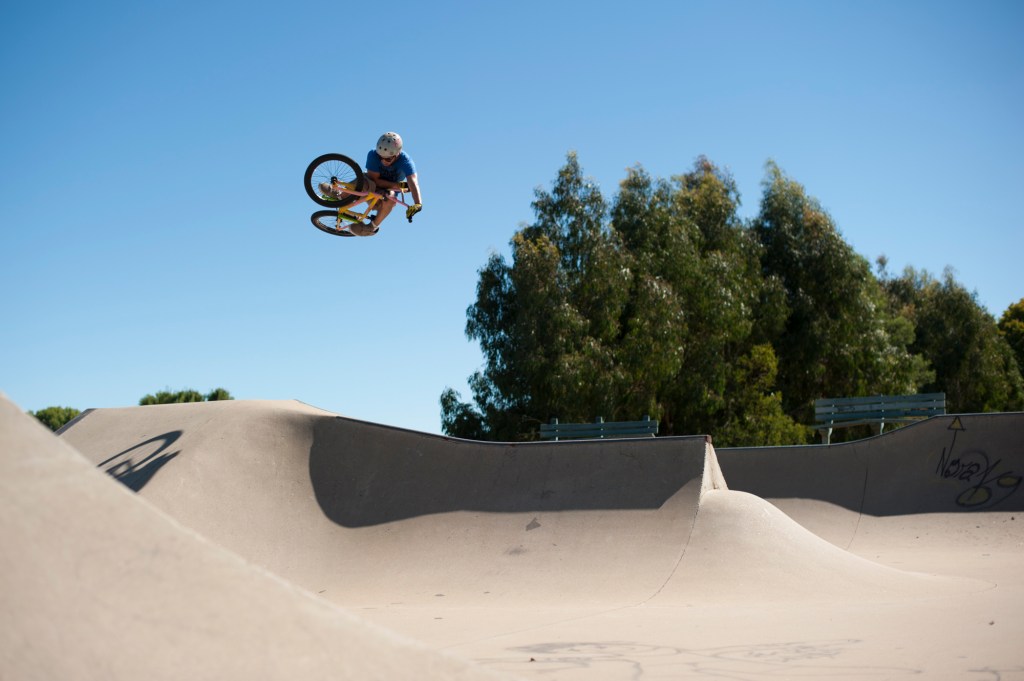
When my parents first bought my bike, I’m sure they didn’t expect it to become such an integral part of my life for the next 15 years to come. I’m also fairly confident they didn’t know it would cause them so much stress and anxiety for those 15 years. My bike did enable me to travel further faster. However it was not with both wheels planted on the ground firmly, but with wheels sailing through the air at greater and greater heights, lengthier and more precarious distances, and at speeds that promised pain if those 2 wheels didn’t meet the ground perfectly at the end. Yes, their son became a BMX rider.
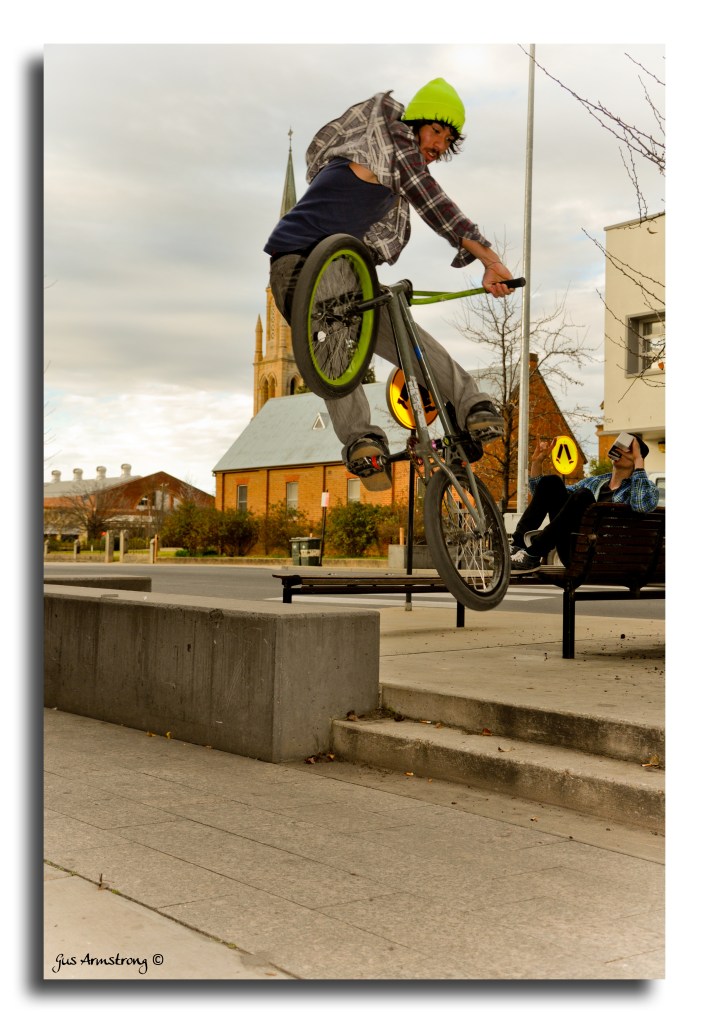
Fangin’ in the street (Mudgee). Photo: Gus Armstrong
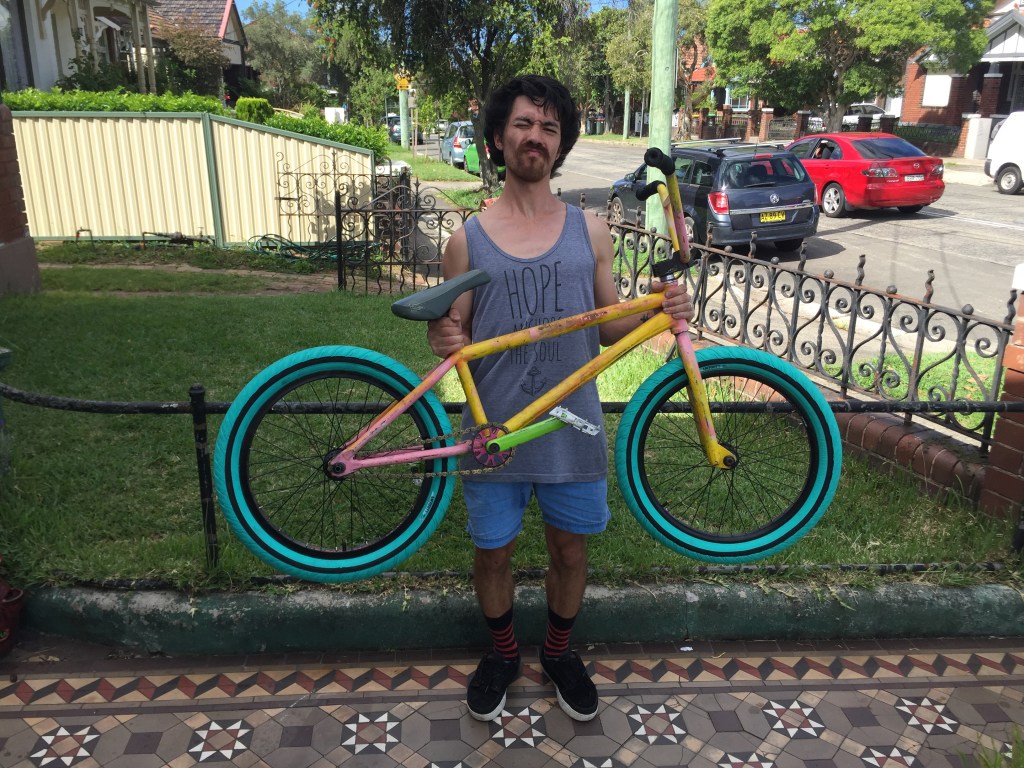
But earlier this year (2020) I sold my BMX. I’m getting older (28 is older in extreme sports terms), I don’t have as much time as I used to, and it’s taken a toll on my body. I sold it to a good dude who would put it to good use. Nevertheless, it was a very bitter experience selling my BMX bike. Seldom do I shed tears but that day I did. It was the first and only BMX bike I ever owned. I never bought a new one, I only ever replaced broken parts. In those 15 years, I’d hand-painted my bike and customised every part so it was a big deal to part with.
It felt like I’d really closed a chapter of my life and it prompted me to think about what those 15 or so years meant. What follows is simply my story and also my reflection.
My story
As I entered into the double digits of life I graduated from my tiny 16 inch Big W kid bike and started pedalling my yellow 20 inch Mongoose bike for the first time. It was heavier than I thought it would be and at first I found it hard to ride. But a little perseverance gets you a long way and competence soon followed. Bear in mind that by a little perseverance, I mean year upon year riding just about every day through high school.
I grew up in a town of about 5000 people which meant the resources for BMX were rather limited. The skate park was this tiny concrete pad with 7 or so metal ramps on it, none of which exceeded 2 m in height. All that to say, it was a perfect place to start. Just about every day my mates and I would go down there and push ourselves just beyond our limits. Then on the weekends we would branch out. I would go to the next town over, Mudgee, where they had a skate park equally as sketchy but it was bigger and made from concrete. If you know maths and physics, bigger ramps means bigger air (and also equally exponential pain upon failure).
But riding the skate park was not what I love to do most. I actually loved riding around town, riding around the streets and seeing what I could find. There was a particular kind of creativity that was required of you in this setting. The steep driveways became ramps. The public toilet wall was something to ride up. The library stairs and rail were to be cleared with a well-timed hop. Ledges became grind rails and street gutters were launch pads.
Throwing down a Turn-down (Milthorpe). Photo: Gus Armstrong
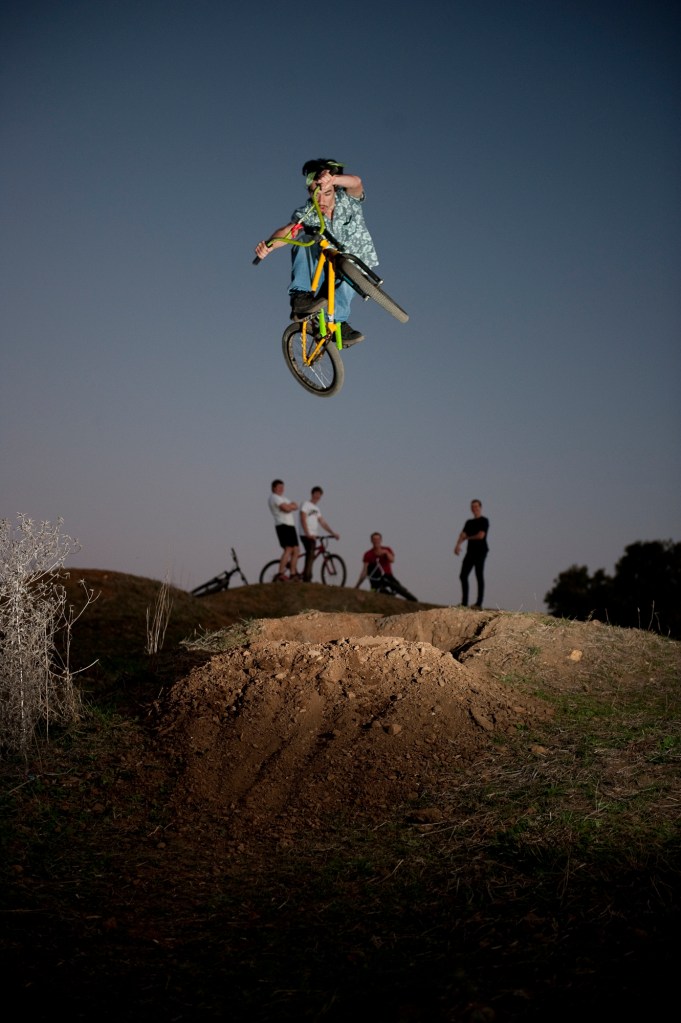
In one sense, this kind of creativity was pressed upon us as our skate park was quite small, which is okay because living in the country also provided me with other benefits. We had ample access to dirt, and as we all know, dirt is very mouldable and you don’t have to stop at 2 m high (especially when you have heavy machinery). I remember fondly how my friend would use an excavator to build dirt jumps in his paddock (which well exceeded 2 m!) It was an insane time while it lasted. I particularly recall (as it is seared into my mind) falling from a great height on 1 of those jumps and sliding down the haggard dirt on the other side on my legs and back. Although the wounds were superficial they were extensive. As I rode the 5 or more kilometres into town the wind would bite at my fresh wounds and it was unceasing. As I hobbled into my house, my mother was beside herself at my state. And although I dreaded the idea, I knew I had to have a shower and put water on these wounds… But it was all worth it of course. I don’t know why mum and dad couldn’t see that! Perhaps because they had to clean my bedsheets as my wounds would ooze freely… But I only speculate.
Fangin’ down a hill (Mudgee). Photo: Gus Armstrong
Eventually, in the last year of high school, the BMX crew would attain true freedom – P plates. And thus it was that we started road tripping (albeit, day trips) to other towns with bigger and better skate parks. We were also exposed to bigger and better BMX riders. At times that was intimidating because people at skate parks can be rough. Other times it was discouraging because they were so good and I wanted to be like them but couldn’t. But for the most part, it was great to see good riders because we were never exposed to many aside from the DVDs we bought at the newsagency.
Fangin’ on some concrete (Orange). Photo: Gus Armstrong
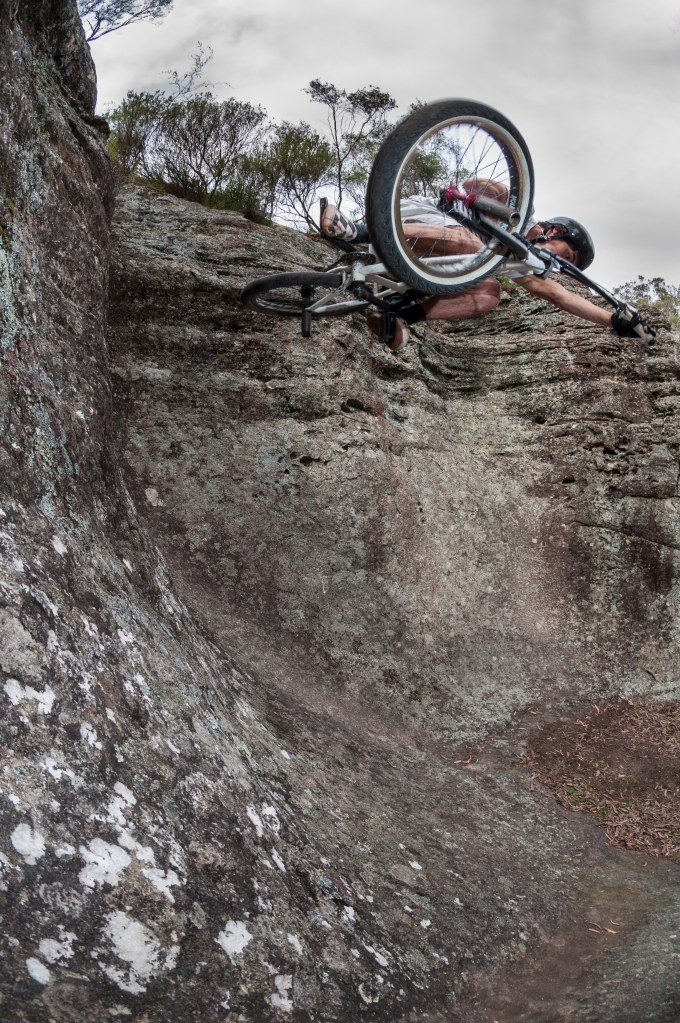
As high school ended so too did the continuous close contact with the crew become difficult. No longer could we ride at leisure whenever we wanted. But we had to make deliberate efforts to do so. And I’m so glad we did. Riding in the streets of Bathurst where I studied at university was some of the best riding I’ve ever done. I would consider myself at the peak of my abilities in those years. At one point I managed to make it into a BMX magazine called 2020. But it wasn’t a mere snap in the corner of the page, I surprisingly managed to be the “centrefold” as it were. I attribute that in no way representative of my skill but rather the lengths at which we would go for a good picture. We went out to a national park and rode on some of the rock formations that were around. It was an incredible time with old friends and especially so because we got such a good photo on the BMX.
Fangin’ up a rock (Dunn’s Swamp). Photo: Gus Armstrong
However, by the later years of university BMX started taking the back seat. My friends and I became more distant which meant that I would ride more and more by myself which meant less riding in general. As I finished my degree and got a job as a nurse, I would move town. By this stage, I had taken BMX out of the back seat and put into the boot. I would still occasionally ride, but without my friends it was a lonely endeavour. This state of affairs persisted for many years. I stopped working as a nurse and moved to Sydney to study theology with my BMX still in the boot.
However, a couple of years into my bachelor of Divinity I began to ride more fervently again. This was mainly because I wanted to get out of the house and stay healthy (or perhaps I’m merely justifying my procrastination here). But I’d also discovered some more people to ride with. By this stage, my old friends were well and truly gone and instead I had a slow and steady trickle of random people that I would bump into at the skate park who would become BMX acquaintances. Of great help in picking up the BMX bike again was a friend at church who also rode BMX with me (and who, it turns out, I had run into some 6 or 7 years earlier one time at a skate park. How we recognised each other, I don’t know).
Revitalised, I rode for another 2 or 3 years. I certainly wasn’t as good as I used to be and nor did I want to be. It was that slow burn that I enjoyed. The simple joy of doing simple tricks with no real progress. There was something to that. In those years I won a BMX competition (really only because the guy that was definitely going to win it didn’t turn up), and I also tore a ligament in my shoulder. So they weren’t uneventful years and I literally have a chip on my shoulder to show for it.
What was particularly special about these last couple of years of BMX were the conversations. I became a Christian in university, really at the time when BMX was receding into the background a bit. So coming back to BMX afresh as well as doing a 4-year degree in theology meant that the conversations at the skate park were wonderful times to talk about faith and life. This was something I grew to love and long for. And was one of the harder things I knew I would be giving up as I gave up BMX (at least with the people at the skate park).
So why did I give it up? Mostly to do with my deteriorating back. I don’t know if BMX was causing the back pain or not. I assume it was, but equally, it may be another issue entirely. But at the end of the day, I was finding it harder to ride. In the moment I loved it. It was the next day… and the many days afterwards that were not to love. It seemed to me to be an unsustainable hobby and I thought it wiser to cease sooner rather than later. So I did, sadly.
After sitting on the decision to sell my bike for many many weeks possibly even months, I finally decided to sell it and did so very quickly. It was to a young lad who was starting off his journey in BMX. In fact, my bike was his first bike. And although I don’t really know the guy, my small interactions with him lead me to be confident that indeed the right person bought my bike.
The day I sold my bike I shed a few tears. I had to sit down and write in my journal about the experience. Which is a funny thing because in the weeks leading up to that day there were extended family that had passed away. I was not particularly close to them and so I was not moved as much by their passing (obviously not because I didn’t care, it was just a matter of emotional attachment), and yet at passing on my BMX bike I was moved very much. It was a strange experience to have come to such a bond with a bike.
What was it all about?
What did all those years of BMX mean in the end? When I sold my bike it made me ask this question. It was interesting to consider my life in that time. The most important thing that happened in that time was when I became a Christian. This perspective on life has changed the way I look at BMX and my time as a BMX rider.
You always want to be better at what you do and this was no different for me and BMX. There is an acute sense, as I remember it, of wanting to be better. I wanted to be better than I was the day before and I wanted to be better than others and I wanted others to see that. But as I reflect back on the many years, the best thing about BMX was the people. The people I rode with made those years, not just me and my bike, but me and my bike and my friends and their bikes.
And perhaps it has taken me all these years to learn that one simple lesson. If that’s all I’ve learnt, then I think it was very well worth it. In one sense it’s an obvious lesson. But of course I only say that now in retrospect. Our hobbies are never about our hobbies really, at least they probably shouldn’t be. Our hobbies should be about people. To enjoy the company of others as together we enjoy riding really fast and hurting ourselves, made the pain worth it and gave the skills and abilities we gained an anchor for meaning. I no longer have those skills like I used to which is okay because the skills only really mattered to those friends. Taken out of the context of those friendships, BMX was indeed a lonely affair. That is my main reflection as I consider those many years.
As I pick up new hobbies I’m hoping that this lesson endures through them all. What I do for fun isn’t necessarily about what I do for fun, rather it’s about the company of those pleasures. May it be the same with you, dear reader.
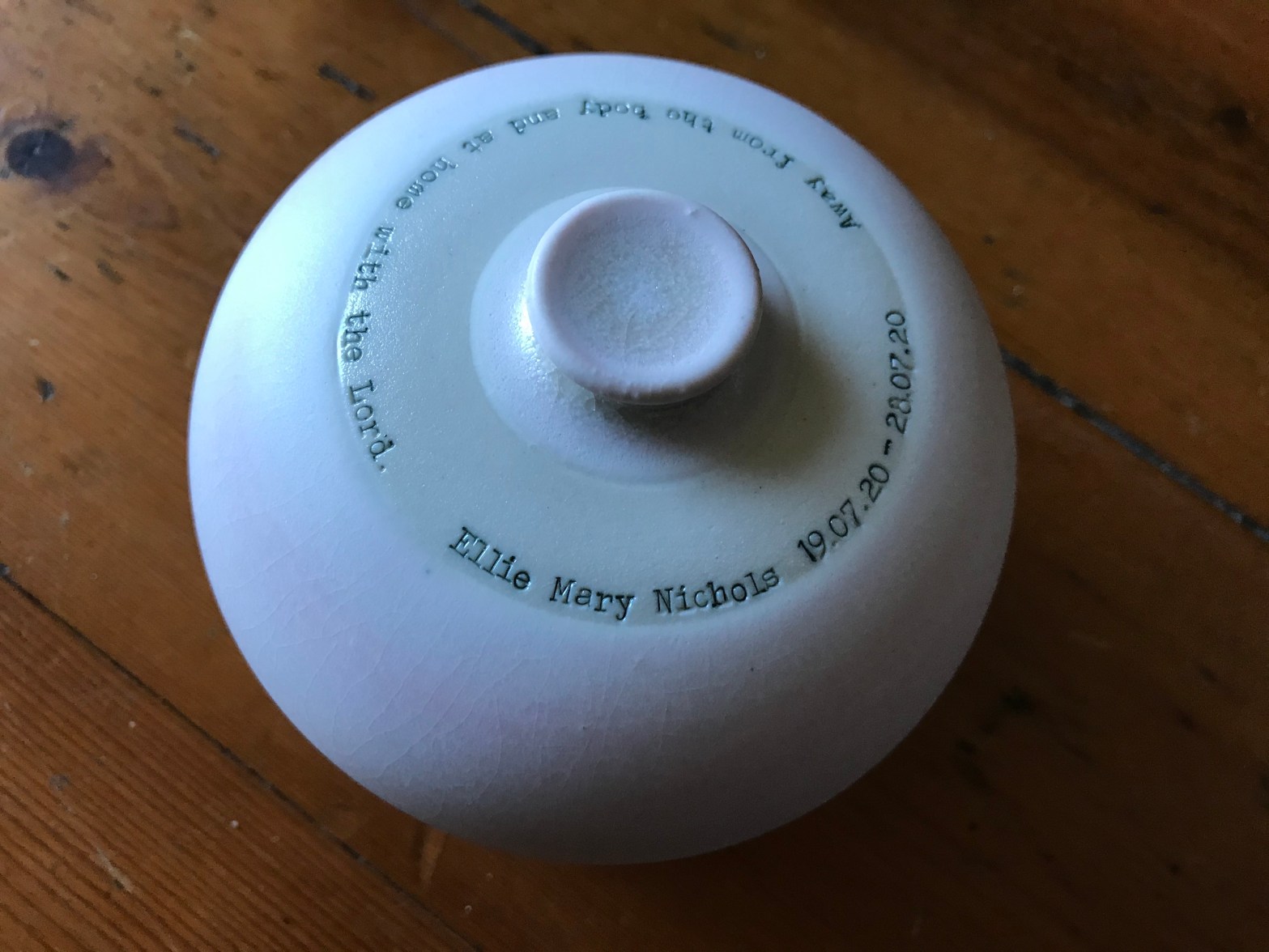
This is a post that I wrote on the evening of Sunday the 26th July, a day and half before my little daughter Ellie passed away.
“So teach us to number our days that we may get a heart of wisdom.” Psalm 90:12
Last Sunday my daughter was born. Four days later, on Thursday night my husband and I gave her back to God. She had an inoperable heart condition.
That evening we took the life support tubes out and prepared to give her one last, long cuddle as her life came to an end.
But then she didn’t die.
We waited and waited, but by morning she was still with us and I found myself with a live infant in my arms who wanted to feed and play.
We were then told that babies with her heart condition can either pass away as soon as the life support tubes are out or at the other extreme live up to five months. As I write this, we have enjoyed the unexpected extra time we have with our daughter.
However, we are living with an acute knowledge that our daughter could die at any moment. We are truly living in the shadow of her death.
As I reflected upon this, I am reminded that all of us live in the shadow of death. However, for much of my life I forget this – I look at the age that my grandmother attained and death can seem so far away. Life is busy and full and I make plans – and imminent death is not one of them. I often live as though I’m not going to die. I imagine that most of us are like this.
But every time I listen to the sharp gasps that my daughter’s heart condition causes I am aware that this day could be her last.
The psalmist reflects upon the finitude and transient nature of human life, and writes, “So teach us to number our days that we may get a heart of wisdom.” (Psalm 90:12)
The days of all of us are numbered. And yet for my daughter’s to be so imminently short absolutely rips the assumed guise of immortality off of my own life.
Minimalism is like a Swiss army knife diet in the hand of a materialistic glutton. It’ll help you get the job done in the way you need to get the job done, if of course you’re a materialistic glutton like me. But like every tool, we need to know what it’s made for. The following quote comes from “The Minimalists”, Joshua and Ryan.
“Minimalism is a tool that can assist you in finding freedom. Freedom from fear. Freedom from worry. Freedom from overwhelm. Freedom from guilt. Freedom from depression. Freedom from the trappings of the consumer culture we’ve built our lives around. Real freedom.” – Joshua Fields Millburn & Ryan Nicodemus
First, the good. Minimalism is a tool that can assist you in finding freedom. Freedom from what? Depends on what you apply the tool to. As I have argued elsewhere it should be freedom from thoughtless consumerism. But that’s not all The Minimilists propose of it’s purpose. They go further than that. Hence, the bad. They say minimalism will help you find freedom from a whole bunch of existential problems, which they sum up as finding “real freedom”.
I got a problem with this and hopefully you do too. You’re not going to get real freedom from minimalism. You’re going to get a helpful tool which you will need to apply to your own ends. But if you think minimalism will be the ratchet to lever open the Pandora’s box of “life’s purpose”, then expect a sad face emoji. Minimalism is not simply the opposite of materialism and the existential angst that is hidden in materialism’s terms and conditions. When it comes to materialism (and I speak at a popular level) we think that the world and all that there is in it is all there is to life, that includes immaterial things such as our own personal relationships and happiness. In materialism, we think happiness can be gained chiefly or only from the world in front of us. Perhaps you can see where I’m taking this. Minimalism can be a form of materialistic consumerism. As a minimalist, one could see value chiefly and ultimately in human relationships and experiences. This is merely an ironic substitution. So minimalism can be a form of materialistic consumerism of purchased goods, just replace the goods with “health, relationships, passion, growth, and contribution.”
To love ourselves or to love each other more than anything else is a grave error. Our chief love is to be the love of God. If this is your end, your set goal, then certainly minimalism may be a tool to this end. If this is not your end or your chief goal, then minimalism will only continue to fail you and harm you while all the time claiming “to set you free”.
True freedom is in Christ and Christ alone. As the Lord Jesus says,
“So if the Son sets you free, you will be free indeed.” (John 8:36).
Free from what? Free from our petty consumerism? No. It is much more profound than that.
“Truly, truly, I (Jesus) say to you, everyone who practices sin is a slave to sin” (John 8:34).
It’s freedom from sin, the root cause of all the issues, which is found in Christ. And of course it’s not just freedom from something, but freedom for something. The goal stated by many minimalists is to have freedom from “stuff” to better their “relationships” and gather “experiences”. This is good but let’s be more specific. The one relationship that matters more than any other is our relationship with the Lord. Let us be free from our “stuff” that we might fulfil the greatest commandment,
“You shall love the Lord your God with all your heart and with all your soul and with all your mind. This is the great and first commandment. And a second is like it: You shall love your neighbor as yourself.” (Matt. 22:37–39).
In loving the Lord more than anything else, what will follow will be the benefits of earthly contentment. As the apostle Paul says,
“Not that I am speaking of being in need, for I have learned in whatever situation I am to be content. I know how to be brought low, and I know how to abound. In any and every circumstance, I have learned the secret of facing plenty and hunger, abundance and need. I can do all things through him who strengthens me.” (Phil. 4:11–13).
Having a robust understanding of the riches of Christ will make all of our earthly concerns for satisfaction and contentment pale in comparison (whether we are rich or poor). Not only is having a good understanding of Christ’s majesty the antidote to unhealthy worldly attachments, but it’s also the gym equipment that we use to be strengthened for our earthly marathon. As the apostle Paul says elsewhere,
“Godliness with contentment is great gain, for we brought nothing into the world, and we cannot take anything out of the world.” (1 Tim. 6:6–7).
To free ourselves from the love of money and possessions doesn’t have in mind the ultimate end. We must ascribe to minimalism an ultimate end that is worthy of the highest scrutiny. Because even in the face of death, owning little or owning lots will change nothing. But in the face of death with Christ as saviour, owning little or owning lots with godliness is great gain now and true riches in the life hereafter.
Every now and then I go through fads. In 2019 this usually occurred at the end of the semesters, during an examination period or at the time an assessment was due. One of those fads was minimalism. I listened to the The Minimalist’s podcast and also started watching Matt D’Avella. These things I really enjoyed and I actually was challenged a lot by them. My wife and I live in a small apartment but nevertheless, I looked around and saw that I had a lot of stuff that I didn’t need nor use. And ironically, I had lots of stuff I wanted to use but didn’t have the opportunity to use because I had all these other things that I wanted to use but I simply had too much to use which meant I couldn’t use things that I owned in the first place! What a strange and weird situation to be in. So quite aside from Marie Kondo’s fad that was sparking joy all around me at the time, I took up minimalism, oblivious to the growing trend around me. The only thing with this fad is that it’s stuck with me ever since.
Following is the definition of minimalism proposed by the world/TED Talk-famous minimalists Joshua and Ryan who collectively are known as simply “The Minimalists”.
“Minimalism is a lifestyle that helps people question what things add value to their lives. By clearing the clutter from life’s path, we can all make room for the most important aspects of life: health, relationships, passion, growth, and contribution.” – Joshua Fields Millburn & Ryan Nicodemus
I like this definition, but if I had to distil it yet, I’d say that at the heart of minimalism is “thoughtful consumption”. And of course, if you want to understand what something is then understanding its opposite is very helpful. Simply put, minimalism is the opposite of thoughtless consumerism. Josh and Ryan call it a lifestyle, but personally, I think it more of a mindset. And the key to that mindset is thoughtfulness, or another way of putting it, intentionality.
Much of modern materialism and modern consumerism is based on thoughtless consumption which is fuelled by advertisements producing a felt need in you. This decades-long systemic approach to business certainly doesn’t leave us in a neutral position. We will be on the back foot if we think it is a neutral position that we occupy and make decisions from. Lots of people are spending lots of money to get lots of aimlessly wandering eyeballs on their products. Meaning, without intentionality on the part of the consumer, they will also get your money. And so minimalism isn’t to be framed as seeking a negative goal, owning less, but is to be framed as seeking a positive goal, thoughtful and intentional consumption.
One criticism that is brought against the minimalism movement is that apparently, only (or mostly) young white men who are single and rich consider themselves its devoted adherents. Now I don’t know if this is true or not because I haven’t looked at the whole of its demographic, but I see what that criticism is getting at (and I also suspect it’s true). But the truth or validity of minimalism is not primarily due to its adherents but rather in its statements. There is a place for judging a philosophy or framework by the people who implement it because then you see the real-world effects of it. Nevertheless, criticism of a framework should primarily be levelled at it’s propositions and stated values before it’s workings. Of course, the majority of make-up users are women, but that says nothing about the value of make-up (it’s only good for half the population). So it is with minimalism.
The fact that minimalism is not a universal ethical norm which will benefit all society the world over doesn’t necessarily negate its value either. The particular usefulness of a tool to a person will depend on that person and their needs. There will be few people who need to adhere to the strict pharmacological regime prescribed for a congenital skin problem, except for those with the congenital skin problem. The same applies to the pharmacological regime prescribed to those suffering from type II diabetes. Only those with type II diabetes are going to need the pharmacological intervention, but the key difference in this analogy is that there are growing numbers of those with type II diabetes. And that’s because of thoughtless consumption, particularly of food.
So think of minimalism as a diet. The intentional and thoughtful consumption of goods for the health of the consumer. Of course, not everyone needs to be on this diet because not everyone suffers from thoughtless consumerism. Yet just as there are growing numbers who suffer from type II diabetes do to their unhealthy life, so there are growing numbers who suffer from materialism. That was the case for me. My unhealthy materialism needed to be addressed, so simply put, minimalism help me address it. Perhaps you’re in the same position…
I’ve been dating video games for 20 years. But in early-mid 2019 we broke up. I was um-ing and ahr-ing about the decision for a little while by that stage. Our relationship was progressing well. I’d played all the Dark Souls games and completed them multiple times. But sometimes you get that inkling that a relationship is just holding you back… you know. By this stage I had tossed the ‘break-up speech’ around in my cranium for many months at least. I’d consulted ex-gamers on their own experience and also current gamers on their opinions.
As with many things, what got me over the line was that I just decided to give it a go. With many of these things I tend not to have a grey zone. In this case I didn’t test the waters by saying, “I’ll give up video games for 30 days and see what happens…”, I just gave them up and immediately tried to fill the void with other things I’d prepared before hand – such as music practice.
In the weeks following I learnt gypsy jazz and felt I’d really won out on this trade off. In the months following I became much more productive in a consistent and steady way; better reading habits, more assignment work happening, general admin tasks were getting ticked off sooner rather than later.
Video games for me were something of a relaxant. But increasingly I found myself not experiencing that relaxation I would expect to. More often I was left a little hotwired on adrenaline which is such a predictable bait-and-switch but still we love to ignore it especially because video games are such trigger-happy fun.
A worry I had was not been able to find something to ‘relax’ with in lieu of the pixels. But it was ill warranted concern. Turns out I didn’t need to relax with anything else. I was actually fine. I simply enjoyed more those activities I was already doing such as bike riding, walking with friends, watching the occasional SBS on demand show for free with no financial burden whatsoever.
So do I still play video games? Yes. I’m a filthy hypocrite that’s been lying the whole time. I actually play video games with my wife but they are two player local co-op games – which has been way more fun than any single player game to date. Why? Because what we do isn’t so much about what we do (at least not as much as we think it is). It’s about who we do it with. I’ve loved video games more for playing them with my wife and with my friends (in person, not online). And this has carried over into my life in general. Whether by causation or correlation, I do find myself spending more time in person with my friends without any mediating screen.
Currently at the time of writing, there is the global pandemic of COVID19 occurring. And for obvious reasons video games sales, consumption and livestreaming is going up. We simply can’t see people as much and have ample opportunity to play them and incentive to do so. But I don’t think what I’ve experienced is effected so much by this. In fact perhaps I’ve coped well with the lockdowns because I don’t play video games…
For some months now I have been thinking about envy. Both myself at times feeling envious of others and realising that other people may feel envious of me. As I begin this, I need to say that this post is not intended to be negative, but rather a bemused reflection upon the irony of this vice.
I’ll begin with a scenario: there are two people, both friends. One of them wanted to have a career in a particular creative industry but after their degree instead re-trained into a career path which took them into a stable and lucrative, albeit boring and at times stressful, full-time government job. Their friend also wanted to work in the same creative industry, but after their degree they went on to pursue this as a career, working an unstable part-time job to sustain themselves while they tried, with limited success, to get their freelance business up and happening. The first friend moved out of home into a rental. The second friend, however, stayed at home – apparently feeling unable to move out due to the instability of their income – although they did have some work in their chosen field. Some time later, the first friend entered the realestate market with the purchase of their first apartment. The purchase caused them great stress and they felt less than satisfied with the quality of the unit and its location, but they bought it nonetheless. In addition to this, they then faced the pressure of a mortgage and at the time felt trapped in a boring job.
However, the second friend felt envious of them. Why? Because the first friend had a stable job and enough money to buy property and move out of home.
Ironically though, the first friend also had reason to be envious of the second. Why? Because the second friend, although poorer, was pursuing what appeared to be a varied and interesting career – the very career that the first friend had originally wanted.
Both wanted something that the other had. Both felt envious.
This scenario is based off real people and real circumstances (albeit with details adjusted). But I write about it because for me it seemed to illustrate the sheer irony of envy. Who would envy the struggles and hardships that both people felt? And yet it is so easy to want just the good things that someone else has (particularly when we feel we lack them) and yet to be blind to the difficulties that are also part of their situation!
Such realisations cause me to laugh at the ridiculous irony of my own envy when I become aware of it. Yet as I think about this irony, I see it playing out again and again in my own and other’s lives.
The irony continues: a few years ago I got married. When my future husband asked me out I was going through a career-woman period, felt content being single and wasn’t thinking about looking to start a relationship. When we got engaged and then married I even had a period of feeling somewhat conscience-stricken that some of my girl friends who were single and dearly wanted to be married were still single – while I, who had not been looking for a spouse, had been given one (and he’s rather lovely too). However, in the process of adjusting to married life I then had times of feeling envious of the freedom of some of my single friends – quite possibly of friends who may have felt envious of me for different reasons. What a ridiculous situation indeed!
As I think about all of this, and the diverse situations that different people have, I am reminded that God is the giver of them all – and they are all gifts from him. I do not know why God gives particular opportunities and life circumstances to some people and different ones to others. Yet I do know that he is good. And ironically in each of them we have the decision to seek contentment or to entertain some reason to be envious of another.
Some months ago, when I was endeavouring to stave off some particularly envious sentiments, I read Psalm 23. It might not seem like a proof text for such a subject (and it isn’t) but it was very helpful for me as I was reminded that God is the shepherd of each of his people. He is the one who provides us with what we need in each season (and here I am reading the line, ‘I shall not want’ as meaning, ‘I shall not be in need’). He is the one who gives us rest and restores our souls. And so, why should I be envious of what God in his shepherd-ly care has provided to another? He cares for me too. I’m not going to miss out on his care – because in his wisdom he will provide me with what I need – even though I may not always fully know what that is. And as he is the shepherd of each of us, I can be confident that he will care for my Christian friends too – each with their own particular struggles and enviable circumstances.