A Verse a Day Keeps the Bible Away

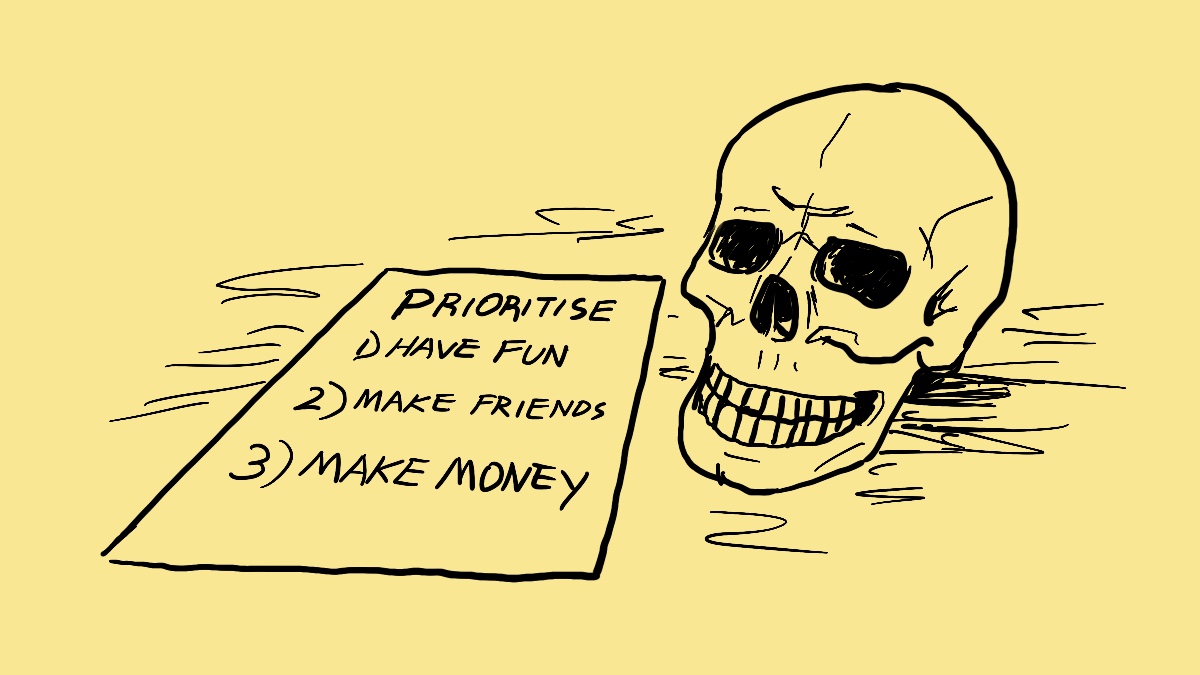
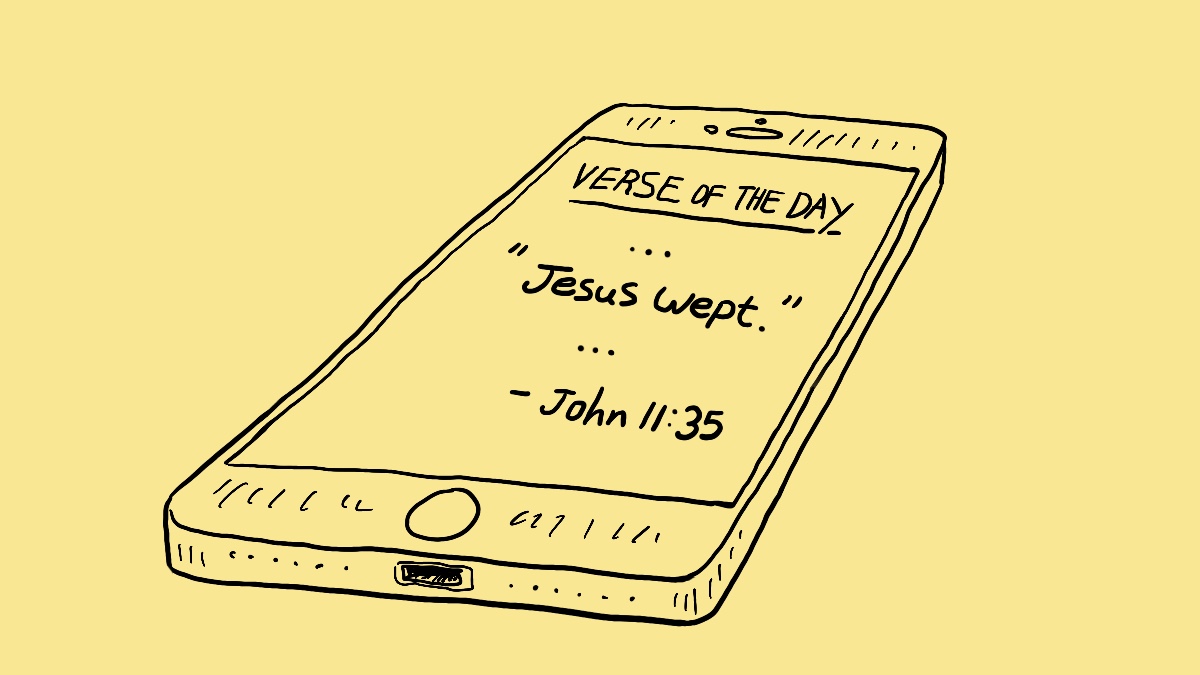
Is some bible better than none? Well, I guess so. But let me ask that another way. If you are reading one bible verse a day as “devotional” reading, are you reading a healthy amount of the bible? I don’t think we could agree to that. So, no. To turn a common aphorism upsideround, ‘a verse a day keeps the bible at bay.’

Sure, there is something good about reading the bible, no matter how little. I should also think we ought to be incredibly grateful for every part of scripture and the treasure and gem every single verse is. They are the words of God for nourishing our souls and guiding our path.

However, with all of God’s word available to us, how could we say we treasure God’s word but in practice read a mere paltry amount of it (proportionally speaking) and with respect and consideration for our time and capacity? Our actions speak for us in this regard. I raise this because I’ve sometimes heard this sentiment spoken, and also because I’ve noticed this at times with my own behaviour (especially as I think about my ‘screen time’ habits).

I want us to push back against a world that tempts us to be so busy that we feel we can’t make time for the treasure of God’s word, but we can make time for YouTube (and other new media). Is this comparison not enough to show us how much of a spiritual battle life is? I think so. I think about my own habits. I’ve consistently spent time watching YouTube out of habit and because others are actively seeking to engage me on their mediums. It’s not a neutral environment where I can just as easily choose to do this or that thing. Rather, there are forces/companies/people/spiritual powers at work with agendas. Media has an agenda, your work has an agenda, the economic marketplace has an agenda, the devil has an agenda, and God has an agenda. Having the wisdom to discern our actions in a world that is seeking to pull us in many directions is an essential skill. This is especially true as the world around us becomes much more complex, subtle and perhaps even insidious in regard to spiritual matters.

In the battle to honour God and live for him, let us consider it a loss (not a win) when we read a verse a day. This kind of thinking is more a symptom of worldliness than anything else in my opinion. The bare minimum regarding spiritual matters sounds exactly like a ploy and outworking of the strategies of a world seeking your affections. To pull you away from God and toward itself.

I’d imagine the attention economy would not be satisfied with you saying to them, “well at least I read your headline, or watched the first 30 seconds”. No. they are not satisfied until you spend all your attention on their products. But in kind, they would be very happy if you said of God, “at least I gave him a little bit of time.”

It can be very easy to succumb to worldly practices with our spiritual disciplines.

What we can’t do is give up. The world fights for our attention relentlessly because we are a product. But God is not like that. He dies for us out of love. While we are coerced by worldly manipulations for the bottom-line, God instead woos us into an affectionate response to Him (at least in part). There is a world of difference between those who see us as products or consumers, and the one who sees us as an object of His love. Our response should be in kind.

Our contentment with a verse a day is an outworking of our affection. Sure, there are seasons of struggle. I want to say that’s different from habitual lacklustre efforts to love God. We can foster greater love for God. We don’t (nor should) wait until we ‘feel it’ to start spending more time with God in his word, in prayer, and with His people. We start with action, and over time we will more and more ‘feel it.’

But for now, maybe a good motivation to fight back (at least from this boyish writers opinion) is to recognise that the world wants your attention. With a little of the famed ‘reverse psychology’ or childish combativeness we dislike seeing in others, we could be motivated to contrarian engagement with the attention economy. Instead, giving greater attention and time to God and his word.

Horizon: Zero Dawn – Reflection on Themes, Narrative, and Hero.

Although the video game Horizon: Zero Dawn is set in a post-apocalyptic (anti)wasteland inhabited by warring tribes of a variety of local deity worshipping persuasions, it is very much a modern secular narrative seeking to speak to the problems we face today (sometimes only thinly covered analogically). It has a lot to say about religion, technology, tribalism, environmentalism, and oddly enough sacrifice (how’d that get into the story?)

If the problem this fictional world is demonstrating is humanity’s propensity to organise in tribes, follow fake gods, and kill each other because of said tribes and gods, then what’s the solution? The solution in the narrative is to free oneself from superstitious religious ideas and free oneself from tribal identities, to transcend the problems they bring, which in turn enables one to make objective (we might say scientific) discoveries about the world and its technologies. These discoveries are what enable the saving of lives – not just saved from our tribal religious-fuelled murderous enemies, but (spoiler) from the equally rogue A.I. threatening to destroy the world again. (Clearly I am distilling the games narrative down into a select number of themes)


The story is clearly hitting on something substantial in our modern world. Tribalism, superstition, war, and the misuse of technology are all topics that should be grappled with because they pose problems to us as people. Tribalism sets up “us versus them” which promotes conflict and war. Superstition tends to be based on ignorance. And technology has the capacity both for good and for evil making the use of technological power for the betterment of society appealing but equally a dangerous engagement as the potential power has latent destructive ability as well. We can agree that those are problems to be dealt with. The game does well in portraying these themes and telling a story of people fighting back against these issues. These are noble issues to engage with.


We should ask how the game portrays these problems.

Let’s start by considering what religion looks like in the game. The tribes that form in the world of Horizon tend to form around local myths, (mistaken) deities of technology, and then codified into tribal traditions. Religious belief and community are intertwined and inseparable in the world of Horizon. So when (metaphorically speaking) Siri spouts forth some vocoded written script, ignorant tribespeople mistake that voice for the voice of god. And so Siri is now a local deity (doesn’t that sound eerily close to home…)


But what is the solution that is posed by this game and the narrative that it tells? Well, the problem is ignorance (which is where these superstitions come from), so the truth needs to be discovered right? Intellectual enlightenment That’s the solution. Someone from the world (the protagonist) needs to discover that technology is not divine, it’s a man-made phenomenon. It is not worthy of worship, it is simply a tool.

After the protagonist discovers the truth, she is able to wield the tool appropriately. The tool becomes a weapon to save humanity from an external threat, a rogue A.I threatening human life. Hurray!

But as the protagonist is a tribesperson, they must first transcend the local superstitions. That’s because the local superstitions are what bind the people in ignorance. The narrative uses the irony of the character been shunned by society to do so. So now they are enabled to see the world “from the outside” as it were. Their perspective is from outside the tribe, outside its superstitions and community. This gives them a perspective the other tribespeople are not able to attain. While they are bound by the chains of tradition, you are not. Convenient! You are empowered to now save the people who hate you and shunned you all your life. And who isn’t motivated to do that? (Wait, loving ones enemies… how’d that get into the story?)*


Ok. Having looked at the narrative of the game, and appreciating the good points it’s trying to make about the perceived problems, let’s consider where is might have some potential problems. Because we should remember, art is an imitation of life. The message of Horizon is trying to tell you what is right and wrong, and through the medium of gaming, what you ought to do and how you ought to think, making analogous connections to the world you live in when you put the controller down.

First, the writers are trying to recreate a tribal-premodern setting where community and (religious) tradition are inseparable. Its meant to be a world where everything is infused with the spiritual. Only problem is, you are, as the protagonist, outside of that world. It works hard at setting up the protagonist to have a “view from nowhere.” The protagonist is somehow able to be the perfect Renaissance hero. They are untethered from the corrupting influence of society (kind of like Frankenstein’s monster).

Although this makes for a good story and is a good carrier for the plot, the protagonist is the impossible hero. It’s a work of fiction, I know. That means you have to suspend your logic to a degree and imagine that this is possible. Because it simply is impossible for any ordinary human being to have this perspective. The question we should be asking ourselves as we play the game or reflect on the game is “how can this tribal woman have a worldview other than the pervasive all-encompassing worldview around her without someone or something outside that worldview teaching her?” Is not possible, so you just have to imagine and accept that this is an impossible hero. And of course they are the best heroes! So it makes for a good story.

But I think this highlights one of the problems with the message of the game. The writers have retrofitted a modern person into a supposedly premodern world. But the very presence of the modern protagonist in a world infused with the spiritual, undercuts the world that they are trying to create. That only displays the world that we inhabit. We can’t help but think that the spiritual is somehow distinct from the physical world. That’s what it means to be modern. So when the writers of Horizon create a protagonist who thinks like a scientist, they show the world they are creating not to be an imagined premodern society of tribes, but just the modern society with the veneer of the premodern. It displays our inability to connect with the world of the past, myself included. We simply can’t imagine a world where spiritual realities are literally infused into the physical world. To use Charles Taylor’s language, we can’t imagine a ‘porous self or world’, because we so thoroughly understand the world through an ‘imminent framework’. Horizon is a little glimpse of that, at least with the protagonist and her interactions with a tribal and religious society.


However, I think the story is trying to get something for which there is a genuine answer. The hope of the moderner is to gain a fresh perspective and see problems for what they are. It also touches on universal problems. The person who caused the apocalypse in the first place, has selfish desires. Their selfishness leads to ultimate destruction.

Moving on, perhaps a better way to look at the game, is not to put yourself in the protagonist’s shoes (again, impossible). But at least reflect afterward. Often, we are not the protagonists. In this game, that means we are the tribespeople. We are ignorant. We call things that are not God, god. It’s an irony. The writers are saying, “look beyond the superstitious religious beliefs and see that the world is simply material. That all there is is material to be crafted into tools. And that survival is the name of the game. And along the way, do good to people.” The irony is, that when we become the protagonist of our own stories, and when we determine what is right and wrong according to our own standards, behold, we make ourselves God. All the while proclaiming, there is no God. Furthermore, we could flip the narrative and its meaning on its head. Modernity is its own form of a tribal, superstitious, quasi-religious worldview.

Often these games put you into the driver seat as the hero. As Christians, we should step back one more significant step. We are not the protagonists in the Christian narrative, Jesus is the protagonist. He is the impossible hero. He comes from outside of our world and teaches us the truth and points to a better world. And then we see that we were ignorant the whole time, but he seeks to equip us with the truth. Much like the villains who cause death and destruction through selfishness, well, we tell ourselves we aren’t those people. But, we should consider, we might not destroy the world, but we often wreck our own worlds, our lives. There are many things to do to turn that around. But the first (often untaken) step, is to turn to the hero from outside, Jesus. There’s nothing wrong with tribalism. Been in Jesus’ tribe is actually pretty great. But you wont get that looking in from the outside.


*Note, I played the game taking options to forgive and help, basically I wasn’t a vengeful, angry person when given the option.

Work When You Don’t Want To

There is a little saying about people who love their work, they’ve, “never worked a day in their life” because they love what they do. It’s never a burden in this imaginary situation. But that’s just impossible. The problem with the modern message about work (which is often really closely linked to purpose) is you have to find it a joy all the time. Only stay in your job as long as you like it. Work should be fun and you should be motivated to work as much as possible because it’s just a blast.

This message has the potential to ironically make work more burdensome for you. And if we are thinking about the principles of work from a few posts ago, we will remember that work and productivity are not simply self-centred pursuits. We can and should be other-person-centred as Christians.

But to push back at the modern message about work, you don’t have to be continually motivated or enjoying work to be a good worker, to be a productive person, to be a professional of sorts.

Obviously, you can’t just work when you feel like it. You have to work even when you don’t like it, and you have to work well. The best workers deliver results regardless of how they feel.

Again, this is where a Christian foundation for work can be helpful to us. Our ultimate motivation is not a motivation driven by the self. The Christian is motivated because of God, and because of one’s neighbour. These motivations are there regardless of our feelings. In fact, we ought to be striving to get our feelings in line with these motivations.

Nevertheless, we clearly ought to enjoy our work. But what I’m suggesting is we will enjoy our work more, if we were not working merely for ourselves, but working as for the Lord, and working for the love of our neighbour (that is, all people). There is more enjoyment in working with this mindset than the modern self-driven mindset.

The Christian then has good grounds to joyfully do difficult tasks. There will be many things in life you are going to have to do which are things you won’t want to do at first or won’t naturally come to you. These tasks won’t please you by their nature. But not everything is about you and me. The Christian ought to have more ground than anyone else to look beyond themselves and joyfully embrace difficult tasks. To work when we don’t want to.


Perman, M. (2018). How to get unstuck: Breaking free from barriers to your productivity. Zondervan. 119-127

Not Lazy, Just Need Some Help.

A productive person is someone who has clarity about what they’re going to do, discipline and persistence to do that work without getting distracted, the ability to focus on one thing at a time, energy enough to do those tasks, speed to do them promptly, a good estimation of how long it would take to complete tasks and therefore the ability to complete your work every day. 45

This person sounds mythical, don’t they? They conjure in our imagination a Greek demigod with Elon Musk’s blood running through their veins. But it’s possible to cultivate these skills and traits. As for everyone who lacks them… Well, to run with the Pantheon metaphor, they’re mere humans. Look down upon them my fellow demigod and judge them with the greatest of criticism.

But…

We might assume that people who struggle with productivity are lazy and we might assume this too quickly. We might tell ourselves they could fix their problems if only they decided to. Ever heard the phrase, “people will find time for what really matters to them”? Perman calls this the ‘willpower fallacy’. It’s simplistic thinking and fails to recognise that the causes that challenge our productivity are often complex. Simply deciding to change doesn’t address the complexity of this challenge. Personal change takes time. We don’t get the results from a Google search. 48

An alternative to this kind of thinking is not to simply assume that a lack of willpower is the problem; therefore, more willpower is needed. In a complex world with increasing demands and responsibilities, it could (more likely) be a lack of skill. The challenge of the modern world, where distractions abound, where we are still adjusting to modernity (and I might say that we are adjusting poorly more often than not – surely you feel that), makes productivity elusive and magnetises distractions and inefficiencies. 49

let’s keep in mind the foundations we looked at in the last post. Productivity is not only for ourselves. In the introduction list, I left out an important characteristic of a productive person. They are loving. They serve other people. In the productivity world, books, writers, and gurus are often concerned about your individual productivity. But as Christians, we are concerned for more. We want to help other people to do their best as well. We are not learning how to work in the modern environment for purely selfish reasons. But if we learn how to work in the modern environment, we ought to be driven to help others do the same. We should reserve judgement on others who are struggling to be productive. We should be slow to indite them with laziness. On the contrary, we should be quick to help. It might not be a lack of willpower, but a lack of skills. I’m sure we can sympathise with that ourselves. Managing smartphones, emails, and Youtube, so that we get the most out of them while avoiding the worst of them doesn’t just take willpower, it takes skill. You need to learn skills. You can’t just muster them up. 49-51

These skills include: determining your intermediate goals, choosing the activities to which you will give your time, defining and managing your projects, determining your next actions, managing your schedule, and just doing the work. 55

So what can you do?

Offer to help someone who seems to be struggling with their work. It might be a colleague of yours, someone in your Bible study group, or at church in a similar field of work. But it doesn’t have to be the same field of work. How to manage your phone will have overlapping applications between a lawyer and a tradesman.

As you help someone else, you will surely be the first person to admit your own struggles. Who doesn’t struggle to keep focused in the modern world were distractions are abundant and nearly force-fed to us?! We need to be humble when we help other people, especially because we are going to be in need of help ourselves. So why not ask other people for help? Ask them how they stay focused for longer than an hour (if they do). Ask them how they manage their emails so that they can work better. Ask them how they work even when they’re not motivated. Then when you learn from them, pass that learning on.

Too often, productivity books tell us to be productive for our own sake. But we can do better than that because we don’t just work for ourselves. We work to serve others and we can serve others by helping them work better as well.


Perman, M. (2018). How to get unstuck: Breaking free from barriers to your productivity. Zondervan.

Productivity for the right reasons matters

Why do we work?

Simply put, it’s part of who we are made to be. God built into our very fabric the desire to work. There is also enjoyment in working when we work for the right reasons, with the right people, with the right kind of compensation. Ecclesiastes has much to say about work. Suppose we love money and work for money alone. In that case, we are cursing ourselves because we will never have enough and work ourselves to the bone with no satisfaction (Ecclesiastes 5:10). But the teacher in Ecclesiastes goes on to say work is intrinsically good according to his observations (Ecclesiastes 5:18-20). When we find joy in our work, we are blessed.

In the New Testament, another dimension is included in work: service for others, but especially of God.

Anyone who has been stealing must steal no longer, but must work, doing something useful with their own hands, that they may have something to share with those in need.” (Eph. 4:28)

Our work is to be useful in general but is also to contribute to other people’s needs.

Whatever you do, work at it with all your heart, as working for the Lord, not for human masters.” (Col. 3:23)

We work for the Lord, not only for those who are our employers. That means we work with good Christian character. And we endeavour to do our best, working with all our heart. So we are driven to produce good quality work as we would do for the Lord.

Make it your ambition to lead a quiet life: You should mind your own business and work with your hands, just as we told you” (1 Th. 4:11)

We also try and live a quiet and balanced life. There is something simply ordinary about work. It doesn’t have to be unique or extravagant.

For even when we were with you, we gave you this rule: “The one who is unwilling to work shall not eat.”” (2 Th. 3:10)

Work is also practical. Work is necessary to provide for ourselves and our families.

Why should we try and work better?

These verses above encourage us to think about work as Christians. There is joy in work and getting things done. But we also want to produce good work as if we were working for the Lord. On top of that, we are mindful of other people. So we want to produce good work for the sake of other people, for the sake of being useful to our superiors, and if we are able to make more money, then we have an opportunity to be helpful in our generosity as well (you do give money away to church and missionaries right?). Or if we can work better, we may be able to work less and serve other people with our free time.

The importance of these foundations.

We need to keep these foundations in the back of our minds regarding work. In the current craze on productivity, the easiest thing to miss is these foundations. Productivity becomes an end in itself. Worse still, money can be the driving force behind productivity. We want to be productive people. Work is built into us. We also want to work better. But we want to do these things for the right reasons from the right foundations.

These foundations will help us better assess work in the modern world. The modern environment is unique. We are not strictly agrarian like former civilisations. We are not quite industrial anymore (even though that’s more recent history).

Work in the modern age is characterised by new technologies. Not all work is, just more and more work is. Hence, by necessity, we need to engage with the principles of productivity in the new working environments of the modern age. That’s where all the self-help and productivity books come into the market. To be sure, there are a lot of trashy productivity books, YouTube channels, and gurus around who are simply trying to capitalise on the craze. But the craze exists for a reason. It exists because the nature of work in the modern age is shifting and changing and people are trying to understand it and accommodate to it.

All that to say, we want to work well. We want to be productive. And this especially concerns us in our age because the nature of work has shifted dramatically around the introduction of new technologies. But the old foundations of work and productivity have not changed – the biblical principles behind work and what ground the Christian worker.

Productivity for the right reasons matters.


Perman, M. (2018). How to get unstuck: Breaking free from barriers to your productivity. Zondervan.

Death Make Life More and Less Serious

Our coming death makes life both more serious and less serious.

We must take life more seriously because this life we have now is to be measured and weighed. It has real consequences, and the Bible tells us it has eternal consequences. Will we or will we not trust in the Lord Jesus with this life that we have been given? That is a serious question, and that question makes life a serious matter because this life will come to an end. It is because of death that this life is given such great seriousness.

To be sure, life was serious before death. In those moments when Adam and Eve lived with God before their fall, their life is valuable and weighty because they are made in the image of God. However, life after the introduction of death has now had something else introduced to it. Even as something is taken away from it. A certain kind of seriousness is added in the presence of death which tempers life’s joys. Death reorganises the priorities of life.

It is tempting to live for the here and now like our life depended on every fleeting moment. Every moment must be productive. Every moment must be squeezed of life to extract the essential nutrients for temporary sustenance. When this temporary moment is overvalued, or taken too seriously, something has become amiss. Ill-defined priorities climb to the top of our existential to-do list and find a misplaced home.

We might say that death is the anecdote to that. You can’t take your toys to heaven, or hell for that matter. Sometimes it feels like all the things we have to do, play with, work for, work with and work to achieve, et cetera et cetera, sometimes they feel like toys. Then it becomes rather silly when we treat those toys like they mean the world to us.

Death touches everything a bit differently. Overall it makes our life decisions vastly more important, especially the one decision to follow or reject the Lord Jesus.

But then to other decisions, life becomes less serious. Our pursuits in light of eternity don’t matter as much as we think they might. What really has weight is how we carry ourselves through life; our character, and our motivations. These things are not necessarily seen by others, but the Lord sees them – the eternal Lord sees them.

So what brings about these random thoughts? Well I’m writing this in my little study. There’s not a lot of stuff in my study, it’s almost like a storage space. But some of the things that I’ve stored in here are hanging up; my bachelor of nursing certificate and my bachelor of Divinity certificate. They each represent four years of my life. These hang up on one side causing me to think about them and what they represent. But then, in front of me hangs a painting. Just a small A4 painting. It’s a little representative picture. There is King Jesus, me and my wife, and our child Ellie who died.

The death of a child is a sobering experience. It gave me a certain perspective on life. It has become both more and less serious. I treated things that don’t matter much like they really matter, and I treated things that really matter like they are optional. But death helps me think a little straighter. As painful as it is, I do appreciate the reminders of death around our house, some pictures here or there, her urn of ashes and clothes hanging up. I don’t visit them all that often, and sometimes they affect me more than other times. But it is helpful.

I’m reminded as I look back over my last couple of months that I tend to get caught up on trivial things. I tend to think more of myself than I need to. I tend to overweigh decisions. I tend to trivialise important things. But experiencing death so closely has helped me. It cuts through the fat and grease of life and helps me get to the meat and the substance.

But like a greasy meal, I get left out in the cold of the world and the fat gets thick again and I fall into poor priorities and motivations and desires. Our lives are like that, they tend to get cluttered with the unimportant in important places and our hearts tend to attach to the world.

I hope you don’t face the kind of suffering I faced. But I do hope you face some suffering if it helps you to see just a bit more clearly. You will be thankful for it. And I hope that reading this will help you see just a little bit more clearly – hopefully without going through the rough waves yourself.

But when you do go through those rough waves, a blessing that can come is that they shake us and wake us from our stupor, our infatuation with the trivial little toys of this world.

Divinely Appointed Cognitive Dissonance – O.T. Motifs

In a prior post, we considered some specific texts in which we encountered the tension between God’s sovereignty and human responsibility. We saw that neither is limited. Those passages were specific. But in the same vein of reasoning, we will consider some of the broad motifs and themes in the Old Testament, which also portray the tension between God’s freedom and sovereignty yet the responsibility of humanity.

The first thing to say is that God commands people and exhorts people. Adam and Eve were told not to eat the fruit in the garden from one particular tree. The law handed down through Moses contains numerous commands. Some commands are moral in nature, others cultic. Some pertaining to civil legislation, or even specific details about tabernacle construction. Broadly speaking, all people are called to seek the Lord. This theme certainly presupposes responsibility on the human agent.

Secondly, the Bible speaks of people obeying, believing, and choosing. Abraham is a prime example of this. He is the man of faith because he believes God and trusts in his promises. After the law is handed down through Moses, all the people of God agree to obey the law. The blessings and curses are put before them, and with their good sense of judgement, they reckon the blessings are worth pursuing.

Thirdly, the Bible is littered with the disobedient acts and rebellious works of mankind. People corrupt themselves and do ‘what is right in their own eyes.’ This would make no sense if people were not at all responsible for their actions.

Related to the rebellion of humanity is their judgement. They are responsible to God for their disobedience. God’s judgement presupposes human responsibility. That is inescapable.

Fourthly when people pray, their prayers are not for nothing. Their prayers aren’t just for show. Nor are people’s prayers automated scripts which are pre-programed. They are genuine pleas and calls from human desire. This relationship between humanity and God demonstrates a kind of agency and responsibility. Is not the interaction of machines but the interplay of personalities, as Carson puts it (p.22).

On the other end of the spectrum, or we might say, pulling on the other end of the rope is God’s sovereignty.

Firstly, God is spoken of as the creator, the possessor, and the ruler of all things. In no way does human responsibility or volition limit these matters or bring some kind of contingency to God. God creates without permission and obstruction. He is the owner of all things. He is the king of all things, ruling all the earth. He is sovereign, the sovereign. Everything is under his control in creation, whether that is the weather, calamity, or prosperity. There is not another force at work in creation called “chance”. The omnipotent God is behind it all. There is nothing purposeless or aimless in the world. As Carson puts it, “it is difficult to conceive how the Lord could control even the details of history unless he controls the minds and emotions of humanity.” (p.27)

Secondly, God elects people for salvation. Some people really get in and knot about this point, but you can’t avoid the language without doing linguistic gymnastics. You cannot escape the fact that God chooses whom to save. God chooses Isaac and not Ishmael. He chooses Jacob and not Esau. He chooses Moses to lead his people then he chooses Aaron to be the priest. He chooses David to be the king. Even broader, he chooses Israel as a nation, not because they were any better than anyone else or any other nation, but simply out of his divine will. The other side of this coin is that the Lord chooses not to save others. The Pharaoh is the archetypal example. Although he hardens his heart, it is equally said that the Lord hardens his heart.

Again, much like the prior post, we’re not called to reconcile this tension, but to live with it. To acknowledge both. We especially feel this tension when we undergo some sort of struggle or suffering. In fact it could be said, that is pretty much the context in which the biblical tension is written. The Israelites are not pondering the metaphysical realities and tensions between God’s sovereignty and human responsibility for the sake of it. The context for much of these passages and themes is the context of suffering.

I would chance a guess (not that chance exists), that suffering will be the context in which we will often ponder this tension as well. In the context of suffering then, we may find great comfort knowing that the Lord is sovereign and in control. When matters of human sin are involved, and we are victims, we must remember that God will hold them accountable and that they are responsible for their actions. When events are beyond human control (such as a natural disaster), again, we would do well to remember that this world was broken by the fall of Adam and Eve and their wilful disobedience of God, for which all of humanity are now involved in, yet the Lord still rules over all things.

This will be the context in which we will often face these tensions. Surprisingly, having a firm framework of ‘compatibilism’ as Carson coined it (if he coined it originally, I’m not sure) would do us well. It does us well because that’s what the Bible presents us with, and in a dark place, the word is a lamp for our feet.


Carson, D. A. (2002). Divine Sovereignty and Human Responsibility: Biblical Perspective in Tension. Wipf and Stock Publishers. (p.18-38)

Divinely Appointed Cognitive Dissonance – O.T. Specific Passages

It’s not long before a Christian encounters the tension in the Bible between God’s sovereignty and human responsibility. I remember facing that tension myself as a younger Christian. Admittedly, it seems to be introduced to us from the outside. Others are talking and debating about it while we listen in. Eventually, we must try and reconcile the tension for ourselves. But because this debate can be rather polarising, we are prone to pick sides based on the most vigorous debater in our early encounters with this tension. Regardless, the tension must be addressed because once you hear about it, you will see it throughout the Bible.

Don Carson is a proponent of a sort of middle way. Although I don’t think he would like that term. It’s not really a middle way. Don calls it ‘compatibilism’. To put it crudely, compatibilism doesn’t seek to alleviate the tension by either emphasising human responsibility or emphasising God’s sovereignty. Instead, it puts the two side-by-side and lets the tension sit very uncomfortably in our craniums. Simply because that’s how the Bible puts it. At times God is shown to be contingent upon human responsibility, and then at other times, God is described as being beyond any limiting contingency.

Basically, the two sit side-by-side in the Bible at times.

But a good practice might be to let them sit side-by-side, to look at the data and hold that tension within our minds. Let’s have a look at some examples.

You intended to harm me, but God intended it for good to accomplish what is now being done, the saving of many lives.” (Gen 50:20)

This is a classic text for seeing the actions of humanity at work for evil yet the Lord at work to accomplish what is good, namely the saving of many lives. Joseph states earlier that his brothers are not the ones that sent him into slavery (although they literally did), but it was God (45:8). Both the brothers of Joseph and the Lord have specific intentions in the same actions. Both the brothers of Joseph and the Lord are at work in the same actions. But ultimately good is accomplished as the Lord intended. 

Consecrate yourselves and be holy, because I am the LORD your God. Keep my decrees and follow them. I am the LORD, who makes you holy.” (Lev. 20:7–8)

The people of God are called to be holy. They are to actively seek after holiness motivated by the character of God and his holiness. Yet in the very next clause, God is the one that makes them holy. We see the people of God seek holiness all the while God makes them holy.

His parents did not know that this was from the LORD, who was seeking an occasion to confront the Philistines” (Judg. 14:4)

In this passage, Sampson’s father berates him for seeking a wife amongst the Philistines. Without a doubt, Sampson’s actions are not commendable. He certainly isn’t seeking holiness as we just looked at above in Leviticus 20. But what his parents don’t know is that Sampson’s actions are ‘from the Lord.’ This will eventually lead to the Philistine’s defeat at the hands of Sampson. Sampson is choosing to walk a path contrary to the way the Lord has called him to live in the law, but the Lord is at work bringing this about at the same time. God is going to punish the Philistines through Sampson, but Sampson’s unholy motivations still do not sully the holiness of God.

Again the anger of the LORD burned against Israel, and he incited David against them, saying, “Go and take a census of Israel and Judah.”” (2 Sam. 24:1) see also 1 Chr 21

Although it is unclear precisely what David did wrong in this scene, it is very clear that for some reason, of which the reader is not given, David has sinned against the Lord. Yet David is incited by God to go about the action which he is condemned for. It is such a clear portrayal of the tension. God incites David to an act that he thereafter condemns. However, David is morally responsible for his actions. Neither human responsibility nor God’s sovereignty are limited. Which is both profound and frustrating for the human mind. To complicate matters further, 1 Chronicles 21 includes Satan as an agent in this scenario as well.

The king answered the people harshly. Rejecting the advice given him by the elders, he followed the advice of the young men and said, “My father made your yoke heavy; I will make it even heavier. My father scourged you with whips; I will scourge you with scorpions.” So the king did not listen to the people, for this turn of events was from the LORD, to fulfill the word the LORD had spoken to Jeroboam son of Nebat through Ahijah the Shilonite.” (1 Kings 12:13–15)

In this scene, Jeroboam was representing the people of Israel who are seeking favour with the king Rehoboam. However, Rehoboam doesn’t listen to the older and wiser counsellors but to the younger counsellors to the detriment of the people of Israel. Again, we see the tension. Rehoboam chooses to act foolishly, and as the story progresses his decision is detrimental. Yet Rehoboam’s folly is attributed to the Lord, this turn of events came from the Lord so that he might fulfil his word spoken by Ahijah.

““Woe to the Assyrian, the rod of my anger, in whose hand is the club of my wrath! I send him against a godless nation, I dispatch him against a people who anger me, to seize loot and snatch plunder, and to trample them down like mud in the streets. But this is not what he intends, this is not what he has in mind; his purpose is to destroy, to put an end to many nations.” (Is. 10:5–7)

This one is crazy too! The Assyrian army is upheld as the rod of God’s anger and the club of his wrath. It is his tool, and he is using it to punish the disobedience of his people. Yet the Assyrians are cursed with woe from the Lord himself who has called them to this task. But there is a reason for the pronounced woe on the Assyrians. It is because they consider their strength their own and not from God. The Assyrians took up arms against Israel of their own violent and destructive will, and yet that is also the Lord’s will.

[Zedekiah] did evil in the eyes of the LORD, just as Jehoiakim had done. It was because of the LORD’S anger that all this happened to Jerusalem and Judah, and in the end he thrust them from his presence.” (Jer. 52:2–3)

In this passage, it is the divine wrath of the Lord that is the cause of the evil which Zedekiah lets loose. Zedekiah’s rebellion, which is akin to the rebellion of evil kings before him, is of course his own rebellion. Zedekiah “did evil in the eyes of the Lord”, but it was because of the Lord’s anger that Zedekiah lets this evil loose. To paraphrase this passage, the Lord, in his anger, caused Zedekiah to do this evil. But it is Zedekiah who is responsible for the evil.

And everyone who calls on the name of the LORD will be saved; for on Mount Zion and in Jerusalem there will be deliverance, as the LORD has said, even among the survivors whom the LORD calls.” (Joel 2:32)

Anyone who calls on the name of the Lord will be saved, however at the end of the verse, it is the Lord who calls his people. It’s as if the two are interchangeable, people are saved as they call on the Lord, and Yahweh calls people to himself and saves them.

I hope your head hurts. My head certainly hurts. Our minds are struggling to comprehend this indissoluble tension, and it’s giving us cognitive dissonance. That’s perfectly fine. It just highlights our humanness.

What these passages ought to encourage us to do is hold in our minds the tension which they hold. These are the Scriptures after all (and these are only a selection). God is presenting us with this tension. One way to alleviate the tension is to emphasise either human responsibility or God’s sovereignty. But that is not the way of these passages. They hold the two in tension, and so must we.


Carson, D. A. (2002). Divine Sovereignty and Human Responsibility: Biblical Perspective in Tension. Wipf and Stock Publishers. (p.9-17)

Proverbs of Susella

As a mother feeds her child,

So too, YouTube feeds her children


To turn is greater than to scroll.

The page is wiser than the screen.


Though the floodwaters rise, the righteous don’t buy more milk than they need.


The fool posts about their annoyance at once, but the wise disable their notifications.


The fool says, “my way is righteous – unlike many,” and many say the same.


Money in the bank,

Food in the fridge.

Both have their expiration date.


A well-trained dog brings honour to its owner.

An ill-tempered dog brings reproach.


One who is wiser in their own eyes

Is smoke in another’s.


To scale a mountain is to delay gratification.

The easy path to pleasures is a precipitous cliff.


The fool heralds his views without understanding his opponents.


A good name is better than a known name.

To be a popular fool ranks lower than a local servant.


Intelligence is not wisdom,

And wisdom is not found on Wikipedia


Mow the lawn, and you will have to do it again.

Correct the fool, and you will have to do it again.


Chat to that neighbour. A long conversation with them is time well spent.


Do not chat to that neighbour. A long conversation with them is time ill spent.

The Christian – A Joyful Detached Critical Servant in the World.

We are exiles in the world. But how should we live in the world? Is it our goal as Christians to transform the world through creating Christian education, Christian government, and a Christian ethos for every workplace? We are certainly called to be faithful Christians in those areas. But that is very different to making those areas “Christian”.

VanDrunen proposes that we be joyfully detached and critical servants in the world. This is how we engage with our cultural activities.

The kingdom of God is not about creating Christian education, government, or workplaces. That is because the kingdom of God in this world can only be identified with the church for which Christ instituted, the community which gathers around God’s proclaimed word in faith and obedience. (p.101) So when we pray “your kingdom come”, we are not praying for the world to change necessarily, we are praying for the church to grow.

We are not engaged in bringing God’s kingdom to earth when we cajole those around us to live in ways that are more aligned with the Christian ethic, whether through education, politics, or general workplace ethos. We are actively contributing to the kingdom of God when we see the church grow, people come to believe in Jesus, and Christians strengthened in their faith. As a secondary matter, our influence in education and politics in the workplace may bring about an environment more aligned with the Christian ethic. But we ought to delineate that from the notion of contributing to God’s kingdom.

What we do want to see is Christians live according to Christian ethics. That’s hard enough! Jesus doesn’t command the government to live according to the Christian way of life. He only ever commands the church to live according to the kingdom ethics which he preached. (p.115) That’s not to say that kingdom ethics won’t benefit the world around us. There can be a case made that where nations took on Christian ethics at a governmental level more peace and prosperity prevailed. But that ‘blessing by association is not the mission.

So finally, what kind of life characterises a Christian living in this world as an exile? We are to be characterised by joy, detached from the world, critical of the culture, but servants of all people.

Ecclesiastes speaks to this theme by encouraging joyful work yet with a detachment from the world and its vanities. Cultural work is a great joy and blessing. However, that doesn’t mean that we are uncritical of the worldly culture around us. We avoid being conformed to worldly thinking which requires active critical thinking. At times this will require argument and debate. It’s not as if we are totally detached from the world. Equally, we are not transforming the world like it’s our kingdom mandate to do so. Nor are we sitting back and watching the world burn in its own cultural furnace.

It seems like we are seeking to strike a balance between cultural engagement, both in terms of service to our neighbour and criticism of the worldly culture. But I’m not sure that “balance” is the right word because the emphasis in the Bible and for the Christian life is to be one of worldly detachment. Our cultural engagement is important, but it certainly isn’t the emphasis of the Bible. We deal with the world as though we had no dealings with it in the words of 1 Cor 7:31. This world is passing away along with its cultural activities like marriage and commerce. That’s not to say they aren’t important. How we conduct ourselves in our marriage in our dealings with the world, whether with justice and grace and love, are of great concern before our God. VanDrunen rightly comments, “Contrary to what some people suggest, we are to spend time on things that do not last.” (p. 166)

Having this kind of mindset and understanding from the Bible will obviously change the way you engage in the activities of this world. Having our minds and hearts set on the kingdom of God as understood to be the new world to come (as opposed to this world which is passing away) and which the worldly expression is the institution of the church will help every Christian pilgrim on their journey through this wilderness. This will especially be true in our day and age as worldly tethers and anchors are prevalent in our cultural worldview. While everyone lives and works for this world, we live and work in this world, but for another world.


VanDrunen, D. (2010). Living in God’s two kingdoms: A biblical vision for Christianity and culture. Crossway. (99-130)