Thoughts on, Recovering the Lost Art Of Reading. Part 1

Does the availability of reading material through the Internet promote better reading in your experience?

First of all, surely it’s a good thing that there is more access to reading material in general across all sorts of mediums, electronic included. That’s because it potentially means more access to knowledge. The trouble with widespread access is that it doesn’t necessarily promote skills in literacy. Having access doesn’t automatically lead to competency in handling or interpreting information. Some might argue that widespread access to reading material has pushed us in the direction of less thoughtful engagement due to the amount available to us. That means that the most attention-grabbing information wins. The problem is that attention-grabbing doesn’t promote thoughtfulness. In this sense, illiteracy could be an outcome in a media-saturated world. (Ryken & Mathes, 2021, p.17)

Similarly, a kind of literacy apathy can develop. This could be linked to what we now call the tyranny of freedom, decision fatigue and phenomena like it.

In the digital age, we can spend upwards of six hours a day using and consuming digital media. No Western age group averages above one hour of reading a day.

It is possible that someone might argue this to be a good thing in one sense. Is it that our imagination grows the more creative material we consume in general, regardlness of the medium? So more well-crafted Netflix shows promote greater creative thoughts in the viewer and more empathetic thinking. Perhaps. What we’re asking is ‘does the medium matter?’ Undoubtedly. We know the difference between the epically long Lord of the Rings movies and the Lord of the Rings novels (and we comment to no end of the difference between them or other examples saying, “but its not the book”). The movies are long by movie standards. But the book is not necessarily exceptionally long in terms of written media. The difference between experiences are worlds apart even though they depict the same world. And in that sense, C.S Lewis might remark that those who don’t read inhabit a tiny world (even if they’ve watched all the movies there are) (Ryken & Mathes, 2021, p. 27).

There is a reason for the shift away from written media to digital media for entertainment. Digital media and its entertainment forms (such as movies or shows and series’) require much less effort to consume. Hence there is a superficial sense of rest. But when it comes to exciting the imagination and taking us out of ourselves, movies or television stories do a lot of the work for us. We don’t need to imagine a world because it is recreated on the screen according to another’s imagination (or a whole team’s worth of visual special effects). Along this train of thought, visual stimulation is much more stimulating in comparison to the theatre of the mind.

Reading material on the other hand requires much more of our cognitive resources, especially that of the imagination in many cases. It’s only natural then that we would prefer the more accessible of the two options. We are often busy with cognitive loads that exceed our comfort and drain us of the self-discipline required to choose the more difficult path, the path of reading for instance.

We might use the imagery of fireworks and a log fire. Digital media being the fireworks – short-lived and exciting. The log fire being a book – it takes effort to make, but captivates the attention and soothes the soul for much longer.

We certainly can’t give up digital media. But we should be encouraged to moderate our media consumption like a diet. I think it’s fair to say that the Western diet is certainly out of kilter to healthy and wholesome habits of consumption. It is not necessarily that we should supplement our digital diet with long-form books. It’s more that we need to adjust our diet to include less sugar and more brown rice. Books are not supplements, but should be staples.

At first, our minds might reel at the idea. We love sugar. I love Youtube shorts, even educational ones (like dad joke reels). But the long-form slow burn is better in so many ways. The short-lived rush isn’t as good as I think it is. It promises more than it ever delivers, like a person with a personality disorder. But the slow-burn book is like a dear friend who sticks about for the long haul and says things that are uncomfortable to you but that are good for you because you know they mean well (and over the long haul achieve their well-intended purposes because they know you better). On the other hand, the person with the personality disorder intent on feeding sugar, is employed by marketing companies to do so and they’re really good at it (personality disorders are weird like that).

We might think that sugar tastes better than brown rice. But perhaps you’re not used to actually making nice rice. You see, when you fry brown rice in oil, and add salt and spices, it is a fantastic dish. It’s just that some of us think anything healthy must be bland – boiled rice, straight. That is not the case.

The best books are the best books for a reason. They do make you work, but they make you better. And a hard-earned reward is almost always more rewarding.


Ryken, L., & Mathes, G. (2021). Recovering the lost art of reading: A quest for the true, the good, and the beautiful. Crossway.

Productive Suffering

Getting into the mindset and the head of the apostle Paul is rather uncomfortable at times. It’s uncomfortable because we like ourselves the way we are. That’s to say that we are comfortable with what we’ve got now. In one sense we assume we have enough strength to do what we need to do, that we are decent people and of good character, and as for our goals in life… We’ll, just been comfortable is enough isn’t it? All that, and sometimes Paul just comes across as a masochist of our modern sensibilities.

The apostle Paul says, “We rejoice [or boast] in our sufferings, knowing that suffering produces endurance, and endurance produces character, and character produces hope,” (Rom. 5:3–4)

Why should you be proud of suffering, or be boastful about it? (The ESV uses the word rejoice to get at this idea with a bit more clarity)

The answer is not immediately obvious to us. In fact whats obvious to us is that the opposite is something worth boasting about; To boast in our comfort, or that things are running smoothly. We’d rather boast about achievements. Sometimes the achievement is that the week was simply ordinary. In our chaotic and busy lives an ordinary week where things simply work could easily stir envy in another’s heart.

Paul has something else in mind though. He doesn’t measure a successful life based on the same standards that we used to measure a successful life. A comfortable life doesn’t necessarily produce good character, hope or endurance. A comfortable life breeds nothing (except maybe more comfort, but even that’s arguable as we adapt). It wants things as it is.

That is contrary to God’s will. When you suffer as a Christian, it produces in you endurance and character and hope.

Peak Christian experience is not worldly contentedness. The Christian life is a journey to a destination. But to arrive at that destination requires endurance and character. You don’t get to the end by any means necessary. You get to the end having journeyed with good character (demonstrating patience, grace, kindness, faithfulness, etc).

Paul says that suffering produces these characteristics in the Christian.

As you endure suffering, your tolerance for suffering grows and you are able to endure more on the journey. Important, because the journey contains more suffering, which in turn produces more endurance. Without endurance, you would not make it to the end. It would all be a waste.

As you endure suffering, it creates character in you. Godly character looks like humility, patience, faith, gentleness. These are fruits of the Spirit of course. Suffering can produce bitterness, pride (‘I don’t deserve this’), anger. But under God’s grace, it produces character.

Suffering also produces hope. The Christian looks forward to the end, not mere the end of temporal or current suffering. If that were our goal then we have travelled in a circle and have not gone anywhere. Our hope is not in this world and what it has to offer, namely comfort. Our hope is in the new heavens and earth, to be in the presence of God. Suffering reminds us of the goal of our life, the direction of our life, and the hope that we have in God for deliverance. This in turn leads us to depend on him all the more.

These aren’t necessarily thoughts to have in the midst of suffering. These are things to be thinking on in preparation for future suffering, or these are matters to consider retrospectively as you look back at past sufferings and the way that God used them.

What do you do about those reflections? I think you should use them to do as Paul says, to give thanks to God and rejoice in what he has done in your life, specifically what he has produced in your life, be that endurance, character, or hope.

Some Honest Wisdom on Work

Last post we talked about the diligent and the lazy with regard to work ethic. But if you’re lazy, don’t worry about reading that one. Too much work.

In this post, we will see that the wise person is an honest worker, while the foolish person is a dishonest worker. But if you don’t like this post, don’t worry. Just tell me you loved it. Better still, don’t read it, and tell me you loved it. If you can get away with it, don’t the ends justify the means…? “just get the job done…” I won’t know the difference.

Let’s check Proverbs.

“The LORD detests dishonest scales, but accurate weights find favor with him.” (Prov. 11:1)

You can’t get away with your shady work. We’re not just accountable to our boss. We are accountable to the God of Justice.

Another.

“Better a little with righteousness than much gain with injustice.” (Prov. 16:8)

Character over results. For the Christian the ends do not justify the means. We cared deeply about how we do what we do. When I’ve talked to people about work decisions…they have asked me, “I’m wondering if I should do this job or that job” and I often say, “you could do either job (neither is wrong nor unwise…) It’s not so much what you do, it’s how you do it.” The proverbs are particularly concerned with honesty. That’s how you do what you do, whatever you do. Or as the Marquis Vincent de Gramont says in John Wick 4, “How you do anything is how you do everything.” Doesn’t that sound so wise? Too bad he didn’t read more proverbs.

“Food gained by fraud tastes sweet, but one ends up with a mouth full of gravel.” (Prov. 20:17)

“A fortune made by a lying tongue is a fleeting vapor and a deadly snare.” (Prov. 21:6)

Do these proverbs seem obvious to you? I hope so. But if they seem obvious to you it’s because you were taught to value honesty. What am I saying? I’m saying it is easy to value dishonesty. Dishonesty and fraud can get you what you want quicker. Less work for more money. If that doesn’t appeal to you, then you’re a robot (which might be possible…). There’s a good reason why these proverbs have been passed down through generations. Because it’s so easy to be dishonest. In the moment it tastes sweet but later on you got a mouthful of gravel.

Another proverb.

“Dishonest money dwindles away, but whoever gathers money little by little makes it grow.” (Prov. 13:11)

Dishonest money disappears little by little. But the honest worker gathers it little by little. Sometimes we think the proverbs speak plain Ol’ common sense. “Of course I should be diligent, laziness doesn’t get you anywhere. Of course I should be honest.” But, It is not self-evident to do these things (I’m labouring this point). I may work in a job with a certain hourly rate and I can get away with not doing a lot of things and still get paid just as much money! And why shouldn’t I? It is also not self-evident that I should be honest in my work. If the job gets done, what’s it matter how the job gets done? That’s a utilitarian view and it is not an uncommon view. But it is certainly an ‘ungodly’ view. It is not easy to be diligent. It is easy to be lazy. It is not easy to be honest. It is far far easier, to flirt with dishonesty in my work. To do what is quickest.

When I was a nurse there was a small lie we were ‘culturally’ asked (not literally) to partake in, and it was very pragmatic. It was not an uncommon practice to sign for the secure drugs at the beginning of the day and then to give out the drugs throughout the day. Who wants to go backwards and forwards from the drug cabinet for every single addictive drug? Much simpler, and much quicker, to just sign for it all at the beginning. Unless something went wrong of course. Then you had a legal document littered with little lies. It is easy to lie in our work. But you should tell the truth. Yet, there are countless exceptions in our mind. Or just excuses. The most glaring one is that it’s really hard to tell the truth often. “Rob why didn’t you get your job done?”“Sorry boss, it’s because this place is overwhelmed by bureaucratic paperwork which you are responsible for. I can’t do my job because your paperwork won’t let me!” Imagine that! (I’m sure you have had those fantasies.) It is not easy to tell the truth. But the truth honours God. He is the God of justice and truth

If you are a Christian, you aren’t motivated by what makes you happiest. You’re motivated by what honours God. That will show in your work and others will see that.

Finally, in conclusion to our mini-series in proverbs, It’s not just what we do but how we do it. But there’s more for the Christian. For the Christian, it’s not just what we do, and it’s not just how we do it, it’s also about who we do it for! We don’t just work diligently and honestly. We work diligently and honestly for the Lord. We might feel like we are a slave to our boss. But we’re not. We’re slaves to the Lord Jesus. You are not your own, but you belong to God and the Lord Jesus Christ. He bought you. If that sounds bad, that’s because we are reading into it. (the wrong things) Jesus is the kind of Lord that comes down and saves you. Saves you from your laziness. Saves you from your dishonesty. He is the kind of Lord that takes us away from the path that leads to death and puts us on the path of life. We are not the ones paying for it. He pays for us. He gives his life for our life. And now our life is his life. Even our work life…

“Whatever you do, work at it with all your heart, as working for the Lord, not for human masters, since you know that you will receive an inheritance from the Lord as a reward. It is the Lord Christ you are serving.” (Col. 3:23–24)

The Wise are Diligent, not lazy.

We spend a good deal of time working. Some of us wish we had more, and others less. The circumstances of our work are important but more important than our work situation is our work principles. Have you thought about what your work principles are? Better still, where did those principles come from? Because without thinking about it, we often pick up the work ethic of our dominant workplace (or our first workplace). It’s luck of the draw then. But also, I’m betting the deck is stacked against a Christian work ethic in an increasingly money-centric what-they-don’t-know-won’t-hurt-them kind of zeitgeist.

My point? We need wisdom (of the biblical sort). Here is what proverbs has to say about what our work ethic should be. These may seem obvious to you. But if they do, I assure you, that’s not because these are universal moral laws adhered to by all people across all times. They are learned. So if they are obvious to you, then thank God someone taught you these principles. Broadly speaking, Proverbs speaks about two principles (which we will look at in two parts). First, the wise are diligent and not lazy and secondly, the wise are honest workers, not dishonest.


“A sluggard’s appetite is never filled, but the desires of the diligent are fully satisfied.” (Prov. 13:4)

Here’s a little nugget of wisdom for you: this proverb conveys two important messages. On a surface level, a person that doesn’t work literally doesn’t eat. While the diligent worker gets their fill of food and is satisfied. On another level though, a lazy person isn’t content, or ‘satisfied’ with their work. They are lazy and discontent. While a diligent worker, is satisfied in their work. An honest days work, done well, is a pleasure. There is achievement and satisfaction. That’s why it matters how you work.

Another.

“Sluggards do not plow in season; so at harvest time they look but find nothing.” (Prov. 20:4)

God in his wisdom has made the world in such a way, that natural law means work yields fruit. (And thorns and thistles… true) But generally, work yields fruit. Neglect leads to loss, and that, in a profound way. If the worker doesn’t plough in winter, he won’t reap a harvest in spring. And if he doesn’t get a harvest in Spring, he doesn’t get seed for next winter. It’s a downward spiral. It started because he’s lazy. One season prepares for the next. In a sense, you start working by doing the chores at home, and then you learn to work for someone else, and then you have pocket money as a teenager.       And after you’ve worked through school and maybe uni, you work in a full-time job, and you pay your rent and buy your own food. This happens because you learned to work. Eventually after working, in theory, you retire, because you ploughed in season, you have a harvest for a later season. This proverb warns of the opposite. Each season prepares for the next. Maybe you never learned to work at home, maybe you didn’t learn to work at school, Then you have to get a job but you didn’t get taught to work. Each season gets harder and harder. We neglected to plough in season. An earlier season was preparing you for a later harvest. It is very profitable in many ways to learn to work

Another proverb.

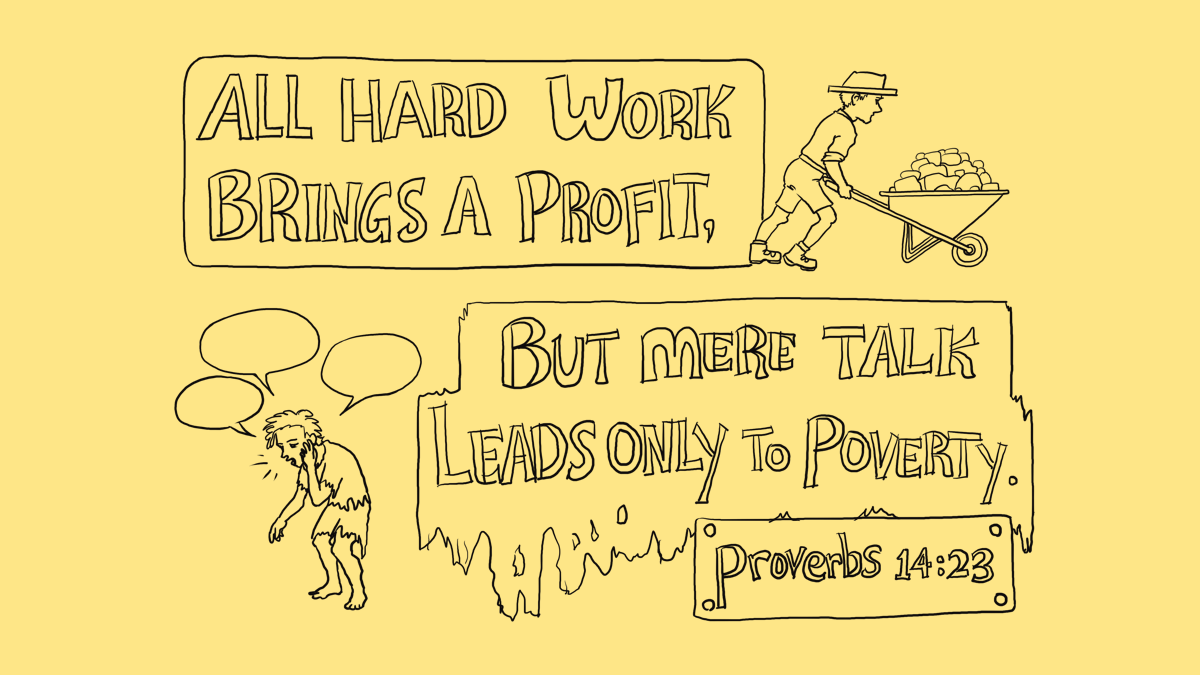
“All hard work brings a profit, but mere talk leads only to poverty.” (Prov. 14:23)

We all have these ideas about what should be done. And we love to talk about what ought to be done. “If I were in charge I would do this and this and this, I would change the world.” We see all the problems to complain about. But so often it’s all just talk. That’s because it is easier to talk than to do.

More proverbs in this section.

“Those who work their land will have abundant food, but those who chase fantasies have no sense.” (Prov. 12:11)

And

“The plans of the diligent lead to profit as surely as haste leads to poverty.” (Prov. 21:5)

Work is not easy. If it’s easy, maybe it’s a fantasy – beware. Chasing after fantasies is like latching onto the latest get-rich-quick scheme. Which makes my mind jump quickly to cryptocurrencies. My mind goes here because of the high-profile frauds and schemes that have accompanied this new space. Not saying cryptocurrencies are illegitimate for business engagement. I’m just saying that there were many people who were chasing fantasies, people who were hasty to make money, and ironically, they lost their money. That’s the kind of situation these proverbs are speaking about. There are times when we do our due diligence and we still lose our money on investments, or business gone wrong. It is a world of thorns and thistles to use the language of Genesis 3. There are snakes in the grass. Someone else’s dishonesty can lead to our poverty, sometimes. (we’re going to look at dishonesty in the next post) But these two proverbs warn us against chasing fantasies, and against being hasty in our work for the sake of money. Instead, to be diligent, to be, “slow and steady” as it were.

The proverbs council us, the wise person is diligent in their work, and not lazy.

What do we do about angry people around us?

Last post, we considered our own anger. All people have it in them. But, what do you do when other people are angry at you?

Because of the nature of sin and the nature of anger, it often perpetuates itself. Like it’s contagious. Someone else’s anger towards us can provoke our own angry. However, remember what I wrote in the last post – anger comes from within. So it is important to point out that other people’s anger doesn’t ‘make’ us angry. It is more accurate to say someone else’s anger against us tempts us into anger ourselves. That is the nature of anger. But instead of getting trapped in the cycle, God counsels us with a way out.

“A gentle answer turns away wrath, but a harsh word stirs up anger.” (Prov. 15:1).

The way of wisdom is not about retaliations or comebacks. Wisdom is not to respond in kind, but to be kind in our response. Anger perpetuates sin. When we are sinned against, it is easy to do the same. But proverbs counsels us,

“A person’s wisdom yields patience; it is to one’s glory to overlook an offense.” (Prov. 19:11)

This isn’t talking about overlooking a criminal offence. This talks about interpersonal difficulties – more small-scale. The stuff that happens the most often – hurtful words said without thought and in the heat of the moment. Wisdom counsels us to overlook, to cover it up, to let it go.

And when we don’t act on it, eventually, the emotion within us simmers down and we calm down.

More proverbial wisdom…

“Do not make friends with a hot-tempered person, do not associate with one easily angered, or you may learn their ways and get yourself ensnared.” (Prov. 22:24–25)

Sometimes this is easy to put into practice and sometimes it’s really difficult to put into practice. If it is someone online, or a friend of a friend, it’s not so hard to disassociate from them. But when it’s family, what do you do? This proverb says that where you have a choice, choose wisely whom you spend your time with. Where you don’t have a choice, do not excuse the problem. Love the angry person, but do not excuse angry behaviour. And do not take on their angry behaviour. Do not ‘learn their ways”

Ill quote Ed Welch, a Christian councellor and author at length.

“Friends can leave us ensnared in anger; family can do the same.

We tend to take on the mannerisms of those closest to us.

The child who hears anger from her parents will be playing house with angry dolls. Later, she herself might be the angry parent. Do you excuse the anger in your family’s home? Be careful. You can certainly love an angry family member, but don’t excuse anger. If you do, you will be tone deaf to your own imitation of that anger. Some families, and even some ethnic groups, boast about how they can be fighting fiercely one minute and hugging the next, as if that is a good thing. It is not. Proverbs counsels us, don’t learn the ways of anger.” 1

We put off the old self. We put away anger, and we put on the new self. We are not just changing what we do. We are changing who we are. Or better yet, God is changing us to be more like him, to be more like the Lord Jesus.

Not only does that motivate us, but it also empowers us. Proverbs isn’t just self-help but it’s God’s help. By the power of the Spirit, God is helping us and changing us. And that will make a difference in your life if you live your life for the Lord Jesus. We are becoming the people that God has made us. Becoming more like the Lord Jesus through the power of his spirit.

“Do not let any unwholesome talk come out of your mouths, but only what is helpful for building others up according to their needs, that it may benefit those who listen. And do not grieve the Holy Spirit of God, with whom you were sealed for the day of redemption. Get rid of all bitterness, rage and anger, brawling and slander, along with every form of malice. Be kind and compassionate to one another, forgiving each other, just as in Christ God forgave you.” (Eph. 4:29–32)


Welch, Edward T.. A Small Book about a Big Problem: Meditations on Anger, Patience, and Peace (p. 59). New Growth Press. Kindle Edition.

Wisdom that Tempers Anger

Have you ever considered what makes you angry? Most people assume that external circumstances cause their anger. For example, when stuck in traffic, it’s easy to feel angry because the external circumstance is intruding on our internal state.

However, it’s not always clear-cut. Understanding the internal origin of anger is important because it helps us identify the problem and provides us with more tools for dealing with it. The problem isn’t necessarily the external circumstances; it’s the anger that arises from within.

At this point, you might be thinking that there’s nothing wrong with getting angry. But is that really the case? According to Proverbs, anger is not associated with a wise life.

“An angry person stirs up conflict, and a hot-tempered person commits many sins.” (Prov. 29:22)

Is it sinful to be angry? Not necessarily. However, anger does make it easier to sin. A hot-tempered person, someone who is quick to get angry, is prone to sin. In summary, someone who is quick to get angry is slow to love God and slow to love people. Oppositely, someone who is quick to get angry, is quick to offend God and quick to hurt people.

Consider this perspective carefully because this is a particular way of viewing the problem. Anger is not ‘wrong’ because it hinders our happiness, or is psychologically unhealthy, or is emotionally damaging for myself (and potentially others). Anger is unwise, according to proverbs, because down the path of anger is the gate to sin. Proverbs 29:22 is saying we need to be motivated by a love for God and a love for people before we are motivated by some self-centered view of anger. I mention this because the world is obsessed with the self, and with psychological and emotional well-being (of which anger is a big part). But the Christian is obsessed with the love of God and those in his image.

What causes anger? Lots of anger comes from me saying, “I want…” Anger’s role in getting what we want has to do with power.

“The wise fear the LORD and shun evil, but a fool is hotheaded and yet feels secure.” (Prov. 14:16)

Anger says, ‘I’m not afraid of God, and I’m not afraid of you; in fact, you should be afraid of me, so don’t get in the road of what I want. Give me what I want.’ We get angry to get what we want because anger feels powerful. Or, as the proverb puts it, we “feel secure” when we are angry.

Another source of anger (not so much where it comes from but why it comes out) is a lack of self-control. The inability to control anger when it rises within us.

“Fools give full vent to their rage, but the wise bring calm in the end.” (Prov. 29:11)

The fool gives full vent. They let loose. They explode, flip the lid, and go berserk. They’ve lost control.

We might think other people “make” us angry. We might tell ourselves, ‘I wouldn’t be angry if they didn’t make me angry. It’s other people’s fault I’m angry. Not my own.’

Here is what James says in the bible.

“What causes fights and quarrels among you? Don’t they come from your desires that battle within you? You desire but do not have, so you kill. You covet but you cannot get what you want, so you quarrel and fight.” (James 4:1–2)

The Bible tells us that anger comes from within us.

So what should we do with these desires within us?

Earlier, we said that anger makes us feel powerful. If we want something, the best way to get it is to get angry and take it. ‘I don’t want it tomorrow I want it yesterday.’ Again the proverbs speak to this power and impatience which comes from anger.

“Better a patient person than a warrior, one with self-control than one who takes a city.” (Prov. 16:32)

Better to be patient than a “powerful warrior”, so to speak. Better to have self-control than to take control of a city. This proverb shows the importance of character over results. We often resort to anger because we think it will get us results. Does anger give us what we want? It’s ironic because when we are angry, no matter what we get, no matter what our anger achieves for us, we’re not happy with it. Do you know why? Because we’re angry! It is an ironic spiral of self-induced, self-purpetuating dissatisfaction.

Instead, the proverb says, it is better to be patient than a warrior, and to be self-controlled than control a city. Self-control is essentially the opposite to been hot-tempered. Instead of being quick to anger, with self-control, one is slow to anger. Proverbs speak of self-control and anger when it talks about patience.

“Whoever is patient has great understanding, but one who is quick-tempered displays folly.” (Prov. 14:29)

The issue of anger is an issue of character. It’s not about doing something different, it’s about being someone different. In the book of Proverbs, we are given a lot of practical advice – wise advice we ought to put into practice. But we need more than that. We need to see it put into practice. What does it look like to be wise? Instruction alone is not enough. We need an example.

We see this wisdom put into practice by the Lord Jesus, who is wisdom Himself. We see Jesus’ patience, love, and self-control. Even when we see his anger, it is not tainted by sin but by zeal for the Lord. His anger is so unlike our own anger. But the New Testament doesn’t only show us what wisdom looks like in the Lord Jesus. By trusting in the Lord Jesus the Bible says God changes our lives (we might reverse 1 Cor. 15:33 and say, “Good company transforms bad character.”) Now, by the power of the Holy Spirit who lives with us, our lives are changed. We bear the fruit of the Spirit – characteristics like patience, humility, and self-control.

Part of the way it happens is when God works in our lives through his word. When we read God’s word, like the proverbs, God speaks to us, challenges us and changes us to be people of self-control, patience, and humility, just like the Lord Jesus. Having a relationship with God is the doorway to a wise life. As the proverb says, “The fear of the LORD is the beginning of wisdom, and knowledge of the Holy One is understanding.” (Prov. 9:10)

Proverbial Wisdom with Money in a Proverbially Foolish Context

Do you think you handle money wisely? It would be nice to answer in the affirmative. Certainly, we need wisdom when it comes to handling money. Not in order that we can make more of the ephemeral stuff. We aren’t talking about money management wisdom. We are talking about biblical, character-trait wisdom. Money has this strange intangible influence over us, seemingly like it has a power all its own. Hence the need for wisdom, or as we have else put it, discernment. A good place for that is proverbs.

When speaking about money, Proverbs puts it straight – people with money have power. The rich enjoy more security influence and power, while the poor are left more vulnerable.

For example,

“The wealth of the rich is their fortified city, but poverty is the ruin of the poor.” (Prov. 10:15)

This is simply an observation. Poverty is bad for people, while wealth provides a certain kind of “security”, we might say, a certain kind of power. So, while the poor have less power, the rich have more power (at least in a worldly sense).

But…

“The wealth of the rich is their fortified city; they imagine it a wall too high to scale.” (Prov. 18:11).

There’s something hidden in that proverb. The security that wealth provides is partly imaginary. We get an ethereal vestige of the ephemeral nature of wealth in this verse.

More observations.

“The poor are shunned even by their neighbors, but the rich have many friends.” (Prov. 14:20).

Again…

“Wealth attracts many friends, but even the closest friend of the poor person deserts them.” (Prov. 19:4).

Proverbs isn’t commending this state of affairs. Just stating it. It’s the reality. Money is attractive and money attracts people so-called “friends”. But of course, they are not real friends if they desert you when you need them most. There is something attractive about money. But people who are attracted to money will leave when the money dries up. No one cares about the movie star who has gone broke or the former professional athlete who is now an alcoholic and a drug addict (in fact, former associations are often embarrassing to once-upon-a-time friends). The money is gone and their friends are gone. A terrible reality. That’s all proverbs is saying about that. Not a commendable state of affairs.

Continuing on the theme of power

“The poor plead for mercy, but the rich answer harshly.” (Prov. 18:23).

And,

“The rich rule over the poor, and the borrower is slave to the lender.” (Prov. 22:7).

Have you ever thought of debt as slavery? They say every Sydney conversation leads to housing prices, so it happens I’ve had numerous conversations about this very passage and its application to the modern property marketplace. Consider, “Mortgage” literally comes from the word “Death-Pact”. Ominous. It just makes you think. Even though debt is an economic reality, even a necessity, this proverb simply makes you stop and think twice. Basically, money is more than money.

There is an inescapable link between money and power. Those who are rich have more security, influence, and power, while those who are poor have less and are vulnerable.

This says nothing about what we ought to do with money. Hence Proverbs councils us about the danger of trusting in money. Because money often leads to security, influence, and power, It is very easy for us to trust in money. Which is precisely why proverbs warns us of this danger.

“Do not wear yourself out to get rich; do not trust your own cleverness. Cast but a glance at riches, and they are gone, for they will surely sprout wings and fly off to the sky like an eagle.” (Prov. 23:4–5).

Maybe you feel like you’ve worn yourself out chasing after money. But you look back and wonder, “Where did all my money go?” It sprouted wings and flew off! Perhaps you know people who are doing this themselves (work colleagues or family, or friends), chasing after money but finding the money runs faster than the big Bolt. Losing money in itself is not a big deal. It’s about what you trust in. Like we looked at earlier money is about more than money.

“Those who trust in their riches will fall, but the righteous will thrive like a green leaf.” (Prov. 11:28).

To trust in money (ironically to our modern ears) takes us away from a thriving life. Oppositely, the righteous thrive with life. Put another way, those that trust in God thrive like a leaf full of life. Either, you trust in money or you trust in God in this proverb. Jesus would say, “You can’t love money and God. You can’t serve both. You’ve got to choose one.”

So why would you choose to trust in God over money?

“Wealth is worthless in the day of wrath, but righteousness delivers from death.” (Prov. 11:4).

It is an absurd thing to think that when I do wrong I can make it right by paying money. Money doesn’t right wrongs. That is absurd. How much more absurd with God? Money can’t buy us a relationship with God. Completely absurd. But many thought that way before the reformation. The only thing that will count when we stand before God is if we have trusted in him. That’s what the Bible calls righteousness. To be righteous (on account of trusting in Jesus), is what delivers us from death. That is what brings us back into a relationship with God.

Proverbs says there is a danger of trusting in money, not only because it’s so fleeting but because money is about more than just money. When we trust in money we are in danger of not trusting God and we start loving the created things rather than the Creator.

So instead of trusting in money what should we do?

We should be generous with our money.

“One person gives freely, yet gains even more; another withholds unduly, but comes to poverty. A generous person will prosper; whoever refreshes others will be refreshed.” (Prov. 11:24–25).

It is hard to believe that this is a wise thing to do. We find it difficult to believe that a generous person is been wise with their money because we have been told constantly that a wise person looks after themselves. You always put yourself first, right? (and even if we wouldn’t say it, we live it)

The proverb we just read is not a mathematical equation. It’s a proverb. It’s not a promise. It’s a proverb. That means it’s making an observation of sorts. It points out the way that God generally works in His world. There is even some secular research to confirm this (to a degree. See Adam Grant’s, “Give and Take”)

What this proverb is pointing out is the irony in the way a wise person lives and a foolish person lives. The irony is, that a generous person receives blessings while the stingy person ends up in the position they always feared would happen.

The Proverbs say a wise person is a generous person. Does that mean we should just be generous in general? Sort of. But I think a Christian can do better and should do better. Let me be a little bit more specific about what the bible prioritises. I think a Christian should, first of all, be generous to their local church. Then to Christian missionaries and missionary organisations. Then to Christian charities. Then, to Christian organisations. So what’s not on the list and why? The world is filled with people who don’t believe in Jesus. They will support non-Christian not-for-profits (think, save the pandas sort of stuff). But they will not support; the local church, missionaries, and Christian organisations. Only you, as a Christian, will do that. So you should prioritise that. But of course, you have the Christian liberty and freedom to support what you want.

That is to be very particular about the topic of generosity. But more broadly speaking, the Bible calls all Christians to be generous people. As the Lord Jesus is generous with us, we are generous to Him.

The world around us does not train us to be generous people. It trains us to think about ourselves. I always have a selfish voice in my mind. And I know that those thoughts aren’t God’s thoughts. They come from the extensive teaching I have received from the world around me. But the voice of the Lord, in his wisdom, in his word, councils us to be generous people.

Finally, let me round off by highlighting a personal favourite principle from the proverbs. Proverbs counsels us towards a balanced life. Not too much, not too little. The motivation for living a balanced life is to avoid spiritual dangers – to avoid sin and to love and honour God. In essence, it’s the wisdom of living a contented life.

““Every word of God is flawless; he is a shield to those who take refuge in him. Do not add to his words, or he will rebuke you and prove you a liar. Two things I ask of you, LORD; do not refuse me before I die: Keep falsehood and lies far from me; give me neither poverty nor riches, but give me only my daily bread. Otherwise, I may have too much and disown you and say, ‘Who is the LORD?’ Or I may become poor and steal, and so dishonour the name of my God.” (Prov. 30:5–9).


Foolish Words in an Expressive Age

Might it be fair to say that in a society that so highly favours individual expression, expression of thought in speech included, we would therefore experience proportionally more unrestrained and foolish speech as a result? I imagine so, because our hearts are naturally septic tanks overflowing out of the gutter of our mouths. Put simply (and less grotesquely), our hearts are displayed in our words. The less restrained (and more expressive) we are with our words, the more we see the foolishness of our own hearts and that of others around us. Fortunately, the Lord has given us counsel for this matter. What does a wise person do when a fool displays unrestrained and destructive speech?

“Do not speak to fools, for they will scorn your prudent words.”(Prov. 23:9)

It makes us wonder who the fool is. At times we all speak destructive and unrestrained words that hurt others. That doesn’t necessarily mean that we are a fool. We may act foolishly at times, certainly. But I think we are called to exercise discernment, essentially, wisdom. A ‘proverbial’ fool, we might say, is someone who, as a pattern of behaviour, spews forth unrestrained and destructive words.

Because of the nature of foolishness, which leads to the harm of others, proverbs councils us to distance ourselves from such a person. Much as you would stay away from a burning building. The less self-control a person has, the more we bear our hearts. And let us remember that our hearts can be terribly dark places.

Sometimes it’s easier, and sometimes it’s harder to put distance between us and a fool. If it’s just an acquaintance, a friend of a friend, it is easier to stay away from them. But other times it is more difficult. The fool might be a relative of sorts. They might be a work colleague whose proximity is not at your discretion. How do you keep your distance from them?

The nature of Proverbs in its prescribed wisdom means general advice is given, but each reader and individual must apply it to their specifics. Naturally, this is the part that we do not like because it requires work. But we must take responsibility. However, the wisdom of Proverbs is not merely for an individual. We are part of a community of faith that seeks to interpret and apply the wisdom of God to all of life. The wisdom of the community of faith is at your disposal to help you and guide you. What does it mean for a Tradie to be wise on the job site? It’s worth asking other tradesmen. But as wise as they may be, asking an IT specialist for wisdom about dealing with the Sparky you’re contracted with may not be as helpful.

There are times when the specifics require specialised insight. But there are also times for which the wisdom of Proverbs can apply more generally. For example, most of our society is active on social media. In theory, this is the easiest place to apply the wisdom of proverbs with regard to keeping our distance from foolish speakers. It’s literally built into the system.

Social media can be a black-and-white display of people. I personally think about Youtube (as it is the social media outlet I use most). With regard to Youtube (and this can be said of many media outlets in general), it’s often the most foolish people who are the most popular people. People say awful things on social media. We might say that they are bearing their hearts. When they do, it’s so obvious. In such an instance, you can take action really quickly and easily. You simply stop following them. That’s easy to do, at least in theory. But it is particularly important to do that.

What will it mean for you to keep your distance from a fool? Again, it is difficult to say. Nevertheless, I think it is worth asking yourself and reflecting on your specific circumstances and relationships. As I said at the beginning, in a world that holds personal expression (including that of our words) as one of the greatest virtues, self-discipline and restraint will naturally be held in lower esteem. I would surmise that it will become increasingly necessary for us to learn how to deal wisely with foolish speech (as is already happening). So perhaps it is going to be wise for you to meditate on the wisdom of Proverbs with regard to this very matter.

Consider the words of the Lord Jesus.

“No good tree bears bad fruit, nor does a bad tree bear good fruit. Each tree is recognised by its own fruit. People do not pick figs from thornbushes, or grapes from briers. A good man brings good things out of the good stored up in his heart, and an evil man brings evil things out of the evil stored up in his heart. For the mouth speaks what the heart is full of.” (Luke 6:43–45)

Rereading Digital Minimalism by Cal Newport

How often do you tune up your tech life or your tech engagement?

I imagine that it was more like a phase if you’ve ever done that. One might make a number of significant adjustments and incorporate new principles, mottos, and values into this emerging and complex sphere. But like all things, our lives gravitate towards complexity and chaos as if chaos and complexity had a gravity all their own. We are all orbiting around it, trying to keep a safe distance and fly an orderly trajectory. We might avoid danger in a crisis because it is pressing and demands our attention (for example, we notice we are becoming acutely anxious the more time we spend on social media pushing us to make an adjustment). But a trajectory towards danger happens incrementally. And so, setting the trajectory again and again at more regular intervals is a better and more helpful management in this metaphor.

Rereading a book is like setting the trajectory again. Rereading is like reassessing.

Rereading the book Digital Minimalism by Cal Newport served this purpose for my own orbit around the tech planet as I skim across its atmosphere. Rereading the book was a reminder of the way that tech is designed. Tech (and media) corporations, like any corporation, want you to keep coming back to their products. Of course that’s what Cal Newport also wants (presumably). He wants me to keep engaging with his book. And I have! As I reread it, I saw the need to adjust my habits and engagement with my phone again.

Despite my convictions and principles about my phone, I reflect and see that I have drifted into practices I was seeking to avoid. And then I am reminded of how hard companies work to get my attention and to have me return to them. I would consider myself a conscious consumer, yet I can easily get baited into a more compulsive use of my technologies and the media to which I subscribe.

Obviously, I am proposing that we cannot be content to drift into more complexity and chaos regarding our use of technology. These new media and technology improvements are developing at such a rapid rate and we are adjusting at a much slower rate with little understanding of what it is doing to us even as there is a growing body of literature about what it does to us. With humility, we understand that we understand very little, although we are fooled by our collective genius to create such technologies. But this collective human intellect and genius does not translate to a correlating amount of practical wisdom.

We know that knowing stuff is not enough. Character is important. So on principle, a degree of humility that assumes that one is getting it wrong will serve us well. Just as new media sows dissatisfaction in us, ironically leading us to seek satisfaction in them (as if the poison were the cure), we can cultivate and embrace dissatisfaction with our engagement with new technologies and new media. This causes us to constantly reflect and assume that we are not engaging well and could engage better with something so unknown. Less engagement is not the answer of course. Less thoughtless engagement is the answer as well as more thoughtful engagement. This will require re-assessing. And maybe even something counter-cultural and seemingly counter-productive, the act of rereading (digital minimalism, that is). A great book.

Jesus as a Way of Life

The Christian is called to imitate the life of Christ. In part, this invitation has to do with the character of Christ (his love, patience, humility, et cetera), and in part has to do with some of his practices (like prayer). Specifically thinking about how we ought to imitate the life of Christ and follow him in character and practice, one author and pastor (John Mark Comer) in his book, “The Ruthless Elimination of Hurry” seeks to tease out what it means to follow Christ in an age of “hurry” and “hustle” where we are time poor, stressed, stretched, and even spiritually fatigued. An excellent endevour. How ought the Christian to imitate Christ with specific regard and application to the busyness of our lives?

The Books Ideas

Let me start by summarising some of Comber’s ideas in his book.

One of the sections of his book is called “the secret of the easy yoke”. As we read the Gospels and see the life of Jesus, we should find his way of life compelling. In one sense, the disciples of Jesus were called to follow him which literally meant to be around Jesus and to literally follow him, doing what he does. It also meant to adhere to his teachings. So when Jesus speaks of his easy yoke, he is, in part, talking about his teachings, teachings which free us from the burden of legalism and give us rest. Jesus also says He is the way, the truth, and the life. Comer writes, “we want the life without the lifestyle”. Meaning something like, ‘we want the benefits of Jesus in our life without necessarily having to ‘follow’ his lifestyle.’ So we might read stories about Jesus and his joy, his peace during uncertainty, his non-anxious presence, his relaxed manner, how he was present in the moment, and we then desire that kind of life. However, we are not willing to adopt his lifestyle. Comer reflects that following Jesus costs us our life, that there is death, but there is also life – an empty tomb. Comer reflects on ‘the way of Jesus’, saying it is a way of life. It is not merely ideas or ethics – Do’s and Don’t. Instead it is a lifestyle. And the lifestyle is what is often missed.

In another section of his book, “a common rule for life”, Comer digs a little deeper into some specifics of Jesus lifestyle. Comer remarks that Jesus was rarely in a hurry. By illustration, Comer asks us to imagine a stressed-out Jesus who gets short-tempered after a long day of work and lashes out at people. Can we imagine Jesus half talking to us and half texting on his iPhone or saying he’d love to speak to us but has a plane to catch to get to the next Ted-X conference in Jerusalem? No, we can’t imagine Jesus acting like this. As Comer points out, Lazarus is dying, and Jesus takes his time to get to him (for specific reasons of course). As Jesus travels to heal Jairus’s daughter, he allows himself to be interrupted, showing that he is in no rush. Jesus does get annoyed with the arrogant religious authorities but not with interruptions. Comer remarks that Jesus’ life is sometimes full to the brim, yet he doesn’t come off as hurried. This unhurried life is not because he lives before Wi-Fi and technology like us. Instead, it comes from his ‘way of life’. Looking at the lifestyle of Jesus, Comer says he has healthy boundaries. Jesus regularly prays alone. At times he is sleeping and needs to be woken up by his disciples. He enjoys a meal with friends over a bottle of wine. He practices a sabbath weekly. He even practised simplicity before it was cool with just the clothes on his back. He is not chasing after money. All this is because he said ‘yes’ to the Father and the heavenly kingdom, which means he says ‘no’ to all other distractions.

Comer asks us to imagine how Jesus would live if he were me. This requires us to do some cultural transposing. How would Jesus be a parent, an account manager, or a truck driver? Comer suggests Jesus would do those things “way slower”. Comer is asking us to ‘imitate Jesus’ in culturally appropriate ways (with specific reference to our culture of hustle and hurry), after all, the gospel is not merely a set of ideas for which we give ascent but an invitation to a relationship with Jesus. Part of that relationship is to trust but also to ‘follow’. Comer uses that word, or wants us to take that word (‘follow’), more literally. So although we can’t literally follow Jesus, we imitate Him.

That’s a brief summary of some of the key ideas of John Mark Comer’s book, “The Ruthless Elimination of Hurry.” Any misrepresentation is my own, so go read the book yourself and see if I’ve summarised well enough. And I do recommend it as a read. It is a good read. I listened to it, and Comer reads it. He is a good author, and for someone of my generation (Y), his laid-back tone and mannerisms are refreshing in a theological book. You might say, hipster.

Some Thoughts

Moving from his thoughts to my own interaction with those thoughts now. There is plenty of good to say about this book and these ideas. You can’t argue with some of those key ideas. We are called to imitate Christ, and even Paul insofar as Paul imitates Christ, and by derivatives, we would say we imitate our spiritual leaders in much the same way as they imitate Christ.

Comer has intentionally applied this teaching to imitate and follow Jesus to a narrow and focused area in our modern lives. Again, commendable, as we want to know how to follow Jesus in all our life and every area of life (which necessitates us asking how to specifically do that in specific areas).

However, I do have some reservations. Perhaps, not ‘reservations’ as such but merely questions. Im not sure I’d disagree with Comer. I’m just questioning the route which was taken to get to his conclusions.

Here are some thoughts in no particular order.

I’m not intirely convinced the gospel give us a biography of Jesus in order to show us what exactly to do. Most notably, we don’t, nor can we, go out and cast out demons and heal and raise the dead, even though the disciples did that as they “followed Jesus”. So there are some basic and clear boundaries. But where do those boundaries end or begin? How do we make sure we put those boundaries in the right place? Otherwise, someone might argue we are not faithful if we are not healing the sick. Still, another might say we are been legalistic if we insist we follow Jesus by literally keeping the Saboth on a Saturday as he (a Jewish man) did. Somewhere in these boundaries is the lifestyle of Jesus. Comer, for his part, in an unspoken way, applies the principles of Jesus’ lifestyle instead of the particulars. That’s commendable. But it’s still tricky to get to the principles and then transpose them to our particulars. That’s a matter of wisdom, I suppose.

Continuing, when Jesus is spoken of as “the way (the truth and life)”, I see it as arguably more likely that he is speaking of himself as the “way” to the Father, not necessarily as the way (or we might paraphrase, ‘style’) of life. Not to say Comer makes an illegitimate point, but maybe he makes the point from a spurious place.

Continuing, taking into account the broader New Testament teachings, I don’t think there’s a place in the New Testament that says, in effect, ‘because Jesus lived a life in which he was interrupted by people and gave his time to people, that is why we live a life that is interruptible but also has boundaries, has margins, so that we can care for people with our time, and that we’re not such busy people because Jesus was not too busy, he kept his eyes on the important things, saving people ultimately, etc.’ We don’t get told this. But we do get told to take Jesus as an example. Yet, it’s regarding his suffering, “To this you were called, because Christ suffered for you, leaving you an example, that you should follow in his steps.” (1 Pet. 2:21). We could extrapolate and say Christ’s example is at least in his suffering, but surely also in all his life. True. But again, I think we are looking at the example of Christ in terms of his character. We look to his humility, his wisdom to speak at times and be silent at other times, and his love for his friends.

A final thought: the world of the 1st century was so different to our own. I merely need to consider Luke 2:41-52, where Jesus is assumed to be with family and friends while his parents make their way home from the temple, but after a whole day, they look for him. Bearing this in mind, I find the task of culturally transposing Jesus’ lifestyle while simultaneously making a distinction between his lifestyle and the general culture of the time into our own time a task that seems very demanding indeed.

Another source for the same application

So, having considered all the above, what then do we do? To repeat it, I don’t think there is anything objectionable in Comers’ writing per se. I believe he has the correct application coming from a means that I’m unsure about. So where might be the right place?

If we were going to stick to the Gospels, I think one of the most apparent places or stories is Jesus’ interaction with Mary and Martha. This is such a famous story on this very topic. I think it also displays exactly the kind of principles which Comber is seeking to explain throughout his book; that life is critically more important than the urgent and demanding tasks that cause us to hustle and bustle in our busyness and yet deprive us of the very thing we need most, to sit at the feet of Jesus in peace.

On top of that, we could consider the Lord Jesus’s teachings on money. This is very closely associated with work and therefore speaks saliently to modern work culture. As we seek so diligently, to our detriment, to work harder and harder and get more and more done for more and more money, our heavenly Father sees our needs and provides for us. On our part, and implicit in the teaching, is a call to be content with this provision.

Conclusion

In sum, a good book. Well written (at least to my generationally Y-attuned ears). And a thoroughly gospel-centred book. But for specific applications, I would instead consider more particularly some of the teachings on work and money that Jesus expounds in his parables and also look more closely at the story of Mary and Martha. These would bolster this book and what you take away from it.


Comer, J. M. (2019). The ruthless elimination of hurry: How to stay emotionally healthy and spiritually alive in our current chaos. Hodder & Stoughton.