Good People Think Better

To understand why you believe what you believe or know what you know is perhaps more important now, given that the marketplace of ideas has become globalised, democratised, and monetised. That’s to say that ideas from all across the world are accessible to you near instantly. The voices you hear are not necessarily those of an elite education per se, but simply the ordinary voices of people like ourselves. But people like ourselves, when given the opportunity—or when they see the opportunity—will do all sorts of things for money, namely promoting all sorts of ideas and selling them (or being paid to sell them). I hate to go there, but by way of illustration I’m basically talking about social media. But at a lesser scale I’m really just talking about the Internet. On the Internet, all sorts of wonderfully thoughtful people exist right next to thoughtless people. And on the Internet it’s simply a marketplace of ideas. How do we sift through them and determine those which are good from those which are bad? That question is simply the question of epistemology (how we know what we know—determining truth).

Looking for truth will require excellence in your intellectual life. But not only excellence in logic (which is probably what you’re thinking about right now when I say that), but excellence in character (something less often considered). You will need wisdom, caution, intellectual humility, love (of truth and people), along with other virtues. That’s to say that the intellectual life is not merely intellectual. It is also formed and informed by character and virtue.

By way of illustration, we know that physical health plays a part in intellectual ability. Some physical disabilities will mean that your senses won’t work properly and your judgements will be in error. Likewise, there is an interplay between emotions and perception and truth, and again between pain and suffering, and emotion, and judgement or perception. Consider Alzheimer’s, or anxiety, or depression, or hearing loss. In the same way, moral character can undermine good thinking. There is an interplay between good thinking and good morality—between the intellectual life and the moral life. This is absolutely nothing new in a religious sphere or to the religiously minded. But I have a feeling that it is very much something that religious and secular people alike are neglecting. So it is that those who are arrogant or dishonest or lazy will have an impeded ability to think well and pursue truth.

And he [Christ] gave the apostles, the prophets, the evangelists, the shepherds and teachers, to equip the saints for the work of ministry, for building up the body of Christ, until we all attain to the unity of the faith and of the knowledge of the Son of God, to mature manhood, to the measure of the stature of the fullness of Christ, so that we may no longer be children, tossed to and fro by the waves and carried about by every wind of doctrine, by human cunning, by craftiness in deceitful schemes.” (Ephesians 4:11–14)

Do you know immature thinkers (regardless of their age) who are tossed about? And do you know those who are using their cunning and craftiness to do so?

“For the time is coming when people will not endure sound teaching, but having itching ears they will accumulate for themselves teachers to suit their own passions, and will turn away from listening to the truth and wander off into myths.” (2 Timothy 4:3–4)

There is a moral, self-centred, and self-pleasing aspect which repudiates sound teaching because of its own passions.

These two passages clearly speak of the overlap between moral fortitude and intellectual aptitude. So clearly the Christian is called to develop both in tandem—cultivating virtue by the sanctifying power of the Spirit, and cultivating knowledge by the enlightening work of the Spirit. In this sense we might say that, similar to how having a physical deficit in sight or hearing will inhibit your ability to understand truth (something we are completely aware of), having a moral deficit will also inhibit your ability, when provided with evidence, to understand truth. So the arrogant intellectual dismisses the lived experience and ideas of the pleb, and the greedy producer dismisses the evidence of the safety advisor.

And those two little illustrations also demonstrate something more. It’s not just that the arrogant intellectual or greedy producer should be judged on the one bad decision—to dismiss the evidence of ordinary people or to produce dangerous goods in that moment. That’s because we understand that their character isn’t something that simply exists in that moment but is who they are. Many and various decisions by these two characters will be tainted by greed or arrogance over the course of time unless something changes morally. And character is judged over time. In the same way (though again this is not how we naturally think, in my opinion) we don’t simply judge one snapshot or narrow idea held by a person or propagated by a person. Sound reasoning or sound beliefs are best determined or judged over time, which would reflect the virtue of patience in one sense.

So it is that epistemology—or the judging of someone’s epistemology—is the concern of a lifetime. Attention is not merely to the end product but also to the formation of the belief framework, and even its maintenance and revision. It’s not just what you believe but how you came to believe that, though obviously it is very important what you believe.

Clearly we wouldn’t judge someone’s faith simply by their Sunday attendance and everything pertaining to it. No, there are six other days which will be accruing evidence of their faith and its quality. Likewise, with one’s beliefs. They are not merely a matter of that moment but are a product of many factors leading up to that moment, including the character that individual exercised in discerning their beliefs.

So should everyone find it necessary to explain why they believe what they believe? I don’t think so (though I think it would be helpful for everyone). But that’s a different question from whether every person ought to pursue truth in good character—for which the answer is absolutely yes. And this is why character is important in the intellectual life. Intellectualism isn’t required of all people, but moral character is.

Consider Paul’s argument in 1 Corinthians 8:1–3:

Now concerning food offered to idols: we know that ‘all of us possess knowledge.’ This ‘knowledge’ puffs up, but love builds up. If anyone imagines that he knows something, he does not yet know as he ought to know. But if anyone loves God, he is known by God.” (1 Corinthians 8:1–3)

It’s not that knowledge is wrong or inherently problematic. In the very next verse Paul speaks of some fundamental truths which we would love everyone to know: “Therefore, as to the eating of food offered to idols, we know that ‘an idol has no real existence,’ and that ‘there is no God but one.’” (1 Corinthians 8:4)

The problem is that loveless knowledge is of no benefit. So a knowledge of what is true must be coupled with love. Love is by nature personal. So it is that knowledge is not going to be merely abstract but will—even if circuitously—affect one’s life (ethics). A clear link and bond between character and knowledge is given in 1 Corinthians 8.

So although not all people are required to have great knowledge or to be capable of sophisticated understandings, all people are required to love truth and apply truth to their life. All people are to seek truth because all truth will impact their actions. And the way that they are to seek truth is through good virtues—discretion and patience, love and discernment, integrity and teachability, circumspection and humility enough to admit error.

And if we’re thinking about moral transformation, then certainly we must be dependent on the Lord. Without the work of his Spirit of regeneration and sanctification through faith in Christ, we would be left to the devices of our own sin (and its outworking being deception or self-deception, or wilful ignorance). These vices are only kept in check by the common grace of God.

And so the Christian is equipped with the sanctifying Spirit to pursue maturity in the faith by pursuing a growing knowledge and love of God and others.

As the apostle Peter puts it:

His divine power has granted to us all things that pertain to life and godliness, through the knowledge of him who called us to his own glory and excellence, by which he has granted to us his precious and very great promises, so that through them you may become partakers of the divine nature, having escaped from the corruption that is in the world because of sinful desire. For this very reason, make every effort to supplement your faith with virtue, and virtue with knowledge, and knowledge with self-control, and self-control with steadfastness, and steadfastness with godliness, and godliness with brotherly affection, and brotherly affection with love. For if these qualities are yours and are increasing, they keep you from being ineffective or unfruitful in the knowledge of our Lord Jesus Christ. For whoever lacks these qualities is so nearsighted that he is blind, having forgotten that he was cleansed from his former sins.” (2 Peter 1:3–9)


Wood, W. J. (1998). Epistemology: Becoming intellectually virtuous. InterVarsity Press. Pages 1-32

Genesis 23 – A Grave in a Cave

I’m not saying it’s my favourite passage in Genesis, because I think a passage so seemingly bland isn’t allowed to be one’s favourite. That being said… Genesis 23, aye. Simply: Sarah, the wife of Abraham, dies, and Abraham buys land to bury her. It’s mostly about a business deal. Where are the explosions, the samurai swords, and the international espionage (i.e. Gen 14—I imagine Abraham has fourteen-inch biceps and an eight-pack at age eighty)? Chapter 23 may read like a real estate transaction, but it’s Abraham’s first and only glimpse of owning even a corner of the land God promised. I find that remarkable given the promises made to Abraham and their centrality, but it shows the unfolding nature of God’s promises—again, especially noteworthy when viewed from this far away and after so much fulfilment. So maybe the reason why I love this passage so much, oddly, is because it makes me really appreciate biblical theology.

It starts with a death: the death of Sarah, the wife of Abraham. We might call her the mother of the faith in some respects.

“Sarah lived to be a hundred and twenty-seven years old. She died at Kiriath Arba (that is, Hebron) in the land of Canaan, and Abraham went to mourn for Sarah and to weep over her.” (Genesis 23:1–2)

At the end of this chapter, after Abraham has bought some land, he buries his wife Sarah—the first recorded burial. It’s weird to say, but Sarah’s death is just a preamble—a setup—for Abraham buying property. But how interesting that death is used as the grounds for purchasing part of the promised land. Preamble over. This chapter is really about real estate.

If you were to say what three things the Bible is concerned with, you could very legitimately argue, as Sydney theologian Graeme Goldsworthy has convincingly argued: the Bible is about God’s people, under God’s rule, in God’s land. And that is exactly what we’re seeing here in Genesis—we’re seeing the genesis of these three ideas which will unfold over the whole biblical narrative.

God’s people are the descendants of Abraham. God’s rule is seen when Abraham, Sarah, and their descendants live by faith in God—when they trust and obey Him. And God’s land is the land of Canaan. But at this stage, Abraham doesn’t actually own anything in Canaan (though he was promised it all)—until Genesis 23.

“Then Abraham rose from beside his dead wife and spoke to the Hittites. He said, ‘I am a foreigner and stranger among you. Sell me some property for a burial site here so I can bury my dead.’” (Genesis 23:3–4)

The Hittites offer Abraham a free tomb, but he’s not having it (for nothing). After some classic Middle Eastern haggling with Ephron, Abraham buys the cave of Machpelah for four hundred shekels. The passage records more than just Ancient Near Eastern haggling rituals—it’s a public purchase, with many witnesses. It’s an indisputable transaction, paid according to the weight of the merchants at the time. The land is legally deeded to Abraham.

Abraham legally owning this land is very different from accepting a free gift of land (similar logic to Abraham’s refusal of the king of Sodom’s gifts in Gen 14). When my brother and I were kids, our neighbours took a fence panel out and let us into their backyard to kick a ball. But that gift only lasted as long as they lived there. When they moved, the gift disappeared. That’s the same danger Abraham faced if he accepted the burial ground as a gift. What if one day the gift was taken back? But now it can’t be—he owns it.

It may seem trivial (which is part of the reason I like this chapter so much), but this is actually very important to the book of Genesis—especially to the unfolding of God’s promises (and biblical theology—again, why I like it). It’s not just Sarah who ends up buried in this tomb. Abraham, Isaac, Jacob, Rebekah, and Leah are all buried there in the end.

At the end of Genesis, Jacob says,
“I am about to be gathered to my people. Bury me with my fathers in the cave in the field of Ephron the Hittite… There Abraham and his wife Sarah were buried, there Isaac and his wife Rebekah were buried, and there I buried Leah.” (Genesis 49:29–32)

The whole family is buried in this one place! But remember—this is not their homeland. It’s important that Abraham doesn’t go back to his homeland to be buried. He didn’t go back to Ur of the Chaldees for his burial plot. Have you ever thought about where you will be buried? Because it might not be the town or even the country where you die. Where you are buried says a lot about you. Which is why I know you’ve thought about it, even if you don’t want to be buried as such.

That Abraham’s whole family is buried in this one little plot of land says something. This burial ground is the only piece of land Abraham ever owns. God promised him the whole land—and all Abraham ever gets is a little grave in a cave.

All of this should make Hebrews 11 come to life:
“All these people were still living by faith when they died. They did not receive the things promised; they only saw them and welcomed them from a distance, admitting that they were foreigners and strangers on earth… Instead, they were longing for a better country—a heavenly one. Therefore God is not ashamed to be called their God, for he has prepared a city for them.” (Hebrews 11:13–16)

Genesis 23 has helped me immensely in seeing the significance of the words of Hebrews 11 (which is often a favourite for people). That’s because Gen 23 is a picture of faith. This is what faith looks like.

As Christians (spiritual descendants of Abraham—stars in the sky, you might say), we look back to the work of Jesus in faith. We trust in His death on our behalf. We believe He is risen from the dead and ruling from heaven. And we believe He will come again. These are the deeds and the promises of God. We have received the Holy Spirit as a down payment of the inheritance to come. Much like Abraham and Sarah were foreigners and strangers on earth, so too is every Christian. This place isn’t our home—we are looking to a new home, a city prepared by God.

Brilliantly, Genesis 23 is emblematic of God’s people. They receive the promises of God for land (among other things), but they receive it only in part while they faithfully wait or hope or long for the fulfilment. Likewise for us. We receive the promises of God, fulfilled in Jesus, and yet we also look forward with faith to the return and culmination of those promises, inheriting the land to come—heaven.

I hope I’ve convinced you to bump Genesis 23 into your top ten Old Testament passages.

Brief Thoughts on Creation (without getting too apologetic)

Do you find it peculiar that in modern scientific university departments there are Christians? I hope not. But I reckon that a number of people around you would be surprised by that fact. It’s probably about a 50/50 Christian-to-atheist ratio according to Gerald Bray.

Why isn’t this a surprising matter?

Because, “In the beginning God created the heavens and the earth.” (Gen. 1:1)

It’s really important to use the word creation. Behind that word is clearly a creator. And this is one of the fundamental aspects of reality—the Creator and creation distinction. One is not the other, nor is there only one and no other. Some might argue that the universe is simply a “brute fact” (Bertrand Russell), and that matter and energy simply are. People might say that matter and energy are eternal—without beginning or end. That’s scientifically tricky because the current scientific consensus points towards a beginning (the Big Bang). And it’s philosophically tricky because every moment depends on the moment before it. And if there is no first moment, well, there’s no next moment—there is no present. Even if the universe were eternal, that wouldn’t explain its existence at all—it’s not self-explanatory. Why is there something rather than nothing? Anyway, getting too deep (I know not everyone finds this helpful, but perhaps it might be a helpful primer for others).

What about the fact that there is order in the universe at all? This is something that is often taken for granted in these debates. But not so for the Christian, because, “God said, ‘Let the land produce living creatures according to their kinds…’ And it was so.” (Genesis 1:24) “The land produced vegetation: plants bearing seed according to their kinds and trees bearing fruit with seed in it according to their kinds.” (Genesis 1:12) “Then God said, ‘Let the water teem with living creatures, and let birds fly above the earth… each according to their kinds.’” (Genesis 1:20–21)

The ordered universe reflects the deliberate structure and design of God’s creative work, for “God saw all that he had made, and it was very good.” (Genesis 1:31) The ordered nature of the universe means that we can trust our senses as we delve into the depths of its beauty. We can rely on the fact that what we have experienced will be there again to be experienced by others and by ourselves. The formless and empty darkness of verse 2 is intentionally filled.

So what is the nature of the universe (creation)? Is it at heart one of chaos or one of order? That is easy to answer if you’re a Christian, but not so easy to justify if you’re not. Though not about creation per se, Paul still says, “God is not a God of disorder but of peace.” (1 Cor. 14:33)

But the most wonderful thing about creation is that it is sustained by God in love. Creation—this universe—is not just “a fact.” It is endowed with the love of God, something greater and deeper and more meaningful than mere matter and energy. There is beauty, truth, and goodness in life (metaphysics). How can this be? Simple. Because God—He is Truth, Beauty, and Goodness. His creation reflects Him. People aren’t merely made “to be”; they are made by a loving God to love God and love one another. On top of that, they are to love creation out of love for God.

The fall of humanity is so disastrous because of the break in this love. Nevertheless, the love of God pervades all creation, as Jesus reminded his disciples when he told them, “Is not life more than food, and the body more than clothes? Look at the birds of the air; they do not sow or reap or store away in barns, and yet your heavenly Father feeds them.” (Matt. 6:25–26)

So in a nutshell. The universe is something rather than there been nothing, or it been eternally. It’s ordered and so measurable. And its not merely matter and energy – truth, beauty and goodness are part of it. All founded on God – Who he is, and what he’s done.

Lessons from big towers -Modern lack of agreement

Everything was going so well it seemed until we all disagreed about everything. (Must have been social media…)

But everything was not well before that anyway. All people are bound as slaves to sin, a terrible condition that we must take seriously. This means that when we unite together, our evil is generally multiplied (unless intervened by the grace of God— commonly known as common grace when applied generally to all people to restrain the effects of sin).

But it’s not so much that we don’t share a common language. But that we don’t share a common basis for ethical reasoning, or rather, we are operating on the principle of pluralism which in it’s absurdity is self-defeating. So we might all be using the same language, but it’s not the same meaning in the end. This will be the perennial problem for those in the kingdom of the world but especially in a pluralist framework. Never-ending frustration at their own ability to foil each other’s plans for domination. “I thought we agreed we’d make me look good.” Yes, me! Wait, me. You? No, me.

By the grace of God there have been limiting factors in the West for some time – a shared foundation prior to pluralism/postmodernism/political multiculturalism (lasts ones edgy!). These were put in place by powerful people, like kings and queens before us, and based on biblical ethics because it was on trend in England a while back (but no more). This has played a big role in civil society at restraining evil or simply chaos, especially when Christians got going on agendas like slavery and child rights for example. But over time the foundations have eroded for that system. And they have been eroded by a rethinking of our ethical framework. Which is exactly the kind of thing people who are being restrained from evil would rethink! “Give me back my God given right to ignore God!”

The Christian, whose ethical framework has underpinned this society for some time, is perplexed, because they are a citizen here (literally), but they are actually primarily a citizen of heaven. So they see the goodness being undone (which will literally affect their daily lives and that of their families) and know its benefit at restraining real evil, and so the danger of undoing it. And they also know why people would love nothing more than to give themselves more freedoms to sin and why they would deceive themselves into thinking it’s a good thing to sin. Nothing makes more sense than this absurd behavior to the keen Christian observer.

The Christian, who belongs to another kingdom (primarily God’s), is humbly saved from this wanton self-destruction by the grace of God. And is saved into a kingdom that is based on the foundation of God’s word—his promises and holiness, justice and wisdom, etc. But there are many in this kingdom. All are united by the Spirit, and all of them live in the kingdom of the world (but are not of it). The undoing of Babel’s madness, curse and chaos has happened. They can all understand the gospel and the kingdom’s ways and each other. And they all gather together on Sunday or whenever church happens for them, under the same word of God.

The Christian can and should take comfort in this. Comfort that though they long and wish and pray that the world would not be so foolish as to disregard God, that in fact they are not so naïve as to think the world would ever do otherwise anyway. But also comfort from the fact that they are in the kingdom of God. This is only as comforting as the degree to which the Christian holds lightly to their (literal) citizenship in the nation they are in. So a Christian will be more disquieted the more they are attached to the hope that this world should be more like the kingdom of God (I agree, it should be), but the world is antithetical to God. 1 John makes that clear. And other places. Ephesians – Light and dark.

It is worth investing time and energy into the very matters that the world disregards. The Christian should invest in considering how and why they believe what they believe and therefore live how they live—epistemology and ethics. These in my experience seem to be the key matters driving worldly people into a Babel-like chaos. The Christian in my opinion does this task first as a citizen of heaven and for the sake of themselves and others in the kingdom, their maturity and faith and lives – so that the Christian can stand up when questioned. But of course also as a means of telling the reason they have for the hope they have in Christ and his kingdom, to change the allegiance of others, conversion. But then finally (and it’s important that this part is not as important), as a means to dialogue with the world to (under the common grace of God) convince them to restrain their own evil (which is usually best argued today as ‘for their own flourishing’).

The more I’ve discipled folk (young and old), the more I see the thin and frail foundations of their worldview and therefore ethical reasoning (why they believe what they believe, and therefor why they live how they live). This comes with time, granted, and younger people have had less of it elapse (including young in the faith whether old in years). But it’s also because in the spiritual (and intellectual) battles of the Christian life, the world gets a foothold, and the ‘transforming and renewal of the mind’ is in a real tussle leaving the sheep confused and on the cusp of wandering this way or that way. God is faithful in all these matters, certainly, and his means are his word and his people (and the Spirit at work in both). As with every age, the dangers are everywhere. And the Christian is to be equipped with all the armor and weapons of Eph 6. But it’s a strange battle. It looks like people complaining, “But who has the time for learning why we believe this or that?!” (though in the same breath we will complain about all the problems mentioned above). The world is a profoundly insidious opponent in the age of distraction and entertainment and time poverty and pleasure.

I hope you have the time to put into foundational thinking for the Christian life and faith – epistemology and ethics. Because more and more. Its my guess (if it hasn’t already happened), you’ll be encountering more people (Christian or otherwise), who need help navigating the crumbling towers we live in because we can’t speak a sensible word in the same language.

The Order Beneath the Tension – Ministry’s Priorities

No minister (or Christian) will be all things equally, at once, or at all times: smart, practical, prayerful, faithful, efficient, effective, respectable, humble, confident, organised, servant-hearted, and so on – in a word, “Balanced.” But there are prerequisites of character that must be in place before ministry begins.

I bring this up because I recently read Gary Millar’s book, Both/And Ministry (a good book!). I should say right here, I’m on board with the book. We should seek to strike that balance and hold that tension that comes with the task of a minister as generalists (even as we know we have strengths and weaknesses). What I’m writing now is what Millar would wholeheartedly agree with (but he is just emphasising a particular angle). The book reminded me of another emphasis that sits alongside his, and which he himself acknowledges: that some of these tensions have an order or hierarchy built in. There are either logical prerequisites or temporal prerequisites whenever we seek to dismantle supposed dichotomies. For example, in the classic trifecta of ministry-ready-checklist paperwork—character, convictions, competencies—there’s a reason that character is first. So we might say that although we need both character and competency, we actually need character before competency, or character before we even consider competency.

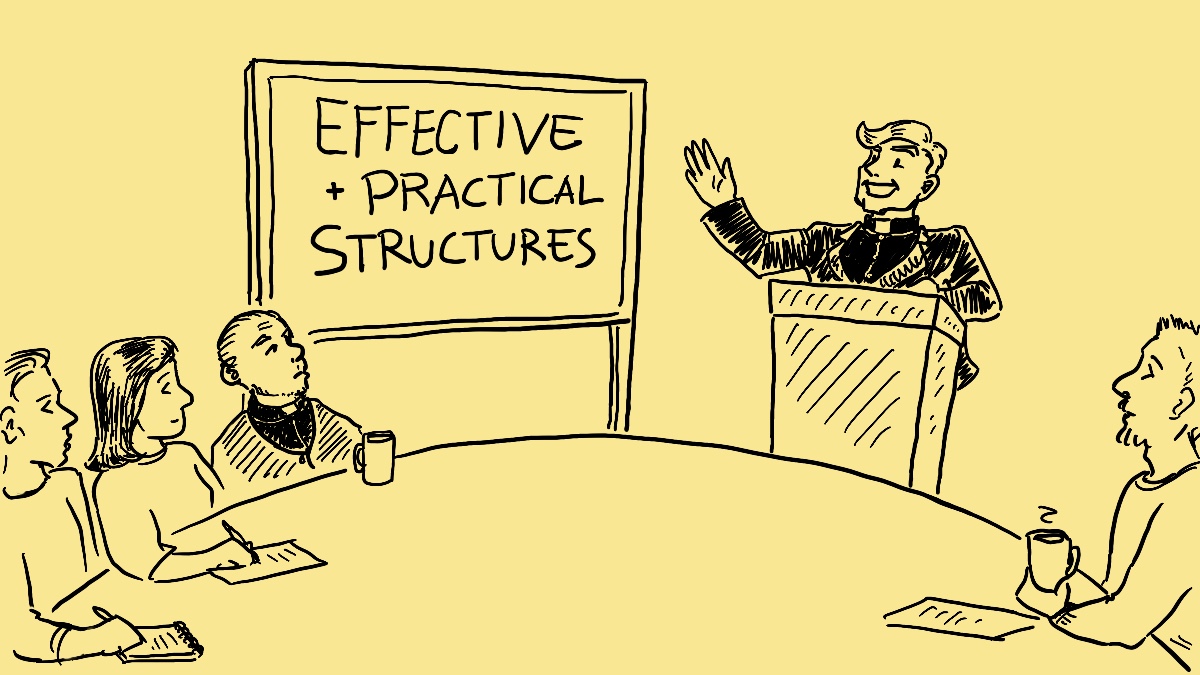
I want to consider some of the “Both/And”s of Millar’s book, and explore the logical prerequisites of the dichotomies he’s harmonising, specifically in chapters 4 and 5 with regard to Ministry and Leadership. Gary’s point in the book is about the balance of the tensions. My reflections in this article are about how there is a subordination of effectiveness, practicality, and organisational prowess to godliness, theology, and people.

Dependent before working

We must be both dependent on God and working hard for the Lord, indeed (tension and balance). But hard work is subordinate to dependence (i.e., James 4:13–16). Unless you’re dependent on God, don’t bother working for God. Our work for God depends on our dependence. As Gary says, “All ministry has to start with the fact that it is God who does the real work” (p.77).

So can you be so heavenly minded that you are of no earthly use? I mean, sure, it’s possible that you pray too much—many things are possible. But I’m not convinced that whoever you are reading this right now, that you actually pray too much (and I bet you don’t know anyone who does, to the detriment of other things in life. Now here I am taking prayer as one of the most tangible expressions of dependence on God). But the Bible again and again warns us against the alternative (I think of Joshua and the Gibeonites in Joshua 9). This is exactly Millar’s point—dependence is not optional or secondary, but foundational.

So yes, we need to be both dependent on God and committed to working hard (p.76), but the actual danger is that we work without depending on God. And is not prayer a strenuous task? In Colossians 4:12 it is referred to as a fight or struggle, which I think is a brilliant description of how many of us feel in prayer. Depending on God is an essential prerequisite to ministry. All ministry is done out of dependence and reliance on God, who brings to growth all the things that we water and plant (as Gary points out, p.78). Clearly, we water and plant (1 Corinthians 3:6–7). But the whole point of that metaphor is dependence on God.

Godly before effective

In chapter 5 Millar reminds us we must be both godly and effective. But unless you are godly you will not be effective (with the exception of those in Philippians 1:15–17). Gary points this out with regard to 1 Timothy, saying, “What we believe and the way we live matter. This is the foundation of any biblical ministry. We cannot sidestep the need to be godly” (pp. 99–100).

To be godly as a leader, according to Scripture (1 Timothy 3:1–7, Titus 1:5–9, Acts 6:3, 2 Timothy 2:2), is to be someone whose character is already shaped by the gospel before they take up responsibility—they are selected or appointed because these certain characteristics are evident. This includes being above reproach, faithful in marriage, self-controlled, temperate, respectable, hospitable, gentle, not violent or quarrelsome, not given to drunkenness, not greedy, not overbearing, and not quick-tempered. A godly leader must be trustworthy, blameless, and have a reputation for wisdom and being full of the Spirit. They must be reliable and able to teach others, with a life that is publicly consistent with their message. What a list! Because teaching and leading bring stricter judgment, Scripture calls for a higher standard in both conduct and example (James 3:1). All of these characteristics must be in place to be godly as a leader, and they must be in place before one even considers effectiveness. Timothy and Titus are looking for these kinds of people so they can then appoint them. You won’t be stepping into leadership until these things are in place. And once these foundational matters crumble, you are no longer going to be in leadership—which is clearly the most ineffective KPI blunder for a leader: not being in leadership!

Let’s say that you’ve got godliness in check. Now it’s time to be effective. What on earth does that mean? The current vibe is that under your leadership or care, people are being converted to allegiance to Christ. And depending on your context, that number will vary. One convert may be ineffective when there are 100,000 under your care, let’s say. But one convert may be very effective in a town of 100 people. But where do I get this idea from the Bible? I don’t get it from the Bible! You won’t get these kinds of answers from the Bible. The Bible doesn’t give you targets (10 converts in a financial year). It gives you actions (pray and tell). You will only get the idea to be fruitful in conversion as a secondary kind of fruitfulness or logical implication of praying and telling under God’s sovereignty (see John 15). And I agree with Miller, there is some impetus for seeing John 15:16’s use of the word fruitfulness to mean converts, because there are some parallels with Matthew 28, especially the idea of “going” out to bear fruit—but it’s not the main idea behind the metaphor of fruitfulness. It’s secondary to character. Arguably fruitfulness is mostly character. I think the overwhelming emphasis points this way. See: Proverbs 11:30, Jeremiah 17:7–8, Matthew 3:8, Galatians 5:22–23, Ephesians 5:9, Philippians 1:11, Colossians 1:10, James 3:17–18, Hebrews 12:11. This idea also makes the most sense if part of one’s task as a minister is to be an example.

The idea of fruitfulness or effectiveness as a leader, specifically as a Christian leader, would require more time. My point here is to point out the prerequisite of godliness for any individual who would even consider leadership. So it is that before any kind of leadership effectiveness would be measured, one must be godly or faithful first.

Theology before practice

If we are going to judge a Christian leader, how should we do it? From the Bible, according to the Bible. As Gary points out, they are required to have “sound doctrine” (2 Tim. 4:2–3). Gary says leaders must be theologically driven according to Titus 1:9 and 2:1—that sound, healthy, or life-giving doctrine is the “fuel” of ministry and motivates every practical decision thereafter (pp. 101–102). We will not be judging a Christian leader by non-Christian standards. What drives a Christian—and therefore a Christian leader—must always be their theological principles before their practical outworking. The practical comes later because it flows from theologically derived principles (or at the very least, is not in conflict with them).

If you flip the order, what happens is you take business models and worldly wisdom and dress them up in spiritual language. This is not necessarily a problem if that wisdom is not contrary to theological principles. But if you start with worldly wisdom and then seek to justify it theologically, how easy would it be to deceive oneself into forcing Scripture to support what has already been approved in practice? I’m not saying this will always happen, but if the order is reversed it becomes more likely—similar to eisegesis, where someone finds in Scripture what they already want to see.

That is why a Christian leader needs to have theological principles in place before considering the practical benefits of any leadership or ministry decision.

People before organisation

People are clued in to people. It’s amazing. Yes, some people are deceived easily, but at the same time—and more often—people will be in tune with you. It is simply the way God wired us: relationally. The triune God’s creation reflects his nature. That is why people are at the heart of ministry, or as Gary says, “leaders must prioritise people” (p.103). You don’t serve structures—you serve people. Structures don’t serve structures; they serve people. And in all this, people serve God.

The more people you gather together, the more you have to organise. So even the impetus for organisation depends on people. The means is the organising, and the end is the people (with the ultimate end being God’s glory). And because people get people, they will know when leaders are more concerned with the sheep pen, the fences, and the food trough than with the sheep.

A heart for people is a prerequisite for being organisationally minded.

Conclusion

Hence, character comes before competencies. So, as I have been considering the “both/and” nature of ministry, I would prefer to use language that reflects a subordination of effectiveness, practicality, and organisational prowess to godliness, theology, and people. Using the language of “both/and” captures the tension (which is the emphasis or angle of Millar’s book), but reading the book has also reminded me that there is an order. Again, not that I think Gary would or does miss the order—as I said, that wasn’t the burden of his book—but his argument reminded me of the importance of keeping the order in view. My reflection is that many of us will miss the order in the messy real-life application. That’s the tension of both/and tensions! Nobody is a theological acrobat who balances everything well. So then, perhaps even “balance” is subordinate to right ministry priorities.


Bibliography

Gary Millar. (2025). Both/And Ministry. Good Book Company.

AI, Wisdom, and the Complexity of Consciousness

With the AI boom having recently made waves in the world of everyday folk, what is washing up on the shores of our thoughts is… our thoughts. That is, our consciousness. So it is that there is a renewed—or at least more realistic and tangible—line of questioning emerging. People talk about uploading their consciousness to silicon (i.e. computers). People talk, in related ways, about augmenting the mind through brain implants. People then talk about AI becoming sentient (from generative to general). And even now, closer to lived experience, people talk about AI making decisions—or helping them make decisions (decision fatigue cured! Except for which AI you will use…).

In all this, there’s a problem. It assumes a lot. Indeed, these thoughts, speculations, and questions assume we actually know the basic and fundamental nature of something common to them all. But we don’t! The problem is this: What is the mind? (Or consciousness?) It should be clear that to indulge these questions of AI and consciousness, we actually need to know what consciousness is—don’t you reckon? Ironically, we have no idea. (Maybe AI can help us…) Is the “I” that is reading this—is that mind of yours your brain? Or is it greater than the sum of your brain? Is it separate (substance dualism)? Is it illusory (mere materialism, brain only)? And how would we square talk of an insubstantial consciousness with uploading it to something substantial and material? What is it that would make AI general or sentient? Isn’t it crazy to think about these speculative scenarios like they are more than hypotheticals when we can’t even begin to speculate about their current fundamental realities? In a nutshell, how does the mind actually interact with the physical world—brain (or silicon)? This is what’s called the ‘hard problem’ in mind/body philosophy. Wanna know why? Because it’s hard to figure out (who ever said philosophers can’t be obtuse?).

I know you don’t want more problems to think about—sorry—but before we get to the business of looking smart in front of our friends about AI stuff and futuristic cybernetic organisms of silicon and carbon… I guess we need to figure out how we will make the necessary decisions to get there (or anywhere). Not hard. I mean, you make decisions all the time. Simple binary, right? 1’s and 0’s (until supercomputers get going—hurry up, IBM).

How tempting it is to speak of life in binary terms: yes and no, black and white. If it were that simple, then it’s easy to imagine that General AI has arrived if it were simply able to make (or appear to make) binary decisions. That would have to be at least a basic criterion in my thinking.

So, how then do you or I make decisions, then? Even simple decisions. What you and I do is keep in our minds all the available environmental factors of the moment (such as physical realities), all the historic context that led up to it, all the social factors at play (such as motivations of yourself and others, and the politics of interactions), and then weigh all that against what we think is going to be the best outcome and the likelihood of that happening (which then requires us to have a basic ethical framework for good and bad and right and wrong—of what wisdom is). And because you have a limited degree of knowledge in all these areas, you are constantly making educated guesses. Which, if we drew it all out, would just look like crazy decision trees.

So what is the picture you get? You get irreconcilable tensions in the decision tree. Keep ‘this’ in mind, but also, oppositely, keep ‘that’ in mind at the same time. We get a sense of the need for wisdom and reconciling these impossibilities when we read Proverbs and Ecclesiastes in the Bible. Both wisdom literature. Both in the Bible. Both informing and guiding life and decisions. Proverbs tells us the way of wisdom is in making good decisions and avoiding foolish decisions, in rather black-and-white terms. Simple enough—binary. But then you read Ecclesiastes. Do your best, sure. But in the end, factors out of your control will mean the wicked will prosper, the wise will suffer, and you will die—rich or poor, doesn’t matter. Best to let the chaos machine run and enjoy it while you can. No sense in chasing the wind.

Both biblical books. Both wisdom. Both guiding. At opposite ends of the spectrum. Which end of the spectrum is right? The answer is that the spectrum is right! It portrays reality. What does the spectrum do for our lives? It tells us to be critical. You are thinking or living on one side, but you need to consider the other. Life going well? Good, but it could turn in an instant quite aside from your planning and wisdom. Life going poorly? Well, you should do something about that. How frustrating to have the two books in the one picture of reality.

With this in mind, Allow me to quote Christipher Watkins at length here:

Philosophically speaking, Proverbs is the Hegel or Plato of the wisdom literature: everything has its place in the system, everything works as it ought, and nothing is lost or obscure. Ecclesiastes, by contrast, is the Kierkegaard or Shestov: the world is an obscure, impenetrable place and philosophical systems are laughably simplistic in their attempt to account for a reality whose depths they do not begin to plumb. What is truly remarkable in the Bible is that Shestov and Hegel sit down together, and Plato takes tea with Kierkegaard. Over two thousand years of church history, many have tried to remake the Bible in the image of a systematic Plato, and others in the image of an existential Kierkegaard. They will both find some biblical material to help them, but the two attempts equally flatten and muffle the multiperspectival biblical witness. … This is a question in relation to which Christians need to know our own temperaments. If we are people who love systematicity and neatness, let us not rewrite the Bible in our own image. And if we are those who are thrilled by adventure, messiness, and unpredictability, let us not assume that the Bible was written for us and no one else. Let us rejoice when the Bible does not think like we do, because only then can we be assured that when we read it, we are looking through a window and not in a mirror. This necessary and irreducible tension between the outlooks of Proverbs and Ecclesiastes is highlighted by John Stott in relation to the Bible as a whole, when he quotes the great nineteenth-century preacher Charles Simeon: “The truth is not in the middle, and not in one extreme, but in both extremes.” Chesterton puts it like this: “The real trouble with this world of ours is not that it is an unreasonable world”—that is, Ecclesiastes alone—“nor even that it is a reasonable one”—that is, Proverbs alone. “The commonest kind of trouble is that it is nearly reasonable, but not quite.” In other words, our theoretical paradigms of humanity, society, and the world almost work, they almost account for the way things are, but they never quite close the deal. The world is amenable to academic investigation, but sooner or later it always exceeds any attempt exhaustively to theorize it, whether in the arts or in the sciences: the modelled always exceeds the model. The bold juxtaposition of Proverbs and Ecclesiastes in the Bible perfectly captures this complex, irreconcilable experience.” (Christopher Watkin, Biblical Critical Theory, Pg 321–322,)

So what?

The reason I bring all this up is because consciousness, decision making, life’s experiences are all complex in the extreme. And when something like AI pops up (a tool unlike any other thus far and with the potential and power to be a milestone in human history – cool right?), it can a helpful vector for considering the limits of our understand ironically. The ironic part is that it ought to highlight our lack of understanding and the complex nature even as it is a demonstration of humanities understanding (sciences and the like).

I’m basically reflecting that it seems cool, and cyberpunk, and smart (and did I say cool?) to think about these ideas—that we can upload our minds to computers like life’s a game. But as cool as all this is to play video games and watch movies about, if we are actually serious about these matters without being thoughtful, I reckon you just look silly. You don’t want to look silly, do you? No, you want to look cool.

I think it’s cool to know the limits of understanding our understanding. It’s cool because it points me to the mind behind all minds, the consciousness from which all consciousness comes (and must come)—God. Father, Son, and Holy Spirit. The personal nature that is the bedrock of all reality. When we reach our limits of understanding, and an infinite chasm is before us, nevertheless, you can see to the other side, and marvel at the otherness of God, and the nature of God, and the nature of us and our world (respectively).

I reckon pondering these truths is actually cool, in an old-school, analogue kind of way.


Watkin, C. (2022). Biblical critical theory: How the Bible’s unfolding story makes sense of modern life and culture. Zondervan Academic.

The Burning Bush of Individualism

The modern Western anthem of expressive individualism could be summed up in the words, “I am who I am.” To be an individual, and to express your individuality, is to be self-determining, and as far as possible, independent.

The scary thing is, or should be, that this motto is how God is described in Ex. 3:14.

The overlap between how people think of themselves in the West, and between the self-disclosure of God’s name is not accidental. More and more peoplein their hearts and minds put themselves in the place of God — considering themselves as radically independent and unreliant upon others and as able to ‘create themselves’, to determine their identity. These characteristics are what’s behind the self-disclosure of God’s name as the great “I AM.” He is ultimately independent and ultimately unreliant on anyone or anything. The uncreated one but the creator of all things. He is the fire in the bush that burns by itself and is not dependent on the bush (Ex. 3:2).

The danger for people who start to drift in this way of thinking is basically a kind of delusion. It simply is not reality. And when things don’t conform to reality stuff gets weird (you don’t want things to get weird do you?). We are always dependent; on God, family, on community. And there is an exchange when it comes to expression. We might call this expression ‘culture’. You contribute to the culture (a little) but so does everyone else, and in turn you are shaped by culture (probably a lot). Ironically, when everyone talks about individualism, they are of course profoundly shaped by a whole culture of people who call for the supremacy of individual expression. Point being, we are blind to our interdependence sometimes.

But that’s not the real problem. The real problem with this delusion is the offense toward the creator. We do not create ourselves. We do not birth ourselves. Which is obvious. But convenient to leave out of this argument of self-expression. As much as we belong to one another (to family and then lesser to our communities), we belong more so to God. In an attempt to break off the shackles of some perceived slavery (again on theme for the Exodus narrative) to those around us, we break away from our own lifelines. Preeminent being God the source of Life.

What happens in the narrative of Exodus? War. War between God and the idols and false supremacy of Pharaoh. Who wins? God. What will happen to those today who propose to contest the Lord in the same way? War. Maybe there is a reason everyone in the secular world feels like their peaceful lives are always at war… And maybe it’s the reason you feel at war within yourself. Even as a Christian. The presence of this kind of sinful tendency is simply the air we breath and will be a temptation for some.

When we imagine we are burning bushes — self-creating and self-sustaining — there should be no surprise when we eventually burn out.

News Consumption (revisited)

Once upon a time I wrote this (https://bigvaiandshiphrah.com/2021/01/07/no-news-is-good-news/), which I am proud of. It’s a fun read (unbiased and fact-checked statement). But I thought I’d revisit the subject. Because… I’ve relapsed. Into ignorance. And I love it. Take that, Dad!

First. Yes, we should care about truth. And yes, news media (of a variety of sorts, like social media, traditional, indie, and alternative, etc.) provide that to a degree regarding the happenings of the world.

But now my thoughts have developed (which means I’ve devolved again). Two major principles are at play: primarily a commitment to truth (you gotta have that) and careful stewardship of time. In order to practically value truthfulness, we need to be pursuing truth through cross-examination of news sources. That would require substantial time and energy—resources I believe are better invested elsewhere. Hence, I consciously limit my direct consumption of news to about roughly nothing.

I tried to be civilised. I really did. I even paid money to be civilised with a subscription to The Economist (which wasn’t cheap! I’m just that civilised, or was), but now I’m back into the blissful state of ignorance and it’s a wonderful time. My knuckles dragging through the mud of my own mundane existence and my simple connection to other people in my general vicinity who sometimes throw rocks at me and sometimes pick fleas off me.

I trust that genuinely important information will reach me naturally through conversations with friends and family, minimizing the need for active and continuous news engagement. But in my experience, few things are important. Typically, most news content has limited practical impact or relevance for my immediate responsibilities. (Someone told me the pope died… and shortly after we got to discussing important matters regarding the next fishing trip. Not intending to be disrespectful, but that’s just to highlight how little difference it makes to my life that a mundane fishing trip has more practical ramifications). Thus, my stance is intentionally one of minimal direct involvement.

While I acknowledge concerns related to emotional health and the stewardship of attention, my primary reason for limited news engagement remains practical but also theological (sorta). My conviction is that consistent engagement with Scripture and its application will inherently involve cultural engagement (simply through lived experience—you cannot avoid it). By prioritizing personal relationships and direct biblical application at a private or local church community level, we will naturally and effectively engage with the culture in meaningful ways, making extensive news consumption largely unnecessary.

Maybe ill change my mind again later. But for now. I’m back where I started.

Stewarding the Body for Gospel Ministry


Have nothing to do with irreverent, silly myths. Rather train yourself for godliness; for while bodily training is of some value, godliness is of value in every way, as it holds promise for the present life and also for the life to come. (1 Timothy 4:7-8 ESV)


First, spiritual training is essential because it’s benefits are enduring through this life and into the life to come. That gives us an anchoring perspective. But I what to consider physical training. To what extent is it valuable, and in what way?

I want to argue that while physical training is still of lesser value than godliness, it may be comparatively more valuable today than it was in the first century when Paul wrote those words, simply because of the vast differences in lifestyle between then and now. Today we prioritise comfort and convenience lending to the dominance of inactivity and sedentary living in the everyday. Hence the “some value” of physical training might actually carry comparatively ‘more value’ for modern readers.

Godliness

Before considering the minor note of the passage, let me say from the start that the emphasis of the passage is clearly on godliness -we mustn’t skip that step (just like I know you would never dream of skipping arm day). Physical training is ultimately useless to someone unconcerned with godliness because you’ll still be unfit to stand before God. That’s why Paul says, “train yourself for godliness” (v.7). Paul’s metaphor borrows the required practices and personal characteristics of physical training and applies it to the spiritual life so that strength, stamina, focus, and endurance become pictures of what’s required in the pursuit of godliness. If we train spiritually then we are conditioning ourselves to withstand and counter false teaching, godless myths, and all kinds of spiritual opposition. To lean into the mindset of Ephesians 6 for a moment: with greater grip strength, you hold fast to the truth of the gospel; with greater muscle mass, you uphold the weight of sound doctrine; and with better endurance, your character stays firm under prolonged spiritual strain. Godliness is the essential training of the Christian life. See to it that this is where you get the most gains.

Physical Training

But now to physical training. The passage is making a metaphoric comparison, but it is also advocating for the limited but real value of physical training. When Paul says that physical training is of “some value,” he’s not dismissing it as unimportant or trivial. The point is that its value is limited in scope—temporal, not eternal. It’s useful for this present life, but not the next. Like James says, “we are a mist that appears for a little while and then vanishes” (James 4:14). Our bodies develop, peak, and eventually deteriorate. While physical training is not of ultimate value like godliness, it is still valuable—for this whole life! Paul’s emphasis isn’t that it’s value is meagre, but that its benefits don’t extend beyond death.

Paul

Let’s consider the apostle Paul, the one who is writing these words to Timothy (his younger apprentice). If someone tells you that physical training is of some value and they want you to listen, take it on board, put it into practice, then you would need to ask yourself of the credentials of said personal trainer. So consider Paul.

Yarbrough, in his commentary, notes that the scholar Eckhard Schnabel, in his essays on Paul’s missionary work, estimates that Paul may have travelled around 450 kilometres a year on foot—not including time spent in small boats (which is its own kind of arduous work). And Paul did this consistently for roughly 30 years. I’d add to that: Paul’s travel didn’t take place in small, daily increments (i.e., a little walk around the block with 15 minutes in the gym afterward every day). It happened in large chunks—long journeys from point A to point B. And in the in-betweens, he was a tentmaker (Acts 18:3).

Aside from this, Paul himself must have been tough – proper tough – the kind of tough that would make even a Navy SEAL recruiter reach for more OHS forms. In 2 Corinthians 11:23–27, Paul details the countless hardships he endured which is worth quoting in full.

I have worked much harder, been in prison more frequently, been flogged more severely, and been exposed to death again and again. Five times I received from the Jews the forty lashes minus one. Three times I was beaten with rods, once I was pelted with stones, three times I was shipwrecked, I spent a night and a day in the open sea, I have been constantly on the move. I have been in danger from rivers, in danger from bandits, in danger from my fellow Jews, in danger from Gentiles; in danger in the city, in danger in the country, in danger at sea; and in danger from false believers. I have labored and toiled and have often gone without sleep; I have known hunger and thirst and have often gone without food; I have been cold and naked.” (2 Cor. 11:23–27)

Of course, Paul acknowledges that he was weak and that his endurance was ultimately sustained by God’s grace and miraculous preservation. But from a human perspective, his life and ministry demanded truly extraordinary physical and mental resilience. So we should conclude, Paul is well qualified to say to a ministry apprentice, “physical training has some value”.

The Ancient Context

What about all the other people in Paul’s time? Consider the following.

In The World of the New Testament, David Downs, in his chapter (12) on “Economics, Taxes, and Tithes,” outlines a general picture of life in the Roman economy. (Downs is drawing on Steven Friesen’s “poverty scale” of the Roman economy, published in 2004.) The picture they provide of the Greco-Roman world is that the vast majority of the population lived at or near subsistence level.

Only a tiny fraction belonged to the imperial elite, and just 1% were regional or provincial elites. Urban elites made up about 2% of the population. A small portion (~7%) had moderate surplus resources, while around 22% lived at a stable but vulnerable subsistence level. The largest group—40%—lived at or just below the threshold needed to sustain life, often working as small-scale farmers, laborers, or artisans. An additional 28% lived below the subsistence line, including the poorest in society: widows, orphans, beggars, unskilled day laborers, and prisoners. (It’s worth noting that some scholars argue life may have been marginally better than these figures suggest).

You’ve got to try and keep this in mind when you read the New Testament and imagine its world. Although this kind of socioeconomic breakdown doesn’t give us a day-to-day picture of their labor and activity, it certainly helps us imagine what might have been required just to survive. You could even read a period piece set in the late 1800’s or even early 1900’s to give some perspective. It’s not hard to picture how physically demanding and economically fragile life was for the overwhelming majority of people in the first-century world.

We see similar summaries in other writings, such as Arjan Zuiderhoek’s essay “Work and Labor in the Ancient World”, in which he writes:

The ancient world, then, was very much a world of work—and hard work at that. Greek and Roman farming populations (and their work animals), as well as urban workers, manufacturers and service providers, had to toil long and hard, day in, day out, to produce the surplus that made possible the impressive material achievements (in terms of urbanisation, infrastructure, art and architecture) and the luxurious lifestyle of the elites of their respective societies. Labour productivity in agriculture was low, which necessitated the employment of the vast majority of the ancient world’s populations in the production of primary foodstuffs, and condemned the vast majority of individuals making up those agrarian populations (as well as a sizeable element of the urban inhabitants) to a standard of living not much above subsistence.” (Zuiderhoek, p. 32)

So, what’s the point here? If life was this physically demanding for so many people, then that’s an interesting context in which to read the words, “physical training is of some value.” It’s not as if people were unfit. On the contrary, they were, by default, laborers and farmers whose diet consisted of the raw, unprocessed produce of their own toil. That required strength, endurance, and resilience. And yet, Paul still says to his apprentice minister: physical training could still be of some value for you.

Today

Today is different. In so, so many ways.

We actually have to exercise in order to move at all sometimes, because modern life can demand as little as 1,000 steps a day—or even less. Inactivity kills us. Overeating kills us. The irony is that we’ve gone beyond subsistence to the point of no longer sustaining health. Our food is so processed that we’ve had to fight legal battles just to call it food.

Consider the latest release (as of 2023) from the Australian Bureau of Statistics:

“Almost one in four (23.9%) people aged 15 years and over met the physical activity guidelines,” and, “Nearly half (46.9%) of employed adults aged 18–64 years described their day at work as mostly sitting.” [ABS – National Health Survey, 2023]

By the way, “exercise” in the 2022 report includes the following:

  • “Nearly half (48.5%) walked for exercise,”
  • “Nearly half (47.4%) walked for transport,”
  • “One in three (32.8%) did moderate exercise,”
  • “Three in ten (30.5%) completed strength or toning exercises,”
  • “Almost one in five (18.6%) engaged in vigorous exercise.”

[ABS – Physical Activity, 2022]

Today, you actually have to think about “fitness.” In pre-modern times, I doubt anyone thought about it (aside from athletes, I presume). That’s because life simply demanded physical exertion. At this point, let me recommend Michael Easter’s book The Comfort Crisis.

Today, people—and therefore, Christians—have to intentionally consider physical training and its “limited value.” And we must do this while resisting the temptations of modern fitness culture: vanity, body idolatry, and self-worship. Instead, we’re called to simply steward our health for the sake of ministry endurance.

The Christian and Physical Training Today

The Christian minister—whose priority is godliness—should train physically in the modern Western world. I’m assuming you’re one of the statistics in the Australian Bureau of Statistics. Today, it’s easier to be unfit and poorly nourished than to be otherwise.

Geoff Robson, in his book Thank God for Bedtime, makes a point about the relationship between godliness and physical sleep. Building on Don Carson’s observation—“If you are among those who become nasty, cynical, or even full of doubt when you are missing your sleep, you are morally obligated to try to get the sleep you need”—Robson writes:

“If we became aware that eating a certain food caused us to behave in a consistently and predictably sinful manner, we’d stop eating it. If you became aware that wearing a particular shirt somehow made you act in ungodly ways, that shirt would go straight in the trash. So if sleep makes it harder for us to maintain self-control, or to remember what we read in the Bible, or to have the energy to help someone in need, suddenly sleep isn’t just a good idea. It’s a godly idea. It’s vital to living a life worthy of the gospel.” (p. 74-76)

In a similar pattern of thought, I would argue that if you have a godly concern for ministry—and a desire to serve with endurance for the long haul—then you should proactively consider your physical fitness. This is not to dismiss the reality of illness. In fact, you might be given ill health by the Lord—a “thorn in the flesh.” As James reminds us, “If it is the Lord’s will, we will live and do this or that.” But surely, as far as it depends on us, we want to make the most impact over the long term. Physical fitness can serve as a simple, baseline metric for supporting that godly pursuit—not at the exclusion of prayer, reading, and teaching (matters of godliness), but as a tool to enable them more effectively.

Health is something to be stewarded for godly ends. Physical training is one tool we use to manage that stewardship. Avoiding preventable health issues is a basic strategy for maintaining strength and energy for ministry. The goal is simple: to remove the hindrances to faithful service and to have the energy to do the work God has set before us. And that’s not even to mention the cognitive benefits of exercise. For white-collar workers in the knowledge economy—such as ministers—this will only become more and more relevant.

Simply put, Paul would want us to run the race and to work hard in the marathon of ministry. Part of that includes our physical capacity and capability. So why is physical training of some value, but lesser value? Because it serves another purpose—namely, ministry. It serves serving. But if it is lacking, it may well become a hindrance to that ministry. The chief concern is godliness; and flowing from that—though in the background—is the service of others in gospel work: proclamation, discipleship, and the like.


References

Easter, M. (2021). The comfort crisis: Embrace discomfort to reclaim your wild, happy, healthy self. Rodale Books.

Green, J. B., & McDonald, L. M. (Eds.). (2013). The world of the New Testament: Cultural, social, and historical contexts. Baker Academic.

Robson, G. (2019). Thank God for bedtime: What God says about our sleep and why it matters more than you think. Matthias Media.

Yarbrough, R. W. (2018). The letters to Timothy and Titus. William B. Eerdmans Publishing Company.

Zuiderhoek, A. (2020). Workers of the ancient world: Analyzing labour in classical antiquity. In A. Bresson, P. F. Bang, & W. Scheidel (Eds.), The Oxford handbook of the ancient economy (pp. 32–48). Oxford University Press.

On Personal Revelation

If you or I were to ask a handful of people—church folk or otherwise—whether, loosely speaking, they felt or knew that God had spoken to them personally, my guess is that many would say they think it has happened. For staunch Reformed folk, this idea tends to make us uncomfortable (if that’s you, I know it does! But also, I bet you’ve heard people say these very things to you!). So, how should we think about this phenomenon?[1]

On first principles, we affirm that God primarily speaks through His written word. Very true. Sola Scriptura, baby. Ultimate authority (I’ve written about that here [2]). God’s Spirit is working through God’s Word with God’s power. Even though that proposition and doctrine is firmly established, we still know that much of our work—whether personally or in ministry roles and responsibilities—is continually pointing people back to God’s Word, because both we and others regularly harden our hearts against it (Psalm 95). Not to put a number on it, but for illustration’s sake, let’s say this is 80% of the work.

But even God’s Word tells us that God has spoken outside His written Word.

This is the disciple who testifies to these things and who wrote them down. We know that his testimony is true. Jesus did many other things as well. If every one of them were written down, I suppose that even the whole world would not have room for the books that would be written. (John 21:24-25)

It’s obvious that not every word Jesus ever spoke is recorded. But consider what those words might have been—personal encouragements and challenges to his disciples, words to passersby, rebukes to his opponents, or his mountaintop prayers to the Father. So, clearly, not every word of God is recorded in written form, and yet all of them are the words of God.

I think the Reformed instinct is to lean so heavily on the authority of Scripture (rightly so) that we sometimes develop tunnel vision as an unintended consequence. The words of Scripture are sufficient for salvation and godliness—the essentials. But they are obviously not everything that God has ever spoken or done. This is not problematic or worrying.

We can also assume that the prophets of the Old Testament spoke messages that were not recorded in the Bible. This may be how many of them became recognized as prophets. Then, of course, there are those who were called prophets whom we never hear from, other than a mention of their existence, or whose writings have been lost. In 1 Kings 18:3-16, Obadiah (not the prophet) hides 100 prophets from Jezebel (and Ahab). Yet, we never hear a word from these 100 fugitive prophets. In 1 Kings 13, there is an unusual story of a “man of God” who is a prophet (unnamed) and another unnamed prophet—except he is a false prophet (perhaps that’s why none of his words are recorded). But regardless, he is still referred to as a prophet. Similarly, just like the 100 prophets Obadiah hides, there is a “company of prophets” in 2 Kings 2:1-15 who witness Elijah being taken up in a chariot of fire.

It’s all very interesting… But what about today? I mean, those examples come from back in the day. Times have changed. The Son has spoken definitively (Hebrews 1).

Now we begin to delve into the discussion of continuationism and cessationism. But for the sake of brevity, the best argument I’ve heard for cessationism is that “the time of the apostles and prophets” ended after the apostles passed away. Another argument is that once the “foundation of the apostles and prophets” was laid (Ephesians 2:20), there was no further need for revelation—and no need means no supply. A historical argument is that miracles are not as common anymore as they were in the early church, and if we follow the trajectory, we see them fade away completely after serving their purpose in the initial spreading of the gospel.

For the most part, I’m not convinced that the theological grounds for these arguments are strong enough (although cessationism is a tenable position). It is just as likely—although I’d argue more likely—that when we read the passages of the New Testament, especially those referring to gifts broadly categorized as revelatory gifts (such as prophecy, but depends on your take on what that is), they continue. There isn’t a sunset clause on these passages. So, I think the safest assumption is to presume they continue rather than to assume they have ceased.

At any rate, that would make sense of two things: firstly, anecdotally, people everywhere still claim to hear from or be led by God in personal ways (receiving personal revelation of a sort). And secondly, the Scriptures still tell us to test such things.

“Dear friends, do not believe every spirit, but test the spirits to see whether they are from God, because many false prophets have gone out into the world.” (1 John 4:1)

“Do not quench the Spirit. Do not treat prophecies with contempt but test them all; hold on to what is good” (1 Thessalonians 5:19-21)

“Two or three prophets should speak, and the others should weigh carefully what is said.” (1 Corinthians 14:29)

But I don’t think these passages are exclusive or exhaustive in describing how God speaks to us today (biblical revelation notwithstanding). God is certainly able to speak to us more directly (not necessarily corporately)—in dreams or otherwise. That aspect of communication is not necessarily the troublesome part—it’s not a question of whether He can. The issue is knowing when He has—determining and testing these words.

We need to be aware of our own self-deceptive tendencies and the deceitfulness of the heart, as well as the spiritual realities of opposition and deception from the demonic. I think this last point is why we are reluctant to accept personal revelations so easily (speaking personally and anecdotally about the Reformed tendency to be skeptical in this regard). We are very aware of the Scriptures’ warnings, and so we are (hyper?) vigilant when it comes to accounts or claims of personal revelation.

For most of the (let’s call them) inclinations of people who think or disclose that God has spoken to them in some way—especially when it includes a sense of being led to do something—it can be difficult, if not impossible, to know how to test it.

First, it must not contradict Scripture—that’s a given. But what about things that are indifferent? Or even more challenging, what about things that we might not call wrong, but perhaps unwise in principle? For example: “God says, ‘Start a business.’” Or, “God says, ‘Travel here…’” or… hehe… ‘Marry that person!’ I love that one! It’s just too convenient. (Or is it…?)

Especially with these indifferent cases, we have no clear grounds on which to say, “That’s not a message from God—God wouldn’t say that.” You might think such a person is being arrogant in claiming to hear from God, but we can just as easily be arrogant in claiming they didn’t.

God leads us. It’s that simple. His providence is all-encompassing. Nothing is too small or too big to escape His guidance – “You should buy bread today.”, “You should move to this city.”, “Marry them!”

And indeed, God cares for our welfare, but He does not merely or exclusively lead us into prosperity—He refines us as well. Suffering does not automatically mean we were led astray or that we were wrong to consider it a word from God. Likewise, prosperity is not necessarily a sign of divine approval—it can be just as spiritually dangerous.

All this to say, there isn’t necessarily a definitive way to say, “That’s from God, and that’s not”—except in cases where Scripture clearly forbids something. God is not telling you to marry a non-Christian. Guaranteed. God is not telling you when He will return. Guaranteed.

But aside from that, we should be gracious and give one another the freedom as Christians to test these revelations. And you only know if it was from God when He actually confirms it through an outcome, rather than just a sense of direction (if an outcome was part of the revelation that is).

Personal revelation should be treated carefully, but revelation that involves or concerns a corporate body, such as a local church, is different. In that case, there should be: More stringent criteria and more caution and consideration. For example: Who said it? From what position or office? What specifically is the content? What are our governance requirements? This is because there are more safeguards around corporate church matters and greater responsibilities given to the church body and its leadership than individuals.

Regarding personal revelation or leadings from God—the Bible is our ultimate authority in governing salvation, godliness, and holiness. But in matters of personal concern, where Scripture is indifferent, we have the freedom to test and apply discernment.

Simple, right?


Bray, G. L. (2012). God is love: A biblical and systematic theology. Crossway.


[1] Personally speaking, I can easily think of four times I’ve encountered a sort of personal revelation (I think).

  1. An old Pentecostal pastor once told my girlfriend at the time (though I wasn’t yet a Christian) that one day I’d be a minister. Behold, I am now a minister. (Crazy and sadly, that minister is no longer in ministry, and that girl I dated is no longer a Christian, as far as I know.)
  2. A strange moment while reading the Bible—I thought God was applying the Word to me specifically in ways that were highly personalized, but which I would never preach to someone else (if that makes sense). They felt like, if I can say it this way, a prophetic inkling or calling in life. I’ve never forgotten that, and I wonder about it regularly.
  3. A dream.
  4. Another dream. Boy, that one was wild!

[2] https://bigvaiandshiphrah.com/2025/02/13/entering-into-the-authority-of-the-scriptures/