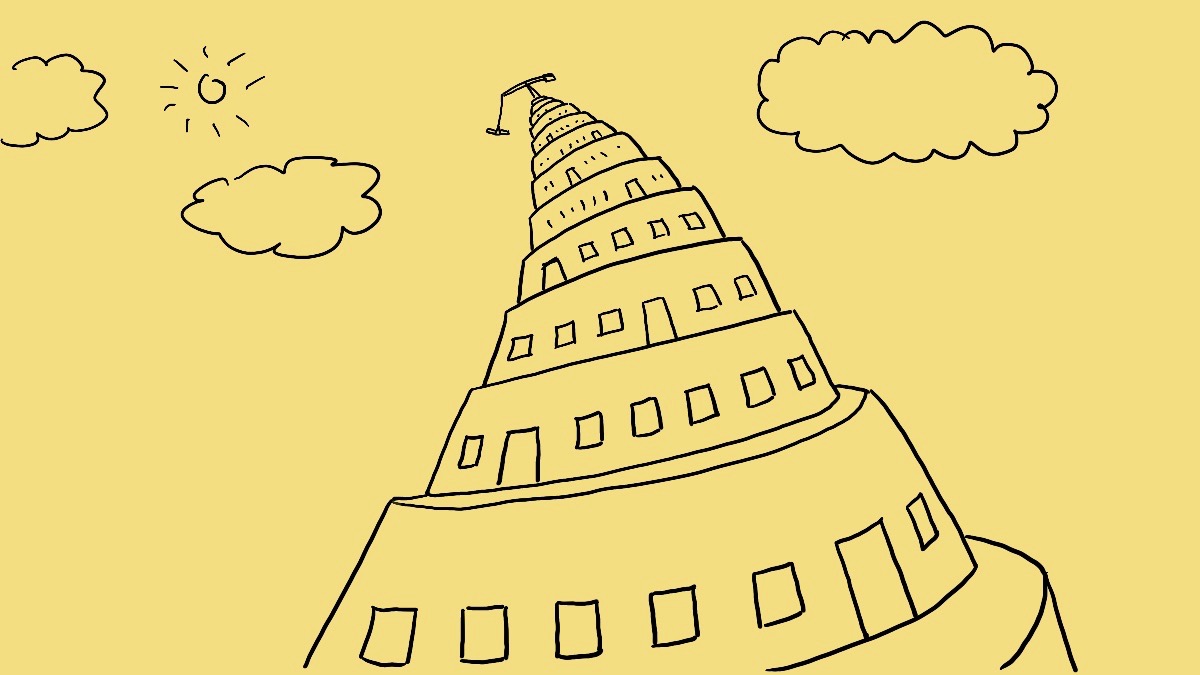
Everything was going so well it seemed until we all disagreed about everything. (Must have been social media…)
But everything was not well before that anyway. All people are bound as slaves to sin, a terrible condition that we must take seriously. This means that when we unite together, our evil is generally multiplied (unless intervened by the grace of God— commonly known as common grace when applied generally to all people to restrain the effects of sin).
But it’s not so much that we don’t share a common language. But that we don’t share a common basis for ethical reasoning, or rather, we are operating on the principle of pluralism which in it’s absurdity is self-defeating. So we might all be using the same language, but it’s not the same meaning in the end. This will be the perennial problem for those in the kingdom of the world but especially in a pluralist framework. Never-ending frustration at their own ability to foil each other’s plans for domination. “I thought we agreed we’d make me look good.” Yes, me! Wait, me. You? No, me.
By the grace of God there have been limiting factors in the West for some time – a shared foundation prior to pluralism/postmodernism/political multiculturalism (lasts ones edgy!). These were put in place by powerful people, like kings and queens before us, and based on biblical ethics because it was on trend in England a while back (but no more). This has played a big role in civil society at restraining evil or simply chaos, especially when Christians got going on agendas like slavery and child rights for example. But over time the foundations have eroded for that system. And they have been eroded by a rethinking of our ethical framework. Which is exactly the kind of thing people who are being restrained from evil would rethink! “Give me back my God given right to ignore God!”
The Christian, whose ethical framework has underpinned this society for some time, is perplexed, because they are a citizen here (literally), but they are actually primarily a citizen of heaven. So they see the goodness being undone (which will literally affect their daily lives and that of their families) and know its benefit at restraining real evil, and so the danger of undoing it. And they also know why people would love nothing more than to give themselves more freedoms to sin and why they would deceive themselves into thinking it’s a good thing to sin. Nothing makes more sense than this absurd behavior to the keen Christian observer.
The Christian, who belongs to another kingdom (primarily God’s), is humbly saved from this wanton self-destruction by the grace of God. And is saved into a kingdom that is based on the foundation of God’s word—his promises and holiness, justice and wisdom, etc. But there are many in this kingdom. All are united by the Spirit, and all of them live in the kingdom of the world (but are not of it). The undoing of Babel’s madness, curse and chaos has happened. They can all understand the gospel and the kingdom’s ways and each other. And they all gather together on Sunday or whenever church happens for them, under the same word of God.
The Christian can and should take comfort in this. Comfort that though they long and wish and pray that the world would not be so foolish as to disregard God, that in fact they are not so naïve as to think the world would ever do otherwise anyway. But also comfort from the fact that they are in the kingdom of God. This is only as comforting as the degree to which the Christian holds lightly to their (literal) citizenship in the nation they are in. So a Christian will be more disquieted the more they are attached to the hope that this world should be more like the kingdom of God (I agree, it should be), but the world is antithetical to God. 1 John makes that clear. And other places. Ephesians – Light and dark.
It is worth investing time and energy into the very matters that the world disregards. The Christian should invest in considering how and why they believe what they believe and therefore live how they live—epistemology and ethics. These in my experience seem to be the key matters driving worldly people into a Babel-like chaos. The Christian in my opinion does this task first as a citizen of heaven and for the sake of themselves and others in the kingdom, their maturity and faith and lives – so that the Christian can stand up when questioned. But of course also as a means of telling the reason they have for the hope they have in Christ and his kingdom, to change the allegiance of others, conversion. But then finally (and it’s important that this part is not as important), as a means to dialogue with the world to (under the common grace of God) convince them to restrain their own evil (which is usually best argued today as ‘for their own flourishing’).
The more I’ve discipled folk (young and old), the more I see the thin and frail foundations of their worldview and therefore ethical reasoning (why they believe what they believe, and therefor why they live how they live). This comes with time, granted, and younger people have had less of it elapse (including young in the faith whether old in years). But it’s also because in the spiritual (and intellectual) battles of the Christian life, the world gets a foothold, and the ‘transforming and renewal of the mind’ is in a real tussle leaving the sheep confused and on the cusp of wandering this way or that way. God is faithful in all these matters, certainly, and his means are his word and his people (and the Spirit at work in both). As with every age, the dangers are everywhere. And the Christian is to be equipped with all the armor and weapons of Eph 6. But it’s a strange battle. It looks like people complaining, “But who has the time for learning why we believe this or that?!” (though in the same breath we will complain about all the problems mentioned above). The world is a profoundly insidious opponent in the age of distraction and entertainment and time poverty and pleasure.
I hope you have the time to put into foundational thinking for the Christian life and faith – epistemology and ethics. Because more and more. Its my guess (if it hasn’t already happened), you’ll be encountering more people (Christian or otherwise), who need help navigating the crumbling towers we live in because we can’t speak a sensible word in the same language.
 Bigvai and Shiphrah
A helpful articulation of the “age of distraction” we’re in! How often I complain of my time poverty yet follow suit with the world in its distractions and the chaos that can bring.
An encouraging reminder that we don’t belong to this world, and to hold loosely to it, whilst remaining sharp to the issues and the hope we can bring to those around us!
LikeLike
I enjoy your latest blog.
a lot to be aware of to consider as we live in a Godly city on an earthly platform. Our spirits battle against our flesh and the evil spiritual realm, but we are given the power and help of the Holy Spirit to guide and strengthen us and actually empower us to walk daily knowing eternally, performing responsibly in this battle for the salvation of others.
its daunting sometimes but exciting as we walk in faith seeing – revealed the hand of God at work in this world.
you 5 have a mighty future ahead.
Praise God
Cheers Bob.
LikeLike