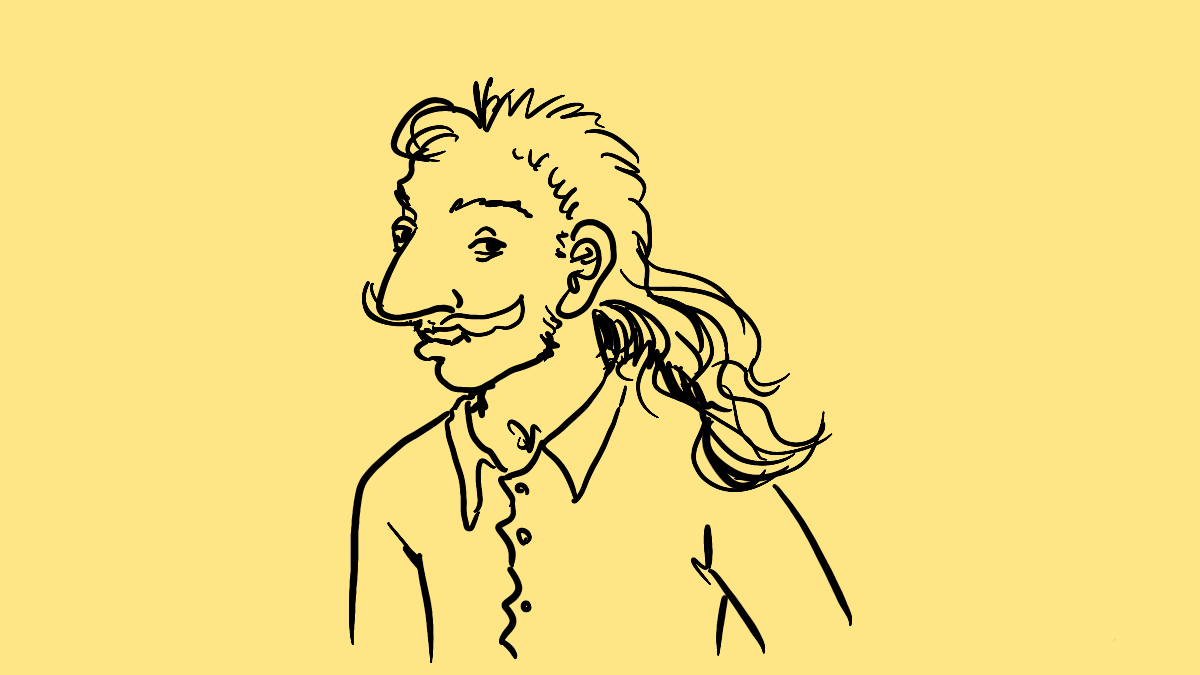
“Do not cut the hair at the sides of your head…” (Leviticus 19:27)
this passage speaks on its own terms. Nothing can be more clear. The context is not required. The plane reading is sufficient. Mullets are clearly ungodly aberrations (and potentially occult). That’s been conservative and generous. Any reputable theological journal or commentary in conflict with this stance is clearly liberal (and potentially occult).
Evidently from this passage, without a doubt, the biblical author is encouraging the people of God to look different than the surrounding nations. Nations which we don’t only presume, but rightly assume wore mullets (and for no other reason I can imagine than to invoke demonic deities – more on that later).
The passage is a warning to the Israelites. Partaking in the culture around them, the Israelites would slowly forfeit their distinctiveness as the people of God. And you would have been able to tell that with just one look. Hair speaks for itself.
So what did the mullet represent in the Old Testament?
It clearly represents a person’s desire to please God merely on the face of the matter, when indeed licentiousness and debauchery are hidden behind. As I would rightly assume they would say in their temples and high places, “business at the front, party at the back.” There is no debate, that is the origin of the oft used mullet slogan. It has its roots in the darkness of the human soul from antiquity.
The imagery of the snake in the garden reinforces this. The mullet is patterned after the deceiver of humanity. The body of the snake is what inspires the waving locks of the mullet attached to the head of a snake.
Clearly, the mullet has satanic and occult historic and theological roots.
Further in the OT narrative, an enemy to the throne of David (his son Absalom) suffers the consequences of his actions. With no uncertainty this incident occurred because Absalom was sporting a mullet contrary to the law of Moses. “Now Absalom happened to meet David’s men. He was riding his mule, and as the mule went under the thick branches of a large oak, Absalom’s hair got caught in the tree. He was left hanging in midair, while the mule he was riding kept on going.” (2 Samuel 18:9).
Fullfillment in the New Testament
What do we do now? Does the law of the Old Testament apply to the Christian? After all Christians eat pork, and they are even permitted to eat meat sacrificed to idols as an idol is nothing. True. But at the same time, the standard for moral and ethical behaviour is not lessened in the New Testament, but increased!
Using an argument from nature, theologically referred to as general revelation , the apostle Paul writes, “Does not the very nature of things teach you that if a man has long hair, it is a disgrace to him,” (1 Corinthians 11:14) People complain that this passage is notoriously difficult to interpret. I disagree. With a hermeneutic based on a plain reading and common sense reading it prohibits the sporting of a mullet by the male gendered population.
All this means that when you see a brother fall into sin (which ironically seems to happen in both the inner city areas and country areas), then it is appropriate to rebuke them for the sake of their soul and the purity of the church.
Aside from that, there’s not really much else to say. But Moses says it best, “Do not let your hair become unkempt” (Leviticus 10:6)
In the interest of being transparent, I must confess that further research needs to be done on the following verse, “They must be holy until the period of their dedication to the LORD is over; they must let their hair grow long.” (Numbers 6:5)
For some reason it acknowledges that a certain sect of Israel may sport a mullet. My current assumption is that they were to infiltrate the bad guys undercover, kinda like Sampson did, and defeat them. That’s probably what it’s all about.
PS: Have you seen this minister? Guaranteed, his theology is is bad as his hair.



I will have to read this again, Robbie, but I can’t decide from the tone of the article whether you are joking or not. (PS I have no personal views on the topic.)
LikeLike