Last post, we considered our own anger. All people have it in them. But, what do you do when other people are angry at you?
Because of the nature of sin and the nature of anger, it often perpetuates itself. Like it’s contagious. Someone else’s anger towards us can provoke our own angry. However, remember what I wrote in the last post – anger comes from within. So it is important to point out that other people’s anger doesn’t ‘make’ us angry. It is more accurate to say someone else’s anger against us tempts us into anger ourselves. That is the nature of anger. But instead of getting trapped in the cycle, God counsels us with a way out.
“A gentle answer turns away wrath, but a harsh word stirs up anger.” (Prov. 15:1).
The way of wisdom is not about retaliations or comebacks. Wisdom is not to respond in kind, but to be kind in our response. Anger perpetuates sin. When we are sinned against, it is easy to do the same. But proverbs counsels us,
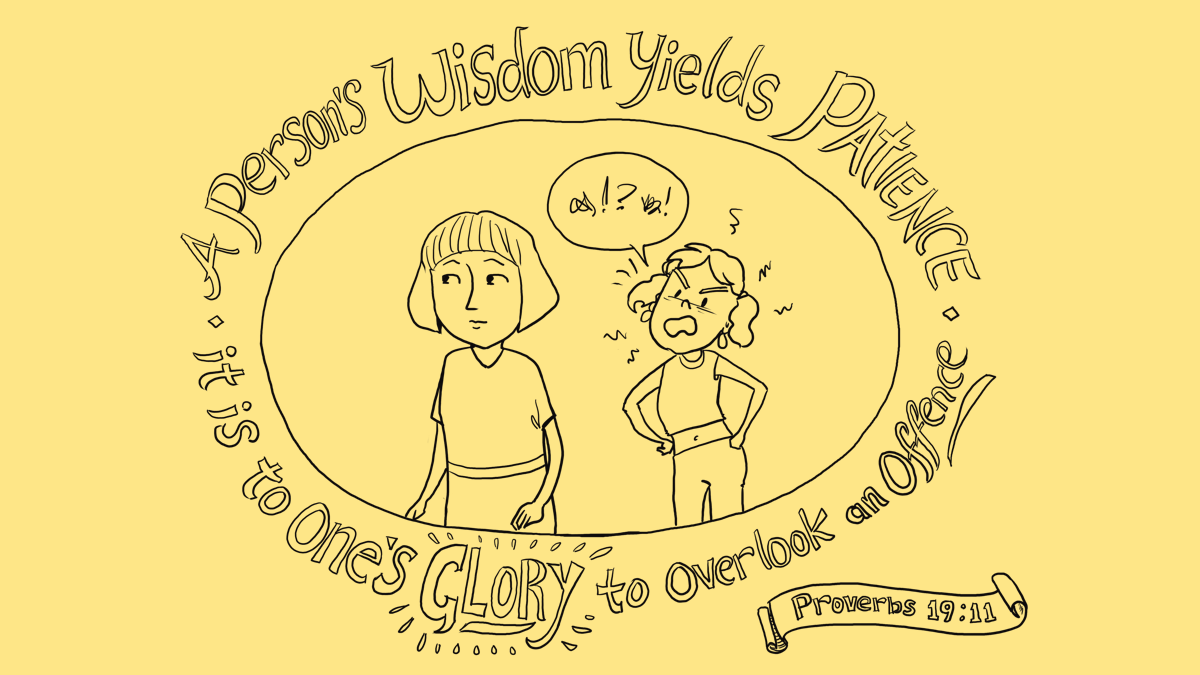
“A person’s wisdom yields patience; it is to one’s glory to overlook an offense.” (Prov. 19:11)
This isn’t talking about overlooking a criminal offence. This talks about interpersonal difficulties – more small-scale. The stuff that happens the most often – hurtful words said without thought and in the heat of the moment. Wisdom counsels us to overlook, to cover it up, to let it go.
And when we don’t act on it, eventually, the emotion within us simmers down and we calm down.
More proverbial wisdom…
“Do not make friends with a hot-tempered person, do not associate with one easily angered, or you may learn their ways and get yourself ensnared.” (Prov. 22:24–25)
Sometimes this is easy to put into practice and sometimes it’s really difficult to put into practice. If it is someone online, or a friend of a friend, it’s not so hard to disassociate from them. But when it’s family, what do you do? This proverb says that where you have a choice, choose wisely whom you spend your time with. Where you don’t have a choice, do not excuse the problem. Love the angry person, but do not excuse angry behaviour. And do not take on their angry behaviour. Do not ‘learn their ways”
Ill quote Ed Welch, a Christian councellor and author at length.
“Friends can leave us ensnared in anger; family can do the same.
We tend to take on the mannerisms of those closest to us.
The child who hears anger from her parents will be playing house with angry dolls. Later, she herself might be the angry parent. Do you excuse the anger in your family’s home? Be careful. You can certainly love an angry family member, but don’t excuse anger. If you do, you will be tone deaf to your own imitation of that anger. Some families, and even some ethnic groups, boast about how they can be fighting fiercely one minute and hugging the next, as if that is a good thing. It is not. Proverbs counsels us, don’t learn the ways of anger.” 1
We put off the old self. We put away anger, and we put on the new self. We are not just changing what we do. We are changing who we are. Or better yet, God is changing us to be more like him, to be more like the Lord Jesus.
Not only does that motivate us, but it also empowers us. Proverbs isn’t just self-help but it’s God’s help. By the power of the Spirit, God is helping us and changing us. And that will make a difference in your life if you live your life for the Lord Jesus. We are becoming the people that God has made us. Becoming more like the Lord Jesus through the power of his spirit.
“Do not let any unwholesome talk come out of your mouths, but only what is helpful for building others up according to their needs, that it may benefit those who listen. And do not grieve the Holy Spirit of God, with whom you were sealed for the day of redemption. Get rid of all bitterness, rage and anger, brawling and slander, along with every form of malice. Be kind and compassionate to one another, forgiving each other, just as in Christ God forgave you.” (Eph. 4:29–32)
Welch, Edward T.. A Small Book about a Big Problem: Meditations on Anger, Patience, and Peace (p. 59). New Growth Press. Kindle Edition.
 Bigvai and Shiphrah
Your blog is the only Christian blog I save.
LikeLiked by 1 person