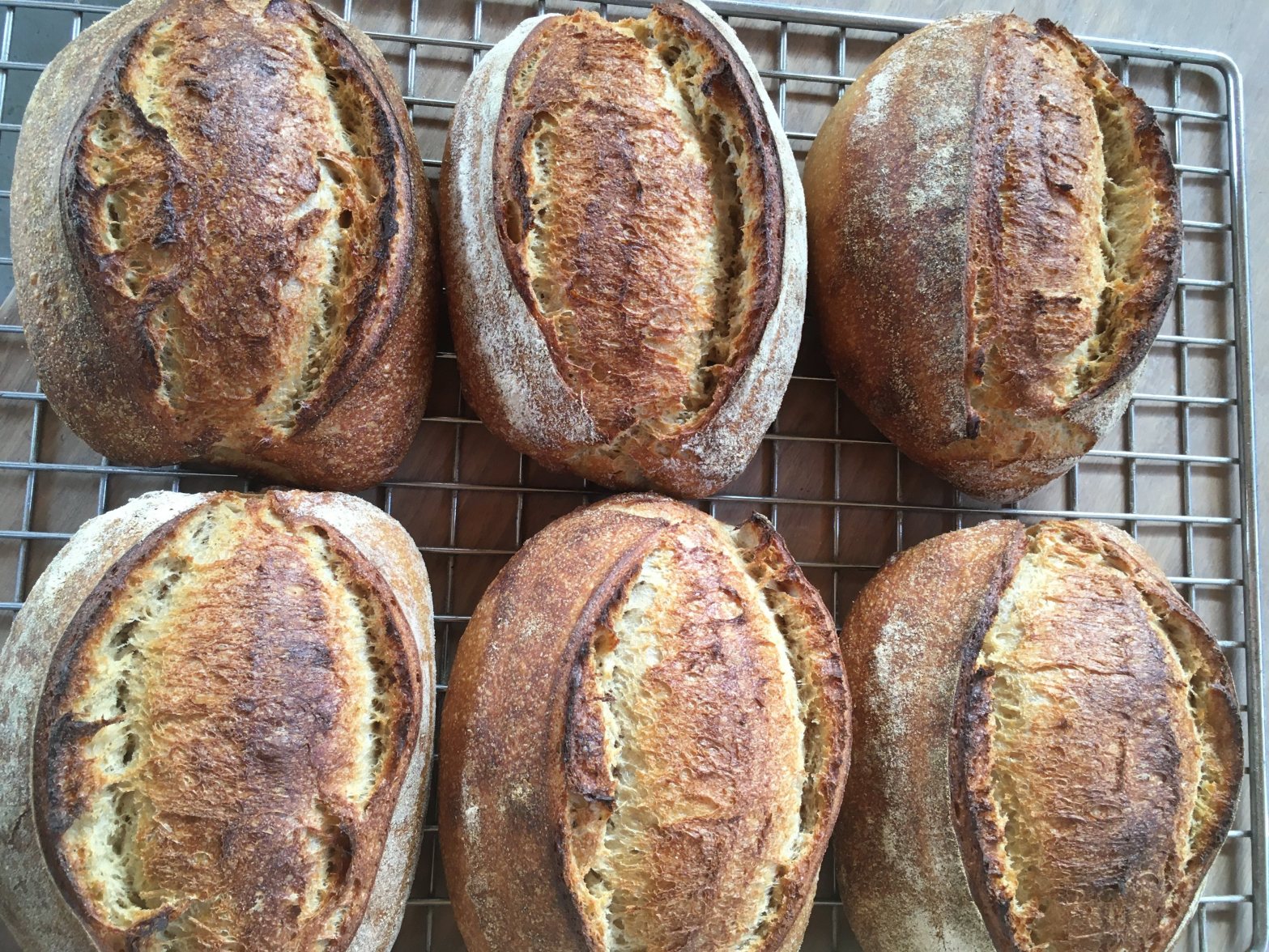
Recently the women of my small church had a weekend away. One of the organisers had suggested we look at the theme of ‘bread’ in the bible, as we were going to stay at the home of a sourdough baker. I was organising the talks and content side of things, and so I looked through the bible at all the references to ‘bread’, including related words such as ‘leaven’, ‘dough’, ‘mana’, ‘loaf’ etc., in order to ascertain whether there were enough distinct themes or topics for most of the women in our church to give a talk. I was surprised to discover at least 12 themes. Of which, some were related subsets of others.
We ended up having seven women prepare talks, with an eighth theme covered in a bible study, and the weekend was an edifying experience – for which I am very grateful.
In reflection upon the whole endeavour I would like to outline in this blog post what those topics were.
1) Blessings and curses coming through bread.
This was the first topic spoken on, and when I did the initial word study I first noticed it in Genesis 3:19. This theme continues through the life of Israel, with bread (as life-sustaining food) being a part of the covenantal blessings for obedience and lack of bread being part of God’s judgement for disobedience. Perhaps unsurprisingly, a number of personal curses involved wishing that one’s enemies had a lack of bread!
The speaker’s talk application involved acknowledging God when given material provision, and also looking to Jesus the true bread, who provides us with life for eternity.
2) Bread in worship.
Or, ‘bread in ritual’ – this topic looked at all the bread used in ancient Israel’s sacrificial system, as part of their worship of God.
The speaker’s application looked at why these rituals were done – pointing to the fact that they were part of a relationship with God, and highlighting the importance of the heart with any act of worshiping God.
3) Unleavened bread and the Festival of Unleavened Bread (ie, the passover).
This theme started in the Old Testament with the Exodus and culminated in the New Testament – in the form of the Lord’s supper.
The speaker’s application was a challenge to consider how we remember our own salvation, and that remembering effects how we live.
4) Leaven.
While leaven was touched on in the previous topic, this talk focussed on the references to leaven in the New Testament.
The speaker identified that there were two uses of leaven – one negative (hypocrisy) and the other positive (spread of the kingdom of God). This lead into an application to consider the effects of our own words and actions and to seek to be positive leaven, spreading the gospel.
5) Breaking bread.
This one was a detective-like topic that involved investigating what it meant that the believers ‘devoted themselves…to the breaking of bread’ in Acts 2:42.
Upon closer investigation it became apparent that this breaking of bread was not only fellowship but also more significantly referring to partaking in the Lord’s supper. Cf 1 Cor 10:16-17.
6) A morsel of bread.
This theme was more the repetition of a phrase, ‘a morsel of bread’ in several places in the Old Testament. In five of those places the phrase was literal. However in two of them the individuals who offered a ‘morsel of bread’ actually then went on to deliver a hastily prepared and very generous meal.
The talk focussed on the passage where Abraham offered the three strangers a ‘morsel of bread’ (Genesis 18:1-8) and looked at it from the perspective of hospitality to strangers (cf. Hebrews 13:2). The importance of doing this was particularly highlighted – as Jesus himself points out in Mathew 25:31-46.
7) Mana.
Bread from heaven…in the wilderness! This is a very educational theme, starting in Exodus 16. It is even interpreted in the Old Testament (Deuteronomy 8:3) and then reinterpreted in the New Testament in two significant passages. The first is the temptation of Jesus, ‘man shall not live by bread alone,’ (Matthew 4:3-4) and the second is in John 6, ‘I am the bread of life.’
The speaker’s big idea was spiritual forgetfulness, with a challenge for us to cultivate our trust in God, as ‘spiritual forgetfulness is the enemy of Christian joy.’
8) Bread and water – covered as a Bible study.
This was one of those themes with lots of passages in which bread and water were referred to together. The study itself asked the question, ‘what is the relationship between bread, water and human life?’ And considered some other questions too, namely what we could learn about God, about people, and how passages pointed to Jesus, etc.
In these passages were a couple of themes. One of them pointed to the fact that bread and water are basic to human life – and that we are dependant on God for life. An application is that we should therefore acknowledge this. Also, the bread and water that we spiritually need is the word of God.
The second theme indicated a responsibility to sustain the lives of others – even if it is with the basics. In one passage, to not give bread and water to those in need was seen as an evil thing, and in another there was instruction to even give it to enemies.
Topics that were not covered either in talks or as a bible study:
9) Eating bread with me: Bread and betrayal.
This theme had a small number of passages, yet fairly prominent ones, climaxing in the betrayal of Jesus.
10) Bread and wise living (Proverbs).
I first had this topic as a subset of the blessings and curses one, as Proverbs sits within the historical context of the Mosaic covenant. However, upon reflection I realised that it could very well be a separate entity in its own right, hence the split.
11) Bread in Luke’s gospel.
This topic had the potential to overlap with some of the other talks, although there were some interesting bread-y passages particular to Luke’s gospel.
12) Like eating bread: metaphors and similes.
This would have been a harder set of passages to give as a talk as it was more grouped by a literary function rather than content.
After giving the passages and topics to all the speakers, and then going through the process of hearing all the talks, it became apparent that bread can be used to talk about many different things. This is probably because as something so basic to human life it appears in so many different yet repeated contexts. The talks highlighted profound truths relating to the nature of our existence, responsibility in our relationships with others and the necessity to acknowledge our dependance upon God. What joy to be reminded of all this, and to see God at work through the proclamation of his word by my sisters in Christ.
*Cover photo courtesy of Bowen Mountain Bread.
 Bigvai and Shiphrah
Thanks for summarising. Good takeaways, and now currently hungry for Bowen Mountain Bread.
LikeLike
Bowen Mountain Bread is indeed delicious…
LikeLike