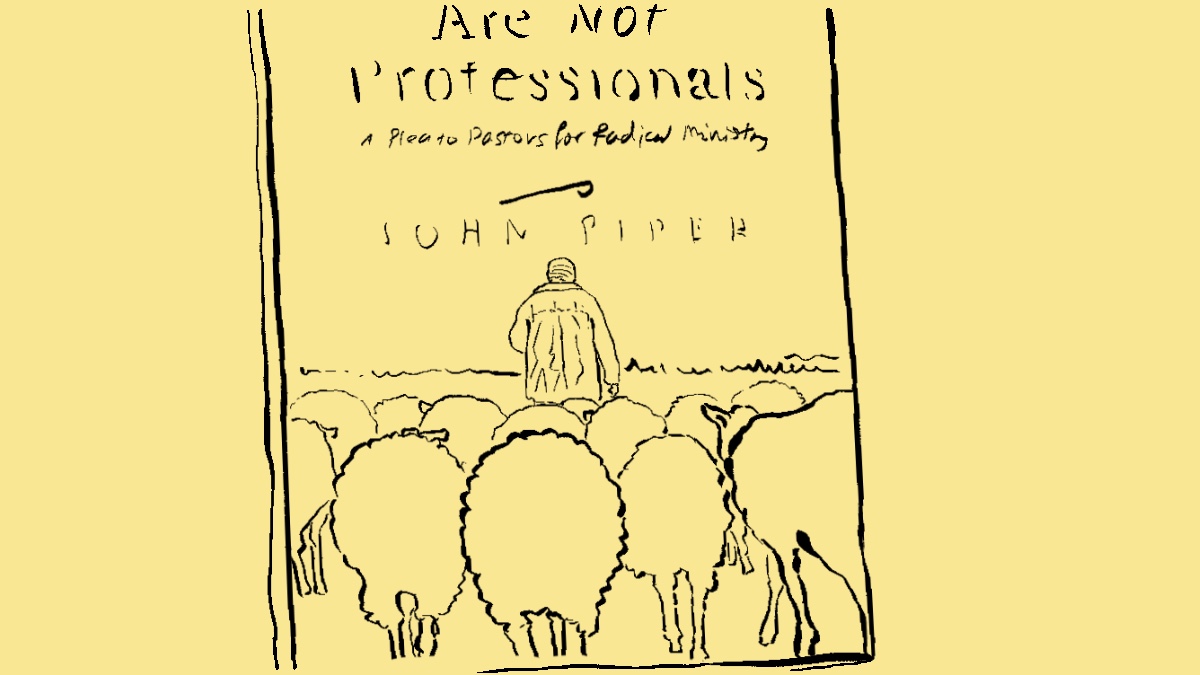
You probably picked up Piper’s book, ‘Brothers, We Are Not Professionals’, thinking about the practicalities of ministry (the ‘profession’ of ministry, per se). However, when you read it you encounter a lot of what could be described as general doctrinal convictions. Obviously, this is not a bad thing. But if you are like me, you were perhaps expecting (or hoping for) something a little more pointed and specific. In my reading, a lot of the material was stuff I would have assumed of the reader in a book like this (i.e., God is love, preach justification by faith, eve consider Christian hedonism, etc. – what we might call the general theological principles). So, to that end, this is my take on some of the key specific practical chapters, or at least the ones I found to be most helpful for me when I read a title like, ‘We Are Not Professionals’.
Note to the reader: you should go and read the following chapters for yourself obviously. I’ve taken liberties in putting his arguments into my own words and adding a good deal of my own thoughts on the subjects and then linked them to ‘professionalism’ directly (which is ironically something Piper does not do except for the first chapter!). Also noteworthy is what Piper does not address in a book like this. Subjects like rest and sabbath, or KPI’s or church governance and the minister.
Nevertheless, his first chapter starts strong and is a good defining chapter. I’ll end with a short summary of this summary at the end.
Ch1. Brothers, We Are Not Professionals
Ministry is service. A Christian (minister) is a slave of Christ. Professionalism is antithetical to that. Professionalism is about wisdom, results, honour, strengths, and recognition. It’s the sleek and trending – the curve that grows ever upward.
Service is cross-bearing, self-denial. It is to be Spirit-Filled clay pots. Crushed, weak, and looking foolish to the world. One cannot do these things ‘professionally’. A servant (minister) doesn’t become the professional clay pot. They are just a clay pot. Service is the stuff of forgettability to the world of professionalism. It is not outwardly impressive. It’s 2 Corinthians. It’s Jeremiah. It’s exile. It’s Jesus. Its fishermen. It’s 1 Corinthians 1.
Talk of professionalism in ministry is a matter to be wary of (though I would say, not totally abhorrent) because professionalism is a sort of standard set by the world. That is why it carries with it inherent danger to the gospel of God.
Talk of the business of church is foreign to the household of God. God’s gathered people have a different mission shaped by the gospel.
Ch10. Let Us Pray
One of the first things that happens in ministry is you get a sort of ‘imposter syndrome’. It can be particularly acute because you are meant to be holy, or ‘set aside’ for ministry. But you will obviously confront two matters. First, you are quite unholy! And secondly, you are labouring at something which is ultimately in God’s hands. Hence the first and greatest practical reminder – Pray. In 2 Cor 2:16 Paul poses the rhetorical question, ‘who is sufficient for such a task [as ministry]?’. Nobody is. The burden of being an aroma of death and life is heavy. A sense of competence is ironically dangerous in this ‘profession’. Which is why Piper would remark, we are not professionals. We are servants. Success is not ours. It’s God’s will worked out as we work for him. And so, we pray, ‘your will be done’.
If you treat ministry like a professional pursuit perhaps the first thing to go, ironically, will be prayer! Not intentionally but certainly in practice this will happen. You will be tempted to think you are spending your time doing ‘nothing’ when you pray. But if you are not praying, all you do will be as nothing.
We might not be praying because we’ve fallen for some sort of pragmatism. But conversely, we might be tempted to ‘pray’ out of a pragmatic motivation. Instead pray humbly, for his will to be at work, and for the strength and wisdom to walk in it. So whereas a kind of professionalism would seek resource from within to accomplish goals for company and kudos, prayer quietly announces to God one’s weakness, dependence, and plea for strength, wisdom, resource, and His ineffable hand and will to be at work through us.
Furthermore, our role, is in part, to be example. Ministers in God’s church ought to lead in prayer, and not only up front, but behind closed doors. Teaching all that the Christian life is one of dependence.
Ch11. Beware Sacred Substitutes (or, Don’t Let Ministry Destroy Ministry)
A minister prays. Understood. But why don’t we pray? One of the reasons, we are too ‘busy’ doing ministry. The fundamental to serving God is relying on God. But to get it around the wrong way is dangerous. That is, to replace a fundamental task, like prayer, with something like ‘ministry’. Ministry relies on prayer. Service is fuelled by dependence. But practically speaking, the ‘doing’ simply overwhelms the ‘depending’. That’s what happens. So beware. Beware of ministry!
If something in ministry seems really important, a gut reaction can be to get to it pronto. And that’s exactly the kind of reaction to be wary of. It certainly doesn’t mean there isn’t a time and place for dealing with something urgent urgently. It’s just the perfect storm for losing something essential one situation at a time (because they keep coming). That’s what happens in ministry. So guard prayer in ministry for the sake of ministry.
On principle this is the very opposite of a kind of hustling professional where work is the essence of work. But in ministry (as reflective of the gospel itself in a way) work comes after grace – the grace of God received compels the worker on in the deeds God has prepared.
Ch12. Fight For Your Life (or, Read Good Books)
Ministry takes it out of you. You need to replenish. Specifically, you need to replenish the soul. How does this happen? Piper argues, through unhurried reading and reflection. Reading about the truths of God or his works in history perhaps (e.g, church history), will fill your soul.
So many of the forces in culture are trivialising, making light of things or short-lived flits of entertainment (this will relate to the next chapter as well). But the spiritual life is no trivial matter. Reading deeply of deep matters will fill the soul. And a full soul will be much healthier for a church leader.
This reading ought to be done for its own sake. It’s not sermon prep, or ministry work, or required reading for a subject – it’s not just ‘part of the job’. It’s part of a minister’s enjoyment of God. To learn of him for the sake of learning more about him because you are a Christian.
Related to this, people in church will know when their minister is reading, or when they are predominantly feeding themselves on YouTube. You are what you eat. The minister’s spiritual diet will be evident. And that is worth noting. Yes, in the first instance you ought to read for the sake of the love of God. But secondarily it will have an impact on those who you serve. They will go deeper because you are deeper.
So now you have more work! And it’s not even about the work at this point either. You have to work at praying. And you must work at reading. And the work is the work that isn’t work. All that to say, we are not ‘professional’ when we attend to these matters. We are being healthy. Enriching our souls.
Now for the flip side. Ministers should be ‘professional’ readers. We read scripture. We read theology. We read (to a degree) the cultural products of our time for the sake of our people and understanding their greater context. So it could be said, there is a sense in which this is part of what we do ‘professionally’ (if we take this not to be at odd’s with all that I’ve written so far). But the main point of this chapter in Piper’s book is to enrich and nourish ones spiritual life. But this paragraph is still worth noting as the appropriate use of reading for the task at hand as well.
Ch13. Be Bible Orientated, Not Entertainment Orientated Preachers
Don’t be silly when you preach. Sounds obvious I hope. You’re not an entertainer, you’re a preacher. There are better entertainers than you and more of them. God’s people don’t need more entertainment! Lord knows. You proclaim the truths of God. Contextually, you proclaim serious truths to a people more accustomed to trivial, flippant, silly, entertainment grabs of 30 seconds or less. And as mentioned earlier, if you are steeped in that world too, then it will show. But conversely, if your authority is clearly the bible, it will show.
To that end your joy should be evident. That’s not contrary to the paragraph above. Your delight in the Lord and all that he is and does should show in your preaching. But that’s different to communicating with the purpose of entertaining. What should/will grab the hearts and attention of God’s people will be God. What do you think your task is if not to show people God in and through his word?
Here is a potential chain of reasoning which might lead you to act otherwise. You will likely start with believing your duty is first and foremost to communicate the truths about God. You gotta tell people about God. Best place is church. But the best way to get more people to church to hear about God is to be an entertaining speaker one might reason (that’s what gets the likes and subs everywhere else). But in order to protect the goal, you entertain for the sake of telling people about God. Everyone is happy! However the means is important (and the motive). Entertainment in the form of the casual, silly, laugh-seeking style will communicate something about God (or rather, not). The message will be light, not reflective of the heavy or deep truths of God. The medium or style will also diminish the depth if this is the method used. And the result will not be what you longed for. You were hoping for committed gospel-hearted, long-suffering, servant-hearted people. Instead, they are shallow and flaky. Not used to meat (or milk!). What might happen in the minds of those at church is the packaging will become more important than the content. “Was it funny? Or fun? Or interesting? Or witty”, not, “Was it true? What should I do? How do I change?”
Underneath this subject is the topic of authority. In preaching the authority is the bible. When entertainment is the packaging the biblical truths and authority of the bible can be hidden or forgotten or not appreciated. People may learn truths, but not why it’s true. Another danger is that people might learn all sorts of other unrelated truths as hooks in a long line that (hopefully) leads to bible truth. The trouble with this is (and increasingly) that others will know more about the weather, cars, sports, finance, etc than you do and an error in some hook will hook in a person’s mind for all the wrong reasons. Then the very thing you were hoping would grab and lead to the bible has now held their attention in a detrimental way. Back from the bible.
If professionalism has to do with getting results and been liked, loved, and admired, then entertainment is going to be key. But that’s not our goals, or God’s goals. We want to see hearts changed by God’s Spirit by God’s word.
Bible preachers, preach the bible. Are you enthralled by the word of God? If so, why so? Is it not because it cuts you to the heart and divides your innermost thoughts? Don’t give people less than that for themselves. The word does the work.
Ch15. Bitzer Was A Banker (or, Practise/Learn Your Greek and Hebrew)
The better you know God’s word, the greater your confidence in its proclamation and the better you will show its authority. That’s why you should keep up your Greek and Hebrew (or learn them).
Many might think this is unnecessary nerdiness which will not help people connect to the bible or God better. ‘Dry scholarship’ and getting lost in the weeds and missing the vistas some might say. Or more likely the cause of losing this skill, simply neglect. Benign and powerful.
Though not guaranteed, with the neglect of the originals by a minister, an outcome that becomes likely is the minister (and therefore church) will get the bible in a second-hand manner. In this scenario truths of the text are discovered by others who the minister then reads which he then gives to the church. There is certainly a place for this reading and second-hand nature. But much better on principle for the minister to have learnt and discovered the intricacies and weaves and connections themselves, firsthand. Like the prior topic above, the subject of authority comes up again. In the second-hand scenario, the authority is less clearly linked to the bible. The modelling of firsthand learning, time and effort, reasoning will lead others not only into the truths you find, but model truth seeking itself. As good as it is to read good books (as argued above in Ch 12), name dropping the latest best seller, or favourite author is still a step removed from the source of that author or works investigations, the bible.
Now we are surely sweating (at least I am!). Not only do I need unhurried time to pray and time to read, but original languages is surely the killer because it takes consistent amounts of time in practise. And that would be a compelling argument if the professionalisation of ministry leads us to value the pragmatics of ministry above the principles of ministry (which is a constant temptation). So keep to the principles, and fight for these skills. Languages are key to exegesis. And exegesis is key to word ministry. And you are a minister of the word.
In my mind, an argument can be made for thinking of original language skills as part of the job and that the minister should consider them part of his ‘profession’, as being set aside to devote time and energy to matters others will simply not have the time or energy to give to. This sort of professionalism is distinct (I think) from the kind that Piper is arguing against.
Ch25. Let The River Run Deep (or, Express Your Passion Appropriately)
Preaching isn’t lecturing. It’s not an info dump. It’s an art. That which moves you will move the church. The truth of God is bedrock. But we speak those truths in love (to use that phrase in a different context). Your love for God is and should be seen in the form of your speaking. You must lovingly speak of God. This is not necessarily about spontaneous outbursts (though that may be appropriate sometimes, and may not be other times), but artfully crafted and beautifully stated prose of the goodness of God. Not for entertainment or manipulation for a result. But in representation of the subject you speak of according to the tone of the text and context you are proclaiming to. Artfully explaining and communicating the intricacies of theology should be delightful for all involved. Not cold or impersonal.
That makes preaching not merely a matter of content or form which could be performed by an educated and competent professional public speaker. It must be affective to be effective – having affected your heart to then effect the hearer. This is far from the possibility of performing a task professionally but is an authentic love of God.
Ch29. Tell Them Copper Will Do (or, Don’t Love Money And Be Generous)
Finally for our purposes, ministers are paid for their work. We are paid to be who we are – Christians (which is a strange thought). Ideally you’d receive a stipend for being a servant. Not receive remuneration for dispensing of a task (though there is some scope for that too). So it’s tricky to navigate being a gospel worker without sliding into considering oneself a ‘professional’ gospel worker because we are being paid to be a Christian basically. Anyone else in the world, when paid for something, would consider themselves in an inevitability of capitalism, as someone who is a professional in that field (the arbitrary threshold probably being when you make enough to live off, which is the very idea of a ‘stipend’).
Speaking of money, the world loves money. And we all live in that world. And we receive money for our work. Although we are all drawn to it, the west is even more so due to the tides of consumerism around us (and that consumerism also creeps into churches and how people ‘consume’ a service).
On the contrary, the Christian faith is marked by abundant generosity. The generosity of God is his giving to us and our generous response in giving of ourselves. The minister is to be generous. And the flip side of that (or prerequisite) is to not love money. To not be greedy. And that may look like one forgoing luxury. If a problem in our churches is that many are giving little while owning lots, then modelling the kind of lifestyle they should live is something a minister should be mindful of. It is appropriate that it be evident a minister treasures God and not things or stuff.
It seems incompatible in the business-minded world that generosity and ‘enough’, and contentment would be valued. I guess that’s just another reason why, brothers, we are not professionals.
In summary, I think those chapters are the best chapters for fighting professionalism in ministry. You are not a professional prayer. Prayer is utterly humbling and reverential. Professionalism would put all the focus on the task, the doing, and the doing better and more efficiently all the time. Substituting service into the place of dependence is almost acceptable, it seems, but contrary to the logic and narrative of the gospel and biblical story. Professionalism is strongest here, perhaps, in the “doing.” “Wasting time” reading books for the sake of simple personal enrichment seems almost luxurious, especially if it does not seem to contribute to any direct goal or outcome, like an event, or seminar, or study, or sermon. But it is about the filling up of your soul on the things of God. It is about the personal nature of a minister, their own love of God.
Then, in the job of ministry, it is about preaching. But how does one preach? If the ends justified the means, then entertainment would be plausible. But that inadvertently undermines biblical authority, and discipleship, and maturity (which seems like a no-brainer to prioritise). Painfully study the original languages, because exegesis is key to preaching, which is key to ministry. Ironically, if you were to be “professional,” I think this is the closest you could get to arguing the need for that specialist skill. Yet how did that fall out of vogue? Simple neglect for rigorous effort.
But do not be cold. Be artful and deep in your preaching. Represent the depth of God’s word with a depth of joy, or warmth of prose, that arrests the heart and shines forth the text. And finally, professionalism is inherently a product of a worldly order; it is after worldly reimbursement. But service is very much a giving, not a receiving. That should be reflected in our contentment with enough to look after ourselves and our families.
Piper, J. (2013). Brothers, We Are Not Professionals (2nd ed.). B&H Publishing.
 Bigvai and Shiphrah