I’m not saying it’s my favourite passage in Genesis, because I think a passage so seemingly bland isn’t allowed to be one’s favourite. That being said… Genesis 23, aye. Simply: Sarah, the wife of Abraham, dies, and Abraham buys land to bury her. It’s mostly about a business deal. Where are the explosions, the samurai swords, and the international espionage (i.e. Gen 14—I imagine Abraham has fourteen-inch biceps and an eight-pack at age eighty)? Chapter 23 may read like a real estate transaction, but it’s Abraham’s first and only glimpse of owning even a corner of the land God promised. I find that remarkable given the promises made to Abraham and their centrality, but it shows the unfolding nature of God’s promises—again, especially noteworthy when viewed from this far away and after so much fulfilment. So maybe the reason why I love this passage so much, oddly, is because it makes me really appreciate biblical theology.
It starts with a death: the death of Sarah, the wife of Abraham. We might call her the mother of the faith in some respects.
“Sarah lived to be a hundred and twenty-seven years old. She died at Kiriath Arba (that is, Hebron) in the land of Canaan, and Abraham went to mourn for Sarah and to weep over her.” (Genesis 23:1–2)
At the end of this chapter, after Abraham has bought some land, he buries his wife Sarah—the first recorded burial. It’s weird to say, but Sarah’s death is just a preamble—a setup—for Abraham buying property. But how interesting that death is used as the grounds for purchasing part of the promised land. Preamble over. This chapter is really about real estate.
If you were to say what three things the Bible is concerned with, you could very legitimately argue, as Sydney theologian Graeme Goldsworthy has convincingly argued: the Bible is about God’s people, under God’s rule, in God’s land. And that is exactly what we’re seeing here in Genesis—we’re seeing the genesis of these three ideas which will unfold over the whole biblical narrative.
God’s people are the descendants of Abraham. God’s rule is seen when Abraham, Sarah, and their descendants live by faith in God—when they trust and obey Him. And God’s land is the land of Canaan. But at this stage, Abraham doesn’t actually own anything in Canaan (though he was promised it all)—until Genesis 23.
“Then Abraham rose from beside his dead wife and spoke to the Hittites. He said, ‘I am a foreigner and stranger among you. Sell me some property for a burial site here so I can bury my dead.’” (Genesis 23:3–4)
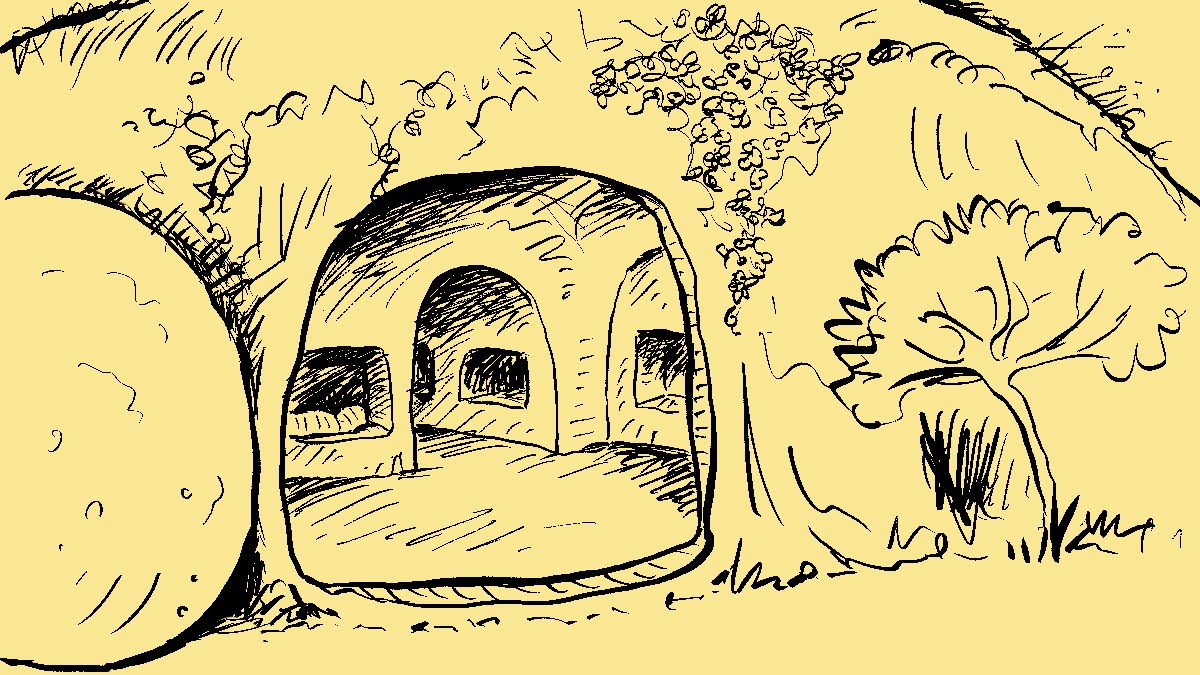
The Hittites offer Abraham a free tomb, but he’s not having it (for nothing). After some classic Middle Eastern haggling with Ephron, Abraham buys the cave of Machpelah for four hundred shekels. The passage records more than just Ancient Near Eastern haggling rituals—it’s a public purchase, with many witnesses. It’s an indisputable transaction, paid according to the weight of the merchants at the time. The land is legally deeded to Abraham.
Abraham legally owning this land is very different from accepting a free gift of land (similar logic to Abraham’s refusal of the king of Sodom’s gifts in Gen 14). When my brother and I were kids, our neighbours took a fence panel out and let us into their backyard to kick a ball. But that gift only lasted as long as they lived there. When they moved, the gift disappeared. That’s the same danger Abraham faced if he accepted the burial ground as a gift. What if one day the gift was taken back? But now it can’t be—he owns it.
It may seem trivial (which is part of the reason I like this chapter so much), but this is actually very important to the book of Genesis—especially to the unfolding of God’s promises (and biblical theology—again, why I like it). It’s not just Sarah who ends up buried in this tomb. Abraham, Isaac, Jacob, Rebekah, and Leah are all buried there in the end.
At the end of Genesis, Jacob says,
“I am about to be gathered to my people. Bury me with my fathers in the cave in the field of Ephron the Hittite… There Abraham and his wife Sarah were buried, there Isaac and his wife Rebekah were buried, and there I buried Leah.” (Genesis 49:29–32)
The whole family is buried in this one place! But remember—this is not their homeland. It’s important that Abraham doesn’t go back to his homeland to be buried. He didn’t go back to Ur of the Chaldees for his burial plot. Have you ever thought about where you will be buried? Because it might not be the town or even the country where you die. Where you are buried says a lot about you. Which is why I know you’ve thought about it, even if you don’t want to be buried as such.
That Abraham’s whole family is buried in this one little plot of land says something. This burial ground is the only piece of land Abraham ever owns. God promised him the whole land—and all Abraham ever gets is a little grave in a cave.
All of this should make Hebrews 11 come to life:
“All these people were still living by faith when they died. They did not receive the things promised; they only saw them and welcomed them from a distance, admitting that they were foreigners and strangers on earth… Instead, they were longing for a better country—a heavenly one. Therefore God is not ashamed to be called their God, for he has prepared a city for them.” (Hebrews 11:13–16)
Genesis 23 has helped me immensely in seeing the significance of the words of Hebrews 11 (which is often a favourite for people). That’s because Gen 23 is a picture of faith. This is what faith looks like.
As Christians (spiritual descendants of Abraham—stars in the sky, you might say), we look back to the work of Jesus in faith. We trust in His death on our behalf. We believe He is risen from the dead and ruling from heaven. And we believe He will come again. These are the deeds and the promises of God. We have received the Holy Spirit as a down payment of the inheritance to come. Much like Abraham and Sarah were foreigners and strangers on earth, so too is every Christian. This place isn’t our home—we are looking to a new home, a city prepared by God.
Brilliantly, Genesis 23 is emblematic of God’s people. They receive the promises of God for land (among other things), but they receive it only in part while they faithfully wait or hope or long for the fulfilment. Likewise for us. We receive the promises of God, fulfilled in Jesus, and yet we also look forward with faith to the return and culmination of those promises, inheriting the land to come—heaven.
I hope I’ve convinced you to bump Genesis 23 into your top ten Old Testament passages.
 Bigvai and Shiphrah