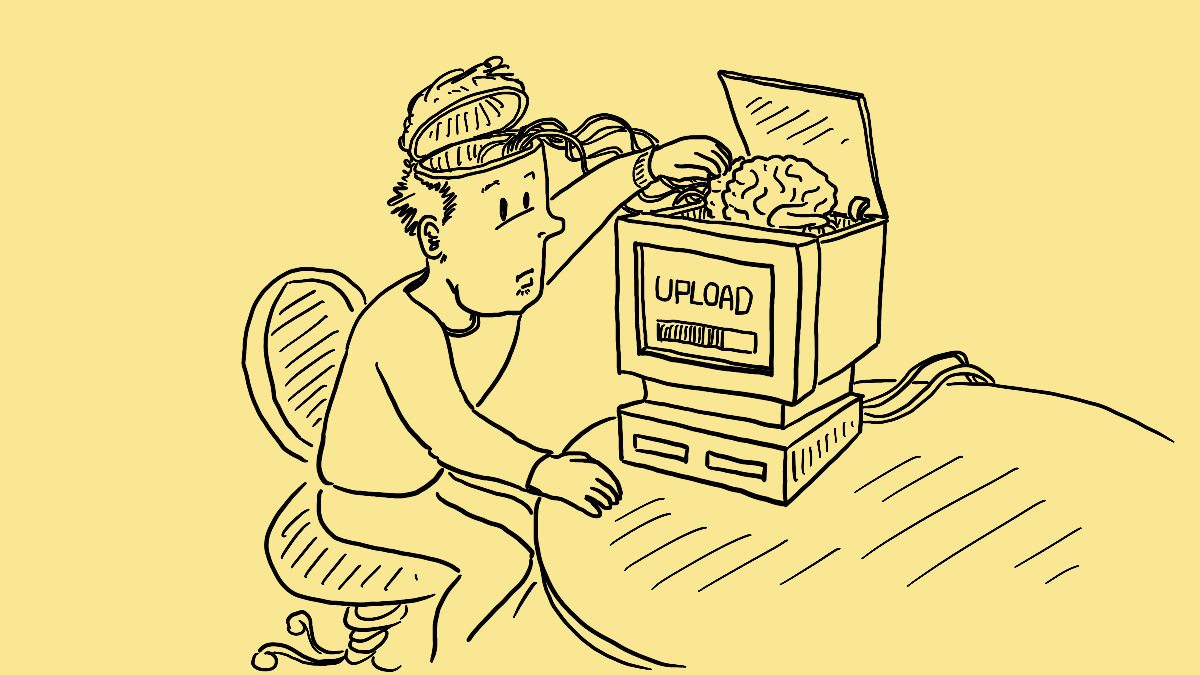
With the AI boom having recently made waves in the world of everyday folk, what is washing up on the shores of our thoughts is… our thoughts. That is, our consciousness. So it is that there is a renewed—or at least more realistic and tangible—line of questioning emerging. People talk about uploading their consciousness to silicon (i.e. computers). People talk, in related ways, about augmenting the mind through brain implants. People then talk about AI becoming sentient (from generative to general). And even now, closer to lived experience, people talk about AI making decisions—or helping them make decisions (decision fatigue cured! Except for which AI you will use…).
In all this, there’s a problem. It assumes a lot. Indeed, these thoughts, speculations, and questions assume we actually know the basic and fundamental nature of something common to them all. But we don’t! The problem is this: What is the mind? (Or consciousness?) It should be clear that to indulge these questions of AI and consciousness, we actually need to know what consciousness is—don’t you reckon? Ironically, we have no idea. (Maybe AI can help us…) Is the “I” that is reading this—is that mind of yours your brain? Or is it greater than the sum of your brain? Is it separate (substance dualism)? Is it illusory (mere materialism, brain only)? And how would we square talk of an insubstantial consciousness with uploading it to something substantial and material? What is it that would make AI general or sentient? Isn’t it crazy to think about these speculative scenarios like they are more than hypotheticals when we can’t even begin to speculate about their current fundamental realities? In a nutshell, how does the mind actually interact with the physical world—brain (or silicon)? This is what’s called the ‘hard problem’ in mind/body philosophy. Wanna know why? Because it’s hard to figure out (who ever said philosophers can’t be obtuse?).
I know you don’t want more problems to think about—sorry—but before we get to the business of looking smart in front of our friends about AI stuff and futuristic cybernetic organisms of silicon and carbon… I guess we need to figure out how we will make the necessary decisions to get there (or anywhere). Not hard. I mean, you make decisions all the time. Simple binary, right? 1’s and 0’s (until supercomputers get going—hurry up, IBM).
How tempting it is to speak of life in binary terms: yes and no, black and white. If it were that simple, then it’s easy to imagine that General AI has arrived if it were simply able to make (or appear to make) binary decisions. That would have to be at least a basic criterion in my thinking.
So, how then do you or I make decisions, then? Even simple decisions. What you and I do is keep in our minds all the available environmental factors of the moment (such as physical realities), all the historic context that led up to it, all the social factors at play (such as motivations of yourself and others, and the politics of interactions), and then weigh all that against what we think is going to be the best outcome and the likelihood of that happening (which then requires us to have a basic ethical framework for good and bad and right and wrong—of what wisdom is). And because you have a limited degree of knowledge in all these areas, you are constantly making educated guesses. Which, if we drew it all out, would just look like crazy decision trees.
So what is the picture you get? You get irreconcilable tensions in the decision tree. Keep ‘this’ in mind, but also, oppositely, keep ‘that’ in mind at the same time. We get a sense of the need for wisdom and reconciling these impossibilities when we read Proverbs and Ecclesiastes in the Bible. Both wisdom literature. Both in the Bible. Both informing and guiding life and decisions. Proverbs tells us the way of wisdom is in making good decisions and avoiding foolish decisions, in rather black-and-white terms. Simple enough—binary. But then you read Ecclesiastes. Do your best, sure. But in the end, factors out of your control will mean the wicked will prosper, the wise will suffer, and you will die—rich or poor, doesn’t matter. Best to let the chaos machine run and enjoy it while you can. No sense in chasing the wind.
Both biblical books. Both wisdom. Both guiding. At opposite ends of the spectrum. Which end of the spectrum is right? The answer is that the spectrum is right! It portrays reality. What does the spectrum do for our lives? It tells us to be critical. You are thinking or living on one side, but you need to consider the other. Life going well? Good, but it could turn in an instant quite aside from your planning and wisdom. Life going poorly? Well, you should do something about that. How frustrating to have the two books in the one picture of reality.
With this in mind, Allow me to quote Christipher Watkins at length here:
“Philosophically speaking, Proverbs is the Hegel or Plato of the wisdom literature: everything has its place in the system, everything works as it ought, and nothing is lost or obscure. Ecclesiastes, by contrast, is the Kierkegaard or Shestov: the world is an obscure, impenetrable place and philosophical systems are laughably simplistic in their attempt to account for a reality whose depths they do not begin to plumb. What is truly remarkable in the Bible is that Shestov and Hegel sit down together, and Plato takes tea with Kierkegaard. Over two thousand years of church history, many have tried to remake the Bible in the image of a systematic Plato, and others in the image of an existential Kierkegaard. They will both find some biblical material to help them, but the two attempts equally flatten and muffle the multiperspectival biblical witness. … This is a question in relation to which Christians need to know our own temperaments. If we are people who love systematicity and neatness, let us not rewrite the Bible in our own image. And if we are those who are thrilled by adventure, messiness, and unpredictability, let us not assume that the Bible was written for us and no one else. Let us rejoice when the Bible does not think like we do, because only then can we be assured that when we read it, we are looking through a window and not in a mirror. This necessary and irreducible tension between the outlooks of Proverbs and Ecclesiastes is highlighted by John Stott in relation to the Bible as a whole, when he quotes the great nineteenth-century preacher Charles Simeon: “The truth is not in the middle, and not in one extreme, but in both extremes.” Chesterton puts it like this: “The real trouble with this world of ours is not that it is an unreasonable world”—that is, Ecclesiastes alone—“nor even that it is a reasonable one”—that is, Proverbs alone. “The commonest kind of trouble is that it is nearly reasonable, but not quite.” In other words, our theoretical paradigms of humanity, society, and the world almost work, they almost account for the way things are, but they never quite close the deal. The world is amenable to academic investigation, but sooner or later it always exceeds any attempt exhaustively to theorize it, whether in the arts or in the sciences: the modelled always exceeds the model. The bold juxtaposition of Proverbs and Ecclesiastes in the Bible perfectly captures this complex, irreconcilable experience.” (Christopher Watkin, Biblical Critical Theory, Pg 321–322,)
So what?
The reason I bring all this up is because consciousness, decision making, life’s experiences are all complex in the extreme. And when something like AI pops up (a tool unlike any other thus far and with the potential and power to be a milestone in human history – cool right?), it can a helpful vector for considering the limits of our understand ironically. The ironic part is that it ought to highlight our lack of understanding and the complex nature even as it is a demonstration of humanities understanding (sciences and the like).
I’m basically reflecting that it seems cool, and cyberpunk, and smart (and did I say cool?) to think about these ideas—that we can upload our minds to computers like life’s a game. But as cool as all this is to play video games and watch movies about, if we are actually serious about these matters without being thoughtful, I reckon you just look silly. You don’t want to look silly, do you? No, you want to look cool.
I think it’s cool to know the limits of understanding our understanding. It’s cool because it points me to the mind behind all minds, the consciousness from which all consciousness comes (and must come)—God. Father, Son, and Holy Spirit. The personal nature that is the bedrock of all reality. When we reach our limits of understanding, and an infinite chasm is before us, nevertheless, you can see to the other side, and marvel at the otherness of God, and the nature of God, and the nature of us and our world (respectively).
I reckon pondering these truths is actually cool, in an old-school, analogue kind of way.
Watkin, C. (2022). Biblical critical theory: How the Bible’s unfolding story makes sense of modern life and culture. Zondervan Academic.
 Bigvai and Shiphrah
Agreed. I was thinking a couple of years ago, of writing a book: It’s But a Machine (I.B.M.) and now, it’s probably too late.
LikeLike