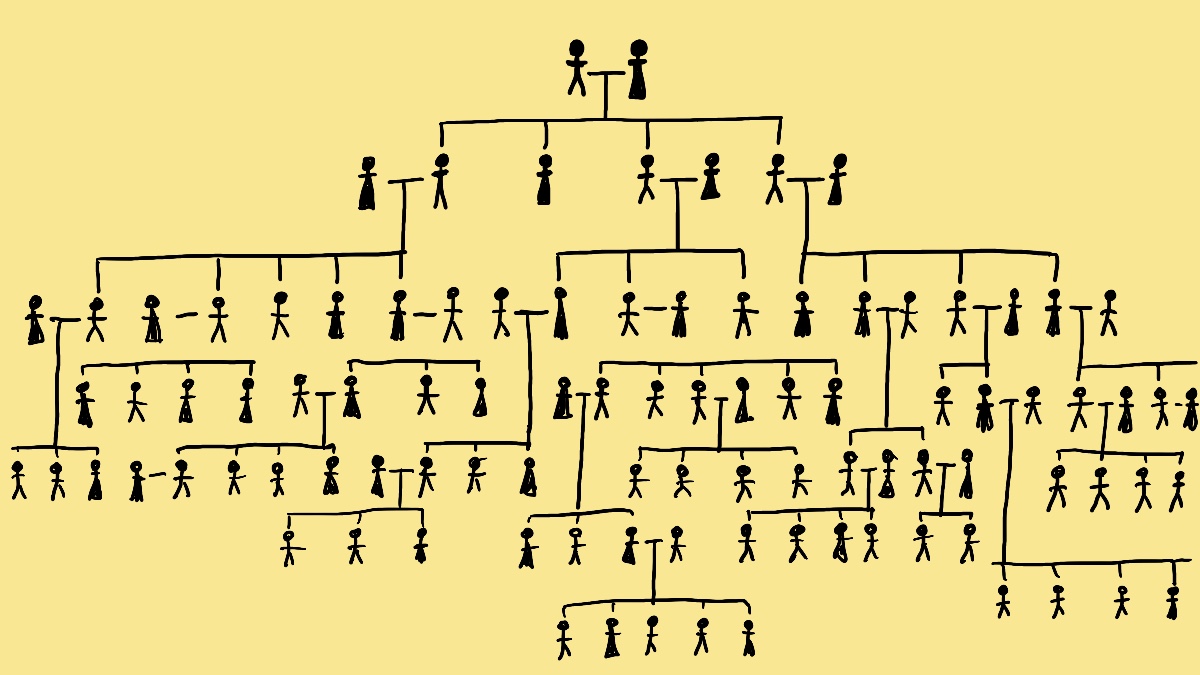
When you come across genealogies in the Bible, which happens inevitably, you may wonder why they are there and also secretly think, “Can I skip this? Or skim this?” Although every genealogy has its own unique purpose, flavor, and message, there are general principles and purposes behind all genealogies in the Bible.
The importance of genealogies reaches beyond those immediately concerned (i.e., the immediate descendants whose lineage is being recorded). Genealogies also speak to us who are totally unrelated. This is a strange idea because the whole practice of recording genealogies is about descendancy and lineage. This is why it is peculiar that they might have relevance to us who are unrelated (and why it’s easy to think they don’t).
First, the genealogies of the Bible tell us something about God Himself. They are a record of God’s faithfulness to the generations recorded and thus a display of His faithfulness in character. If you are wondering if God is faithful or trustworthy (and who doesn’t wonder this?), then you can surprisingly consider the genealogies a source for contemplation.
Secondly, genealogies tell us something about ourselves. Before the Abrahamic genealogies and the genealogies of Israel and its tribes, there are genealogies of Adam’s descendants. These remind us that we are all part of this lineage, no matter how dispersed we are now or how disconnected we may feel. We still remain, in mysterious ways, related and connected.
Genealogies also tell us that God sees and values each of us. This is ironic because when we read any genealogy, we often glaze over these individuals and care little about who they actually were. They are meaningless names to us because we don’t know the vast majority of them. They only ever appear in the Bible as names in a genealogy, and we think, “Who is that? And why would I care about them?” However, God knows exactly who that person is, and more than that, He knows the lineage and story of every person and every family, including ours. The irony is that as we care little for the people in the genealogies, similarly, in the eyes of the world, we may seem like nobodies, of little importance to world affairs. But hundreds of “nobodies” are named in the genealogies and recognized by God in His plans and purposes. Likewise, we are known by God (see also, 1 Cor. 8:3 & Gal. 4:9) and therefore valued by God. Genealogies also speak a tale of death—one generation lives, raises another, and then dies. It’s a tale of death but also a tale of dependence. Each generation owes its existence to the one before it. As little as we may know about them or feel any connection to them, we owe them our existence. In this sense, genealogies also highlight the importance of family.
Finally, genealogies tell us about God’s dealings with humanity. We are called to pass on the faith to the next generation, ideally as we have inherited the faith from our parents. Our purposes go beyond ourselves. It’s not only individuals who do great things in the Bible, but each individual’s calling extends beyond themselves and sometimes their impact is felt only through the generations as outworked and built upon by further generations. In the West, we might naturally think in terms of those immediately around us, but the genealogies remind us of the calling to pass on the faith in a longer chain to the next generation, with impacts for generations to come (under God).
What might at first glance seem like a meaningless list of names with no relation to us is, hopefully, recognized as a meaningful message of God’s faithfulness, our importance (or rather, God’s recognition of us), and our greater duty to the generations to come.
 Bigvai and Shiphrah