We spend a good deal of time working. Some of us wish we had more, and others less. The circumstances of our work are important but more important than our work situation is our work principles. Have you thought about what your work principles are? Better still, where did those principles come from? Because without thinking about it, we often pick up the work ethic of our dominant workplace (or our first workplace). It’s luck of the draw then. But also, I’m betting the deck is stacked against a Christian work ethic in an increasingly money-centric what-they-don’t-know-won’t-hurt-them kind of zeitgeist.
My point? We need wisdom (of the biblical sort). Here is what proverbs has to say about what our work ethic should be. These may seem obvious to you. But if they do, I assure you, that’s not because these are universal moral laws adhered to by all people across all times. They are learned. So if they are obvious to you, then thank God someone taught you these principles. Broadly speaking, Proverbs speaks about two principles (which we will look at in two parts). First, the wise are diligent and not lazy and secondly, the wise are honest workers, not dishonest.
“A sluggard’s appetite is never filled, but the desires of the diligent are fully satisfied.” (Prov. 13:4)
Here’s a little nugget of wisdom for you: this proverb conveys two important messages. On a surface level, a person that doesn’t work literally doesn’t eat. While the diligent worker gets their fill of food and is satisfied. On another level though, a lazy person isn’t content, or ‘satisfied’ with their work. They are lazy and discontent. While a diligent worker, is satisfied in their work. An honest days work, done well, is a pleasure. There is achievement and satisfaction. That’s why it matters how you work.
Another.
“Sluggards do not plow in season; so at harvest time they look but find nothing.” (Prov. 20:4)
God in his wisdom has made the world in such a way, that natural law means work yields fruit. (And thorns and thistles… true) But generally, work yields fruit. Neglect leads to loss, and that, in a profound way. If the worker doesn’t plough in winter, he won’t reap a harvest in spring. And if he doesn’t get a harvest in Spring, he doesn’t get seed for next winter. It’s a downward spiral. It started because he’s lazy. One season prepares for the next. In a sense, you start working by doing the chores at home, and then you learn to work for someone else, and then you have pocket money as a teenager. And after you’ve worked through school and maybe uni, you work in a full-time job, and you pay your rent and buy your own food. This happens because you learned to work. Eventually after working, in theory, you retire, because you ploughed in season, you have a harvest for a later season. This proverb warns of the opposite. Each season prepares for the next. Maybe you never learned to work at home, maybe you didn’t learn to work at school, Then you have to get a job but you didn’t get taught to work. Each season gets harder and harder. We neglected to plough in season. An earlier season was preparing you for a later harvest. It is very profitable in many ways to learn to work
Another proverb.
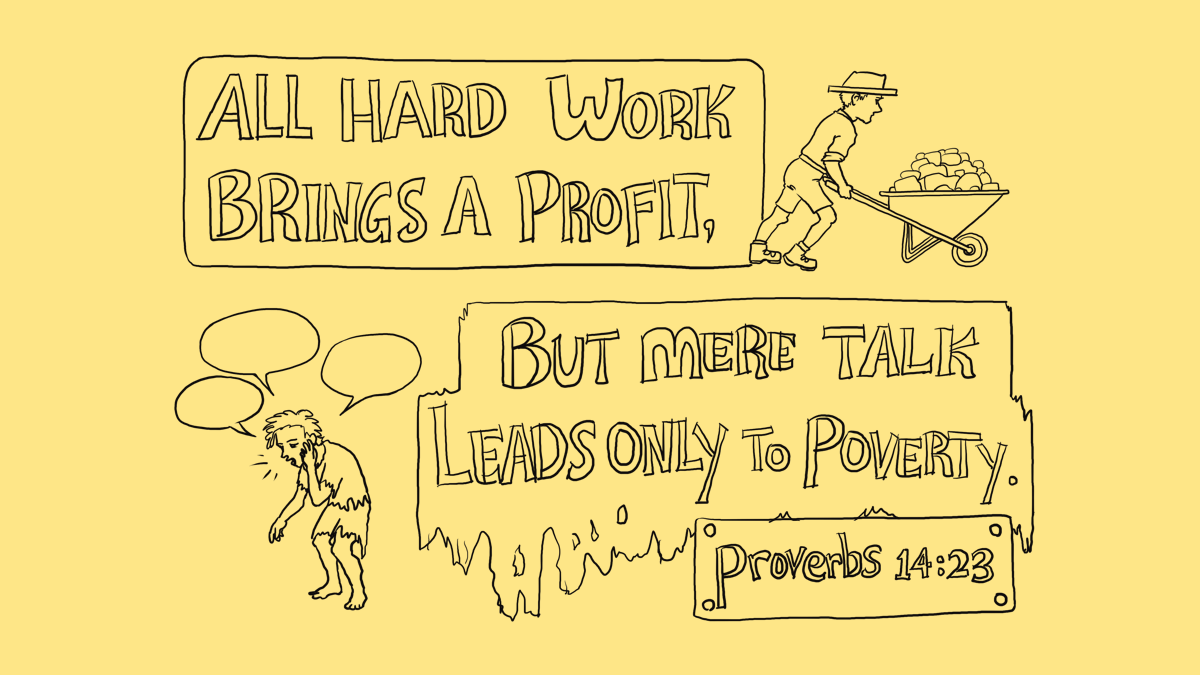
“All hard work brings a profit, but mere talk leads only to poverty.” (Prov. 14:23)
We all have these ideas about what should be done. And we love to talk about what ought to be done. “If I were in charge I would do this and this and this, I would change the world.” We see all the problems to complain about. But so often it’s all just talk. That’s because it is easier to talk than to do.
More proverbs in this section.
“Those who work their land will have abundant food, but those who chase fantasies have no sense.” (Prov. 12:11)
And
“The plans of the diligent lead to profit as surely as haste leads to poverty.” (Prov. 21:5)
Work is not easy. If it’s easy, maybe it’s a fantasy – beware. Chasing after fantasies is like latching onto the latest get-rich-quick scheme. Which makes my mind jump quickly to cryptocurrencies. My mind goes here because of the high-profile frauds and schemes that have accompanied this new space. Not saying cryptocurrencies are illegitimate for business engagement. I’m just saying that there were many people who were chasing fantasies, people who were hasty to make money, and ironically, they lost their money. That’s the kind of situation these proverbs are speaking about. There are times when we do our due diligence and we still lose our money on investments, or business gone wrong. It is a world of thorns and thistles to use the language of Genesis 3. There are snakes in the grass. Someone else’s dishonesty can lead to our poverty, sometimes. (we’re going to look at dishonesty in the next post) But these two proverbs warn us against chasing fantasies, and against being hasty in our work for the sake of money. Instead, to be diligent, to be, “slow and steady” as it were.
The proverbs council us, the wise person is diligent in their work, and not lazy.
 Bigvai and Shiphrah