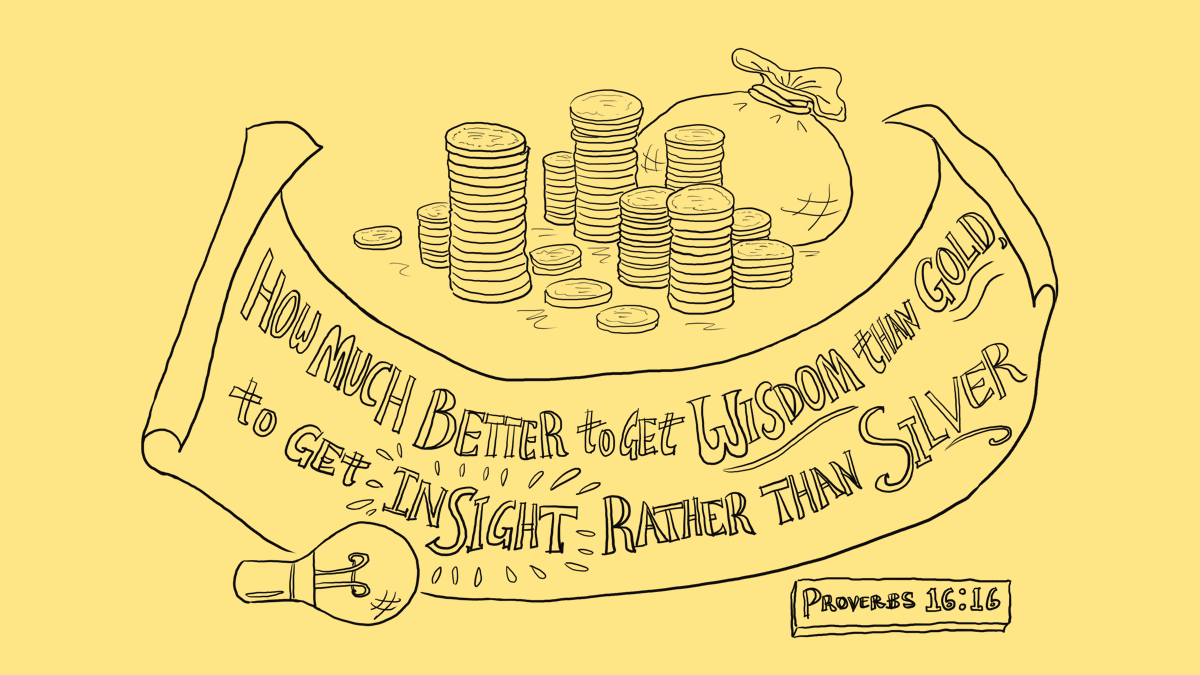
Do you think you handle money wisely? It would be nice to answer in the affirmative. Certainly, we need wisdom when it comes to handling money. Not in order that we can make more of the ephemeral stuff. We aren’t talking about money management wisdom. We are talking about biblical, character-trait wisdom. Money has this strange intangible influence over us, seemingly like it has a power all its own. Hence the need for wisdom, or as we have else put it, discernment. A good place for that is proverbs.
When speaking about money, Proverbs puts it straight – people with money have power. The rich enjoy more security influence and power, while the poor are left more vulnerable.
For example,
“The wealth of the rich is their fortified city, but poverty is the ruin of the poor.” (Prov. 10:15)
This is simply an observation. Poverty is bad for people, while wealth provides a certain kind of “security”, we might say, a certain kind of power. So, while the poor have less power, the rich have more power (at least in a worldly sense).
But…
“The wealth of the rich is their fortified city; they imagine it a wall too high to scale.” (Prov. 18:11).
There’s something hidden in that proverb. The security that wealth provides is partly imaginary. We get an ethereal vestige of the ephemeral nature of wealth in this verse.
More observations.
“The poor are shunned even by their neighbors, but the rich have many friends.” (Prov. 14:20).
Again…
“Wealth attracts many friends, but even the closest friend of the poor person deserts them.” (Prov. 19:4).
Proverbs isn’t commending this state of affairs. Just stating it. It’s the reality. Money is attractive and money attracts people so-called “friends”. But of course, they are not real friends if they desert you when you need them most. There is something attractive about money. But people who are attracted to money will leave when the money dries up. No one cares about the movie star who has gone broke or the former professional athlete who is now an alcoholic and a drug addict (in fact, former associations are often embarrassing to once-upon-a-time friends). The money is gone and their friends are gone. A terrible reality. That’s all proverbs is saying about that. Not a commendable state of affairs.
Continuing on the theme of power
“The poor plead for mercy, but the rich answer harshly.” (Prov. 18:23).
And,
“The rich rule over the poor, and the borrower is slave to the lender.” (Prov. 22:7).
Have you ever thought of debt as slavery? They say every Sydney conversation leads to housing prices, so it happens I’ve had numerous conversations about this very passage and its application to the modern property marketplace. Consider, “Mortgage” literally comes from the word “Death-Pact”. Ominous. It just makes you think. Even though debt is an economic reality, even a necessity, this proverb simply makes you stop and think twice. Basically, money is more than money.
There is an inescapable link between money and power. Those who are rich have more security, influence, and power, while those who are poor have less and are vulnerable.
This says nothing about what we ought to do with money. Hence Proverbs councils us about the danger of trusting in money. Because money often leads to security, influence, and power, It is very easy for us to trust in money. Which is precisely why proverbs warns us of this danger.
“Do not wear yourself out to get rich; do not trust your own cleverness. Cast but a glance at riches, and they are gone, for they will surely sprout wings and fly off to the sky like an eagle.” (Prov. 23:4–5).
Maybe you feel like you’ve worn yourself out chasing after money. But you look back and wonder, “Where did all my money go?” It sprouted wings and flew off! Perhaps you know people who are doing this themselves (work colleagues or family, or friends), chasing after money but finding the money runs faster than the big Bolt. Losing money in itself is not a big deal. It’s about what you trust in. Like we looked at earlier money is about more than money.
“Those who trust in their riches will fall, but the righteous will thrive like a green leaf.” (Prov. 11:28).
To trust in money (ironically to our modern ears) takes us away from a thriving life. Oppositely, the righteous thrive with life. Put another way, those that trust in God thrive like a leaf full of life. Either, you trust in money or you trust in God in this proverb. Jesus would say, “You can’t love money and God. You can’t serve both. You’ve got to choose one.”
So why would you choose to trust in God over money?
“Wealth is worthless in the day of wrath, but righteousness delivers from death.” (Prov. 11:4).
It is an absurd thing to think that when I do wrong I can make it right by paying money. Money doesn’t right wrongs. That is absurd. How much more absurd with God? Money can’t buy us a relationship with God. Completely absurd. But many thought that way before the reformation. The only thing that will count when we stand before God is if we have trusted in him. That’s what the Bible calls righteousness. To be righteous (on account of trusting in Jesus), is what delivers us from death. That is what brings us back into a relationship with God.
Proverbs says there is a danger of trusting in money, not only because it’s so fleeting but because money is about more than just money. When we trust in money we are in danger of not trusting God and we start loving the created things rather than the Creator.
So instead of trusting in money what should we do?
We should be generous with our money.
“One person gives freely, yet gains even more; another withholds unduly, but comes to poverty. A generous person will prosper; whoever refreshes others will be refreshed.” (Prov. 11:24–25).
It is hard to believe that this is a wise thing to do. We find it difficult to believe that a generous person is been wise with their money because we have been told constantly that a wise person looks after themselves. You always put yourself first, right? (and even if we wouldn’t say it, we live it)
The proverb we just read is not a mathematical equation. It’s a proverb. It’s not a promise. It’s a proverb. That means it’s making an observation of sorts. It points out the way that God generally works in His world. There is even some secular research to confirm this (to a degree. See Adam Grant’s, “Give and Take”)
What this proverb is pointing out is the irony in the way a wise person lives and a foolish person lives. The irony is, that a generous person receives blessings while the stingy person ends up in the position they always feared would happen.
The Proverbs say a wise person is a generous person. Does that mean we should just be generous in general? Sort of. But I think a Christian can do better and should do better. Let me be a little bit more specific about what the bible prioritises. I think a Christian should, first of all, be generous to their local church. Then to Christian missionaries and missionary organisations. Then to Christian charities. Then, to Christian organisations. So what’s not on the list and why? The world is filled with people who don’t believe in Jesus. They will support non-Christian not-for-profits (think, save the pandas sort of stuff). But they will not support; the local church, missionaries, and Christian organisations. Only you, as a Christian, will do that. So you should prioritise that. But of course, you have the Christian liberty and freedom to support what you want.
That is to be very particular about the topic of generosity. But more broadly speaking, the Bible calls all Christians to be generous people. As the Lord Jesus is generous with us, we are generous to Him.
The world around us does not train us to be generous people. It trains us to think about ourselves. I always have a selfish voice in my mind. And I know that those thoughts aren’t God’s thoughts. They come from the extensive teaching I have received from the world around me. But the voice of the Lord, in his wisdom, in his word, councils us to be generous people.
Finally, let me round off by highlighting a personal favourite principle from the proverbs. Proverbs counsels us towards a balanced life. Not too much, not too little. The motivation for living a balanced life is to avoid spiritual dangers – to avoid sin and to love and honour God. In essence, it’s the wisdom of living a contented life.
““Every word of God is flawless; he is a shield to those who take refuge in him. Do not add to his words, or he will rebuke you and prove you a liar. Two things I ask of you, LORD; do not refuse me before I die: Keep falsehood and lies far from me; give me neither poverty nor riches, but give me only my daily bread. Otherwise, I may have too much and disown you and say, ‘Who is the LORD?’ Or I may become poor and steal, and so dishonour the name of my God.” (Prov. 30:5–9).
 Bigvai and Shiphrah