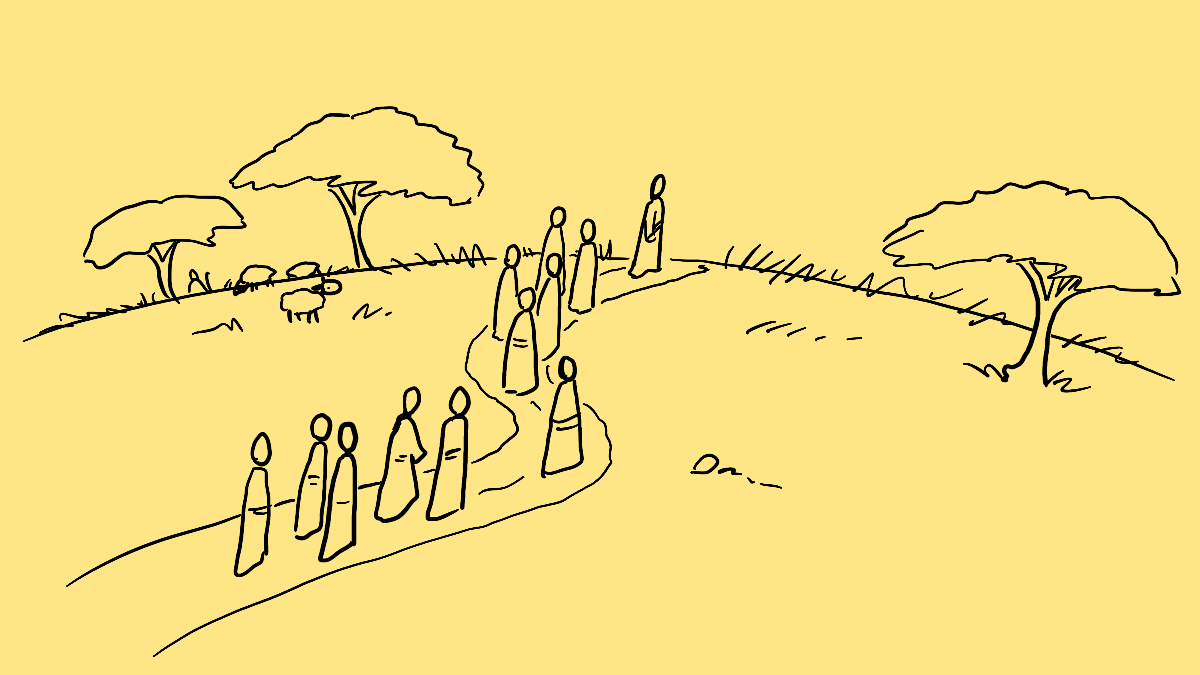
The Christian is called to imitate the life of Christ. In part, this invitation has to do with the character of Christ (his love, patience, humility, et cetera), and in part has to do with some of his practices (like prayer). Specifically thinking about how we ought to imitate the life of Christ and follow him in character and practice, one author and pastor (John Mark Comer) in his book, “The Ruthless Elimination of Hurry” seeks to tease out what it means to follow Christ in an age of “hurry” and “hustle” where we are time poor, stressed, stretched, and even spiritually fatigued. An excellent endevour. How ought the Christian to imitate Christ with specific regard and application to the busyness of our lives?
The Books Ideas
Let me start by summarising some of Comber’s ideas in his book.
One of the sections of his book is called “the secret of the easy yoke”. As we read the Gospels and see the life of Jesus, we should find his way of life compelling. In one sense, the disciples of Jesus were called to follow him which literally meant to be around Jesus and to literally follow him, doing what he does. It also meant to adhere to his teachings. So when Jesus speaks of his easy yoke, he is, in part, talking about his teachings, teachings which free us from the burden of legalism and give us rest. Jesus also says He is the way, the truth, and the life. Comer writes, “we want the life without the lifestyle”. Meaning something like, ‘we want the benefits of Jesus in our life without necessarily having to ‘follow’ his lifestyle.’ So we might read stories about Jesus and his joy, his peace during uncertainty, his non-anxious presence, his relaxed manner, how he was present in the moment, and we then desire that kind of life. However, we are not willing to adopt his lifestyle. Comer reflects that following Jesus costs us our life, that there is death, but there is also life – an empty tomb. Comer reflects on ‘the way of Jesus’, saying it is a way of life. It is not merely ideas or ethics – Do’s and Don’t. Instead it is a lifestyle. And the lifestyle is what is often missed.
In another section of his book, “a common rule for life”, Comer digs a little deeper into some specifics of Jesus lifestyle. Comer remarks that Jesus was rarely in a hurry. By illustration, Comer asks us to imagine a stressed-out Jesus who gets short-tempered after a long day of work and lashes out at people. Can we imagine Jesus half talking to us and half texting on his iPhone or saying he’d love to speak to us but has a plane to catch to get to the next Ted-X conference in Jerusalem? No, we can’t imagine Jesus acting like this. As Comer points out, Lazarus is dying, and Jesus takes his time to get to him (for specific reasons of course). As Jesus travels to heal Jairus’s daughter, he allows himself to be interrupted, showing that he is in no rush. Jesus does get annoyed with the arrogant religious authorities but not with interruptions. Comer remarks that Jesus’ life is sometimes full to the brim, yet he doesn’t come off as hurried. This unhurried life is not because he lives before Wi-Fi and technology like us. Instead, it comes from his ‘way of life’. Looking at the lifestyle of Jesus, Comer says he has healthy boundaries. Jesus regularly prays alone. At times he is sleeping and needs to be woken up by his disciples. He enjoys a meal with friends over a bottle of wine. He practices a sabbath weekly. He even practised simplicity before it was cool with just the clothes on his back. He is not chasing after money. All this is because he said ‘yes’ to the Father and the heavenly kingdom, which means he says ‘no’ to all other distractions.
Comer asks us to imagine how Jesus would live if he were me. This requires us to do some cultural transposing. How would Jesus be a parent, an account manager, or a truck driver? Comer suggests Jesus would do those things “way slower”. Comer is asking us to ‘imitate Jesus’ in culturally appropriate ways (with specific reference to our culture of hustle and hurry), after all, the gospel is not merely a set of ideas for which we give ascent but an invitation to a relationship with Jesus. Part of that relationship is to trust but also to ‘follow’. Comer uses that word, or wants us to take that word (‘follow’), more literally. So although we can’t literally follow Jesus, we imitate Him.
That’s a brief summary of some of the key ideas of John Mark Comer’s book, “The Ruthless Elimination of Hurry.” Any misrepresentation is my own, so go read the book yourself and see if I’ve summarised well enough. And I do recommend it as a read. It is a good read. I listened to it, and Comer reads it. He is a good author, and for someone of my generation (Y), his laid-back tone and mannerisms are refreshing in a theological book. You might say, hipster.
Some Thoughts
Moving from his thoughts to my own interaction with those thoughts now. There is plenty of good to say about this book and these ideas. You can’t argue with some of those key ideas. We are called to imitate Christ, and even Paul insofar as Paul imitates Christ, and by derivatives, we would say we imitate our spiritual leaders in much the same way as they imitate Christ.
Comer has intentionally applied this teaching to imitate and follow Jesus to a narrow and focused area in our modern lives. Again, commendable, as we want to know how to follow Jesus in all our life and every area of life (which necessitates us asking how to specifically do that in specific areas).
However, I do have some reservations. Perhaps, not ‘reservations’ as such but merely questions. Im not sure I’d disagree with Comer. I’m just questioning the route which was taken to get to his conclusions.
Here are some thoughts in no particular order.
I’m not intirely convinced the gospel give us a biography of Jesus in order to show us what exactly to do. Most notably, we don’t, nor can we, go out and cast out demons and heal and raise the dead, even though the disciples did that as they “followed Jesus”. So there are some basic and clear boundaries. But where do those boundaries end or begin? How do we make sure we put those boundaries in the right place? Otherwise, someone might argue we are not faithful if we are not healing the sick. Still, another might say we are been legalistic if we insist we follow Jesus by literally keeping the Saboth on a Saturday as he (a Jewish man) did. Somewhere in these boundaries is the lifestyle of Jesus. Comer, for his part, in an unspoken way, applies the principles of Jesus’ lifestyle instead of the particulars. That’s commendable. But it’s still tricky to get to the principles and then transpose them to our particulars. That’s a matter of wisdom, I suppose.
Continuing, when Jesus is spoken of as “the way (the truth and life)”, I see it as arguably more likely that he is speaking of himself as the “way” to the Father, not necessarily as the way (or we might paraphrase, ‘style’) of life. Not to say Comer makes an illegitimate point, but maybe he makes the point from a spurious place.
Continuing, taking into account the broader New Testament teachings, I don’t think there’s a place in the New Testament that says, in effect, ‘because Jesus lived a life in which he was interrupted by people and gave his time to people, that is why we live a life that is interruptible but also has boundaries, has margins, so that we can care for people with our time, and that we’re not such busy people because Jesus was not too busy, he kept his eyes on the important things, saving people ultimately, etc.’ We don’t get told this. But we do get told to take Jesus as an example. Yet, it’s regarding his suffering, “To this you were called, because Christ suffered for you, leaving you an example, that you should follow in his steps.” (1 Pet. 2:21). We could extrapolate and say Christ’s example is at least in his suffering, but surely also in all his life. True. But again, I think we are looking at the example of Christ in terms of his character. We look to his humility, his wisdom to speak at times and be silent at other times, and his love for his friends.
A final thought: the world of the 1st century was so different to our own. I merely need to consider Luke 2:41-52, where Jesus is assumed to be with family and friends while his parents make their way home from the temple, but after a whole day, they look for him. Bearing this in mind, I find the task of culturally transposing Jesus’ lifestyle while simultaneously making a distinction between his lifestyle and the general culture of the time into our own time a task that seems very demanding indeed.
Another source for the same application
So, having considered all the above, what then do we do? To repeat it, I don’t think there is anything objectionable in Comers’ writing per se. I believe he has the correct application coming from a means that I’m unsure about. So where might be the right place?
If we were going to stick to the Gospels, I think one of the most apparent places or stories is Jesus’ interaction with Mary and Martha. This is such a famous story on this very topic. I think it also displays exactly the kind of principles which Comber is seeking to explain throughout his book; that life is critically more important than the urgent and demanding tasks that cause us to hustle and bustle in our busyness and yet deprive us of the very thing we need most, to sit at the feet of Jesus in peace.
On top of that, we could consider the Lord Jesus’s teachings on money. This is very closely associated with work and therefore speaks saliently to modern work culture. As we seek so diligently, to our detriment, to work harder and harder and get more and more done for more and more money, our heavenly Father sees our needs and provides for us. On our part, and implicit in the teaching, is a call to be content with this provision.
Conclusion
In sum, a good book. Well written (at least to my generationally Y-attuned ears). And a thoroughly gospel-centred book. But for specific applications, I would instead consider more particularly some of the teachings on work and money that Jesus expounds in his parables and also look more closely at the story of Mary and Martha. These would bolster this book and what you take away from it.
Comer, J. M. (2019). The ruthless elimination of hurry: How to stay emotionally healthy and spiritually alive in our current chaos. Hodder & Stoughton.
 Bigvai and Shiphrah