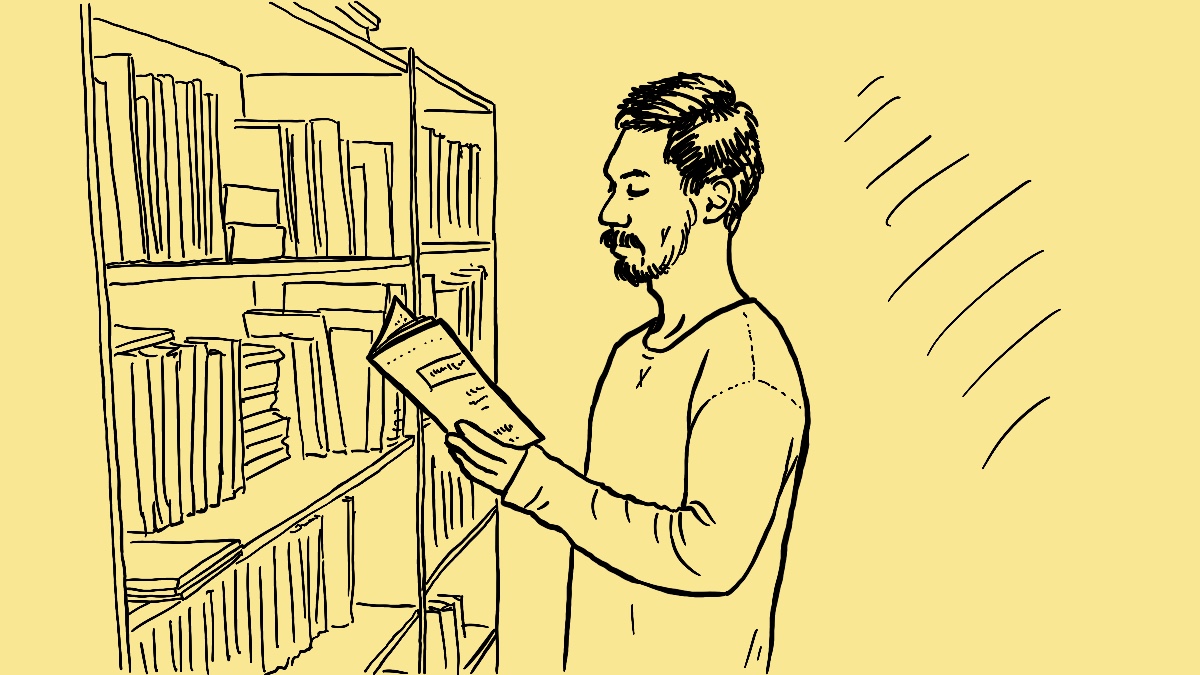
What does a good reader do?
In a productivity-driven world, a good reader is someone who reads the most books. In a time-poor society, a good reader is someone who reads books the fastest. In the therapeutic age, a good reader is someone who finds the books that makes them feel good.
These perspectives on the skill of reading should hopefully highlight that the way we approach reading a book in part determines what we get out of that process.
In her book, “Reader, Come Home”, Wolf proposes there are three key standards that make a good reader. These standards mirror Aristotle’s standards for a good society. “The life of knowledge and productivity; the life of entertainment and the Greeks’ special relationship to leisure; and finally, the life of contemplation.” (p.13) Drawing from this, a good reader is one who acquires knowledge, one who has learnt to enjoy the process of reading, but important to my thoughts in this post, one who practices contemplation.
The final chapter on contemplation by Wolf has to be my favourite in her book, “Reader, Come Home”. It is the one I’ve thought most about, the one I re-read, and of course, the one I contemplated on.
She writes, “The third life of the good reader is the culmination of reading and the terminus of the other two lives: the reflective life, in which—whatever genre we are reading—we enter a totally invisible, personal realm, our private “holding ground” where we can contemplate all manner of human existence and ponder a universe whose real mysteries dwarf any of our imagination.” (p. 190).
Cultural critiques note that in the first two respects we excel. We want more knowledge and we want more entertainment. But in the critical aspect of contemplation, each day we drift further and further from its practice, which ultimately happens because we drift further and further from valuing it. Generally speaking, people consider that the digital culture undervalues and even threatens the meditative dimensions of human life. I wholeheartedly agree. I agree because I see that happen in my own life and try and fight it off, I see it happening in other people’s lives around me, and I’ve heard it commented on in many places by many different voices.
Just stop and think about the last time you stopped and thought…
That memory may have been easy enough to conjure up. But let’s ask the same question with a bit more of an edge. Stop and think about the last time you stopped reading so that you could think deeply about what you just read…
Those moments are very novel to our experience.
We face many difficulties when it comes to the art of contemplation. We crave novel stimuli which makes the slow burn of quiet contemplation a restless activity. Quiet contemplation itself might be hard to achieve literally because there are many noises around us. I think of the notifications we receive, the phone ringing, the music we are playing non-stop, the people talking around us (in certain situations such as on the train), and of course our own noisy thoughts. Alternatively in our landscape, we fall prey to thinking that it is more important to react than to think deeply. We don’t want to take the time to contemplate, because we want to be distracted. Our distractions then are masquerading themselves as “been in the know”. (p.188) Furthermore, contemplation takes time. This investment of time to sit quietly and think is a big ask when we are time-poor people who are constantly striving for “efficiency.”
For the most part, the last point is the most demanding obstacle to overcome. Contemplation takes time. We have to ask ourselves if we are going to be people who allocate our time to the process of deep reading and deep engagement with a book. Now at this stage, we think we have spent enough time performing the reading process. But we have not (which is precisely the challenge). We need to then perform the follow-up activity of simply doing nothing but sitting quietly and thinking about what we have read. This is the act of inwardly digesting and mulling on the thoughts presented to us.
The consequence of failing to contemplate will mean that we lose the opportunity to grow in wisdom. Knowledge alone is not wisdom. We can have all the facts and figures, as it were, without the skill to implement and apply.
The answer is deceptively simple but will require great self-discipline. We need to allocate time for contemplation.
“Exemplified by the interactive dynamic that governs our deep-reading processes, only the allocation of time to our inferential and critical analytical functions can transform the information we read into knowledge that can be consolidated in our memory. Only this internalized knowledge, in turn, will allow us to draw analogies with and inferences from new information. The discernment of the truth and value of new information depend on this allocation of time. But the rewards are many, including, paradoxically, time itself—for uses that could otherwise go by the wayside of our lives without notice, my segue to turn to the invisible harvests that spool from the third, contemplative life.” (p.192)
As our culture, broadly speaking, transitions into the predominance of digital media, the skill to slow down and reflect is important. The barrage of so-called information increasingly necessitates the immersion of oneself into an involved book to have socially useful skills. And this skill is the character attribute of wisdom. Our world already highly values knowledge. But we might say that it overvalues it to the detriment of its own use. Knowledge requires the time and space to contemplate it in order to then apply it to our lives and this world.
The task of contemplation will take time. But it will be time well spent.
Reference
Wolf, Maryanne. Reader, Come Home. HarperCollins. Kindle Edition.
 Bigvai and Shiphrah
One thought on “The Reader’s discipline of Contemplation”