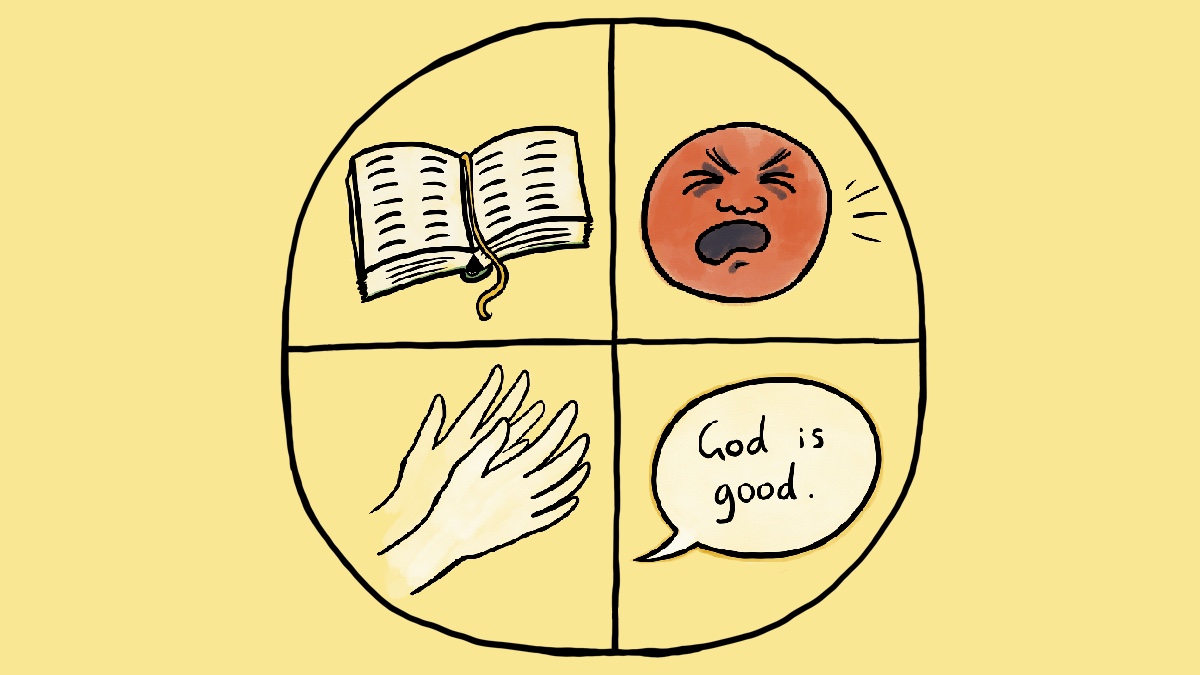
How do you deal with your pain?
We could ignore it and pretend it’s not there. We could medicate ourselves so that we feel less pain or suffering. If the pain is caused by someone who wants to hurt us then we want to hurt them back. We could blame others for our pain, sometimes that makes us feel better. Or we could compare our suffering to someone else. We might say, “at least my pain is not as bad as their pain” or we say, “I am suffering much more than other people are, I deserved pity”… and that makes us feel better.
Some of these have their place. There is a place to simply ignore suffering. There is a place to medicate against suffering. There is a place to fight back against an adversary. And a bit of perspective can help us with our own suffering.
But that’s not how God has taught us to deal with pain and suffering. The way the Christian deals with hurt is given to us in Psalm 13 (amongst others).
God tells us to turn to him, complain to him, ask him for help, and affirm our faith in him.
First, we must turn to God.
If we don’t turn to God then the alternative is that we rely on ourselves to find the answer to our pain and suffering. The problem with that is that our own resources will eventually deplete. Hence, we must first turn to God using his resources.
That means we open God’s word. Perhaps you thought turning to God means turning to God in prayer. Which is true, we turn to God in prayer. But we must first turn to God in his word. We must first hear from God. Because God will teach us how to pray.
Secondly, we complain to God.
I don’t think any of us have a problem complaining to God. We have got a lot of stuff to complain about. Complaining to God is going to be the easiest thing for us to do. Although it’s always an emotional and turbulent stage.
“How long, LORD? Will you forget me forever? How long will you hide your face from me? How long must I wrestle with my thoughts and day after day have sorrow in my heart? How long will my enemy triumph over me?” (Psa. 13:1–2)
Thirdly, ask God for help.
You can’t just stop at the complaining stage. If you’re anything like me, that’s what you do. In life I get stuck at the complaining stage. Jemima, my wife, will happily complain to you about how bad I am when I get stuck in the complaining stage. It’s too easy to get stuck complaining to God all the time. You’ve got to move beyond that. You’ve got to ask God for help.
“Look on me and answer, LORD my God. Give light to my eyes, or I will sleep in death, and my enemy will say, “I have overcome him,” and my foes will rejoice when I fall.” (Psa. 13:3–4)
The Christian has many trials, and many enemies.
For us living in Australia, it can be as simple as certain people who want to pass awful laws. Some of the laws in Victoria, basically exist to undermine Christian ethics and values. They are self-proclaimed enemies of God.
We live in a broken world where everything seems against us at no personal fault. You face some sort of trial, whether at work, or home. Whether financial or health related – physical or mental health deteriorates.
Then there’s our own sin. When you have a heart on fire for the Lord, there is nothing you hate more than the enemy that dwells within. The sin that wants to wreck your life. You want nothing more than to get rid of it, to defeat it for good. But you just can’t seem to win the battle against temptation, whatever form it takes.
And of course, there is the archenemy, Satan, the Devil. A personal spiritual entity whose only purpose it seems is to accuse us and tempt us. It’s hard to describe spiritual warfare but it’s naïve to ignore spiritual warfare, to ignore this dangerous enemy.
Whenever you face these trials, these enemies, turn to God, complain to God and ask God for help.
Finally, we must reaffirm our faith in God.
This is possibly the easiest part of the process… to miss! But it is equally one of the most important parts of the process. As Christians it is essential that we remember and proclaim who God is, especially when in pain or trouble.
“But I trust in your unfailing love; my heart rejoices in your salvation. I will sing the LORD’S praise, for he has been good to me.” (Psa. 13:5–6)
The writer reaffirms their trust in God’s character. The writer praises God because God has been good to them. But get this, their circumstances have not changed. They are not praising God because between verse 4 and verse 5 God immediately acted in some way. They are praising God because of who he is and because he does save (the exodus from Egypt is surely in the mind of the writer and the cross of Jesus Christ should be in our minds). God saves his people. God loves his people. I will therefore praise God no matter what circumstance I find myself in.
When we turn to God, when we complain to God, and when we ask God for help, we are doing it because we are feeling it. We say the first half of the psalm because we are feeling the pain. We say the second half of the psalm even when we don’t feel it! The writer is choosing to reaffirm their faith in God. They are choosing to praise the Lord. Don’t just praise God when you feel like praising God. Don’t let your feelings or your circumstances dictate when you praise God.
No matter your feelings and no matter your circumstances, turn to God, complain to God, ask God for help and in the end, praise God.
 Bigvai and Shiphrah