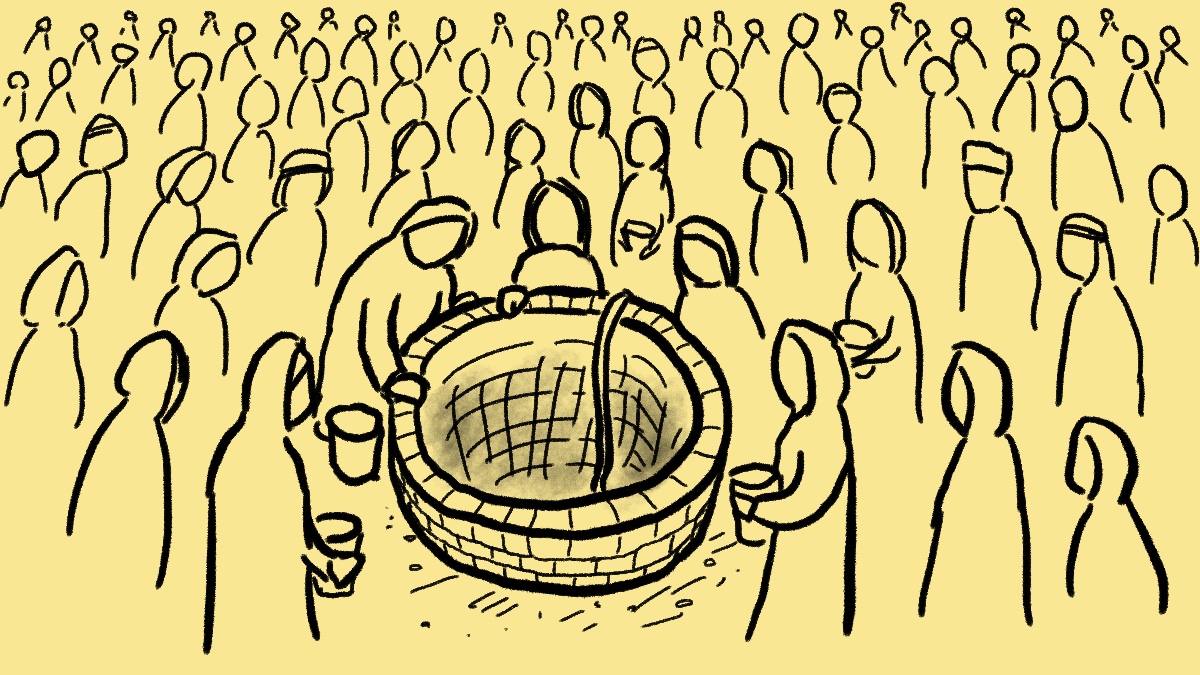
We find what we look for. In many ways, big and small, this is true. We are looking to convince someone of the truth about lollies, they give us bouts of energy and help us complete those pressing tasks. Of this, I am completely convinced. But likewise, it happens on bigger and grander scales too. A whole people can be looking for water from a well, convinced the well has water because after all, they are all there trying to get water from it. It would be rather silly if the well had no water. After all, look how many millions of people are here at the well!
So it is in our world. Our worldview is a self-propagating one. We live in a psychologised and therapeutic world. Chasing happiness is the name of the game. Unfortunately, it’s one of those new kinds of games that technically doesn’t have an ending. It’s just a good ride.
As has been well documented and talked about in many different places, we are peoples who are suffering from a cacophony of distractions, a multitude of choices, a growing collection of un-assimilated knowledge and a proportionally growing weight of the burdensome responsibility towards it all. One particularly is the burden of happiness. We hear of pleasures, we must seek them. We hear of injustices, we must right them (and feel good doing so). We hear of new opinions and positions, we must adjudicate them (which is really fun, thrilling almost). All this, done in a bid to find some happiness: to feel good for stomping on injustice, feel good for experiencing the thrill of some chase, feel good informing the ignorant of the views they should hold. There is a lot to do to feel good. Many buckets to fill. It’s a job to fill them, isn’t it? Luckily, God is on our side right? He helps us fill the buckets of happiness we need filled up. And there are lots, even for God to do. Where did all these buckets come from? No idea, I just put them out here to fill up. Just doing my job here pouring water into them. Help me out will you God! The sun is out today and it’s evaporating as I pour all this good stuff in.
David Wells makes this point about our happy-hunting culture,
“[Our culture] shapes the way we see things, what we see, and what importance all of it has to us. It allows us our own private reality because it inclines us to live only within ourselves and to see all of reality from behind this peephole. We see everything from the position of the self with its senses and aches and needs. This shapes everything else. In this psychological world, the God of love is a God of love precisely and only because he offers us inward balm. Empty, distracted, meandering, and dissatisfied, we come to him for help. Fill us, we ask, with a sense of completeness! Fill our emptiness! Give us a sense of direction amid the mass of competing ways and voices in the modem world! Fill the aching emptiness within! This is how many in the church today, especially in the evangelical church, are thinking. It is how they are praying. They are yearning for something more real within themselves than what they currently have…” (p.126)
This is a pretty astute comment. It cuts me somewhere inside. Perhaps the work of the Spirit within… The culture around me is very much like this. It tells me to look for happiness wherever I can find it. And I also happen to be a Christian living in this culture, so I have someone I go to when I have a problem, God. Except what I have done is I’ve taken my culturally produced felt need to God without considering necessarily if this is indeed the burden of God toward me in his word. This happens because of the subtlety of culture – it’s everywhere around us in the thought world (but paradoxically it’s also relentless at the same time, throwing its barrage at us).
What’s the right way of viewing the world then? If the world is not there to provide for me a sense of contented happiness, what then? David wells continues,
“Those who live in this psychological world think differently from those who inhabit a moral world. In a psychological world, we want therapy; in a moral world, a world of right and wrong and good and evil, we want redemption. In a psychological world, we want to be happy. In a moral world, we want to be holy. In the one, we want to feel good, but in the other, we want to be good.” (p.126)
This is a shift of the mind that requires one to be born all over again, such is the difference in worldview. But that is the Christian experience. We are born into the moral world, the world made by the holy God of love. His character is imbibed by his creation. The presence of moral darkness and corruption introduced by his creation has tilted this world on its axis. Our man-made compasses led us astray but led us exactly where we wanted them to go. We sought after the blessings, not the one who blesses. But no longer. As Christians we know we live in a moral world ruled and governed by the holy and loving God. We confessed our moral failures and experienced his redemption. Now we too seek to image the one we are made after, the Lord Jesus. He is goodness. His presence is happiness to us.
In our broken therapeutic world, we will never stay long in the feel-good climate. The therapeutic world spins on its axis and we are taken to another season of discomfort or worse, all too soon. But in a moral world, we seek redemption through the death, resurrection and ascension of Jesus. Now in Him, we are as He has made us. We seek now, not to feel good, but to be good, no matter what darkness we find ourselves in through all the seasons.
Wells, D. F. (2014). God in the whirlwind: How the holy-love of God reorients our world.
 Bigvai and Shiphrah